Seven of Cups Paired with Two of Pentacles — Tarot Combination Explained
- Arcana
- Seven of Cups — Minor Arcana, Cups; Two of Pentacles — Minor Arcana, Pentacles
- Elements
- Seven of Cups — Water; Two of Pentacles — Earth
- Elemental interaction
- Friendly elements — energies support each other
- Numerology
- 7 + 2 = 9
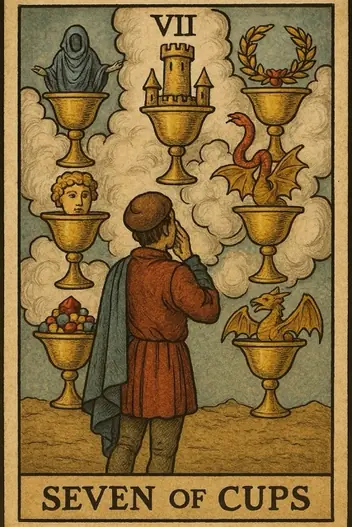
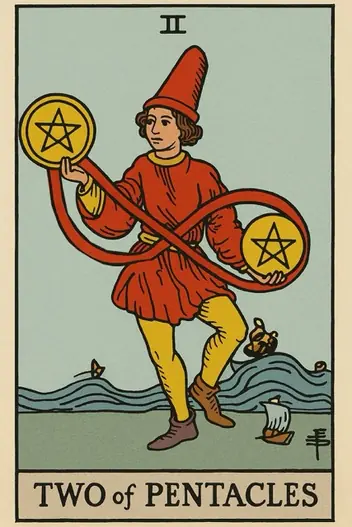
The intersection of the Seven of Cups and the Two of Pentacles represents a psychological tug-of-war between unlimited desire and finite resources. The Seven of Cups embodies the archetype of the dreamer, presenting a cascade of fantasies, illusions, and potential choices—each one tempting but often unrealistic. In contrast, the Two of Pentacles is the pragmatic juggler, constantly managing competing priorities, cash flow, and daily responsibilities. When these cards combine, you are forced to ask: Which of my fantasies can I actually afford to pursue, and which are draining my energy?
This pairing signals a critical moment of cognitive dissonance. Your imagination is running wild with possibilities, but your real-world obligations demand focus, balance, and risk assessment. The key is not to kill your dreams—but to prioritize them wisely and allocate your time and money accordingly. Without this discipline, you risk either paralysis by analysis (drowning in options) or impulsive overcommitment (juggling too many projects poorly).
What Do Seven of Cups and Two of Pentacles Mean Together?
The core dynamic here is a strategic tension between expansion and stability. The Seven of Cups offers a menu of desires: new love interests, career pivots, creative ventures, or lifestyle changes. The Two of Pentacles reminds you that you have only two hands—and limited bandwidth. This combination often appears when you are overwhelmed by choice and struggling to maintain your current obligations while chasing new opportunities. Psychologically, this reflects the Jungian conflict between the Self (integration) and the Shadow (unexamined fantasies) . The seeker may be using daydreams as an escape from the monotony of daily life, or conversely, using busywork to avoid confronting difficult decisions.
In practice, this pair demands a reality check. You must evaluate each option with a cost-benefit analysis: What is the emotional, financial, and time investment required? Which fantasies align with your long-term values, and which are distractions? The Two of Pentacles is not a card of stagnation—it is a card of dynamic equilibrium. You can juggle multiple balls, but only if you are willing to drop the ones that do not serve your core goals. Bold action without a plan leads to burnout; bold planning without action leads to regret.
Ask your question and flip the cards
or simply focus on it
Love and Relationships
If you are single:
This combination warns against romanticizing multiple potential partners or idealizing a connection that lacks substance. Focus on one real person rather than a fantasy of who they could be.
If you are in a relationship:
You may be juggling your partner’s needs with your own desires or external temptations. Honest communication about priorities is essential to avoid resentment.
In relationships, the Seven of Cups and Two of Pentacles often signals a crisis of attention. You might be emotionally invested in a daydream of a perfect partner while neglecting the real person in front of you—or worse, entertaining multiple romantic interests without commitment. The core psychological issue is fear of scarcity: the belief that if you commit to one path, you will miss out on something better. Practical advice: schedule a time to discuss your shared goals and boundaries. If you are single, limit your dating pool to 2-3 serious candidates and evaluate them based on consistency, not fantasy. Bold emotional honesty is the antidote to illusion.
Ask your specific question
Don't rely on generic meanings. Get a customized reading tailored specifically to your energies.
Seven of Cups and Two of Pentacles: Career and Money
Strategic Opportunities:
Use this energy to brainstorm multiple business ideas—but commit to only one that aligns with your core skills and market demand.
Strategic Opportunities:
Diversify your income streams carefully, such as a side hustle that complements your main job without overextending you.
Calculated Risks:
Avoid investing in speculative ventures (e.g., crypto, get-rich-quick schemes) or taking on debt to chase a fantasy. Beware of shiny object syndrome.
In career and finances, this combination is a wake-up call for prioritization. You may be juggling multiple projects, clients, or job offers, but spreading yourself too thin leads to mediocrity in all areas. The Seven of Cups’ illusions can manifest as overestimating your capacity or underestimating the time required for a new venture. Psychologically, this is the Dunning-Kruger effect in action—you think you can handle more than you actually can. Strategic action: list your top three professional goals, then rank them by ROI (time, money, energy). Drop the bottom two unless they are passive or automated. Bold financial warning: do not confuse activity with productivity. If you are busy but broke, you are juggling the wrong balls.
What If Seven of Cups or Two of Pentacles Appears Reversed?
If the Seven of Cups is Reversed:
Illusions collapse, and you see the emptiness behind the facade. This can be a painful but liberating insight. You stop believing in "easy money" or the "perfect partner." The psychological risk is falling into cynicism and apathy, rejecting all possibilities. Advice: Use this state as a cleansing process—throw away everything that doesn't work, but keep one realistic goal.
If the Two of Pentacles is Reversed:
You are losing control of the balance. This is a warning of burnout or financial collapse. You are no longer juggling; you are dropping all the balls. The main reason is you have taken on more than you can handle. Advice: Urgently delegate, drop 50% of your commitments, and take a pause. This is not weakness; it's the only way to preserve your resources.
If BOTH are Reversed:
Complete imbalance. You are simultaneously disillusioned with opportunities (Seven reversed) and exhausted from trying to hold onto them (Two reversed). This is a crisis of meaning. You don't know what you want, and you don't have the strength to even try. A logical way to correct this: Do a "digital detox" for 3 days, turn off all notifications, and ask yourself one question: "If I had infinite energy, what would I do right now?" The answer will point to a suppressed desire.
Shadow Side & Pitfalls
The shadow of this pairing is self-deception and burnout. The Seven of Cups’ darker manifestation is escapism through fantasy—spending hours daydreaming about a new career, a perfect relationship, or a big win, while ignoring the mundane work required to achieve it. The Two of Pentacles’ shadow is compulsive busyness—using constant activity as a shield against facing difficult choices. Together, they create a vicious cycle: you feel overwhelmed, so you escape into fantasy, which makes you less productive, which increases your overwhelm. Cognitive biases at play include the optimism bias (believing you can handle more than you can) and sunk cost fallacy (continuing a failing project because you have already invested time). The real pitfall is not making a decision at all. Indecision is itself a choice—and often the worst one.
Seven of Cups and Two of Pentacles: The Combined Message
Constructive use of this combination requires rigorous prioritization. The Seven of Cups provides you with a vision of the field of possibilities, while the Two of Pentacles offers a tool for managing resources. Your task is not to choose the "best" option, but to eliminate the superfluous. Apply the "anti-list" principle: write down everything you are ready to give up right now.
A deep strategic piece of advice: imagine you have only one resource — attention. Where will you direct it? If you scatter your attention across 5 tasks, each receives only 20% of your potential. Focus on a single task for 90 minutes without switching. This will grant you a depth that no amount of multitasking can provide.
Remember: the Two of Pentacles is not about quantity, but about the quality of balance. It does not say "do everything." It says "do what keeps the system in equilibrium." If one of your projects or relationships constantly throws you off balance, ask yourself: is this truly a valuable ball, or is it time to let it go? Conscious renunciation is not a loss, but a freeing of resources for what truly matters.
Where to Go From Here
The core message of the Seven of Cups and Two of Pentacles is: Dream big, but budget your energy. Your fantasies are valuable—they reveal your deepest desires—but they must be grounded in a realistic plan. The seeker must learn to say no to good opportunities in order to say yes to great ones. This combination is not a curse; it is a call to strategic focus. You can have it all—just not all at once.
Ready to apply this insight to your unique situation? While this article explains the general archetype, the true power of Tarot lies in personal context. Your specific question, timeframe, and life stage change the meaning entirely. Use the Fortune Cards app—available on the web or for download—to get a deep, personalized interpretation of this exact combination for your specific question. The app analyzes your unique situation, not just the cards. Stop guessing. Start deciding.
Interpretation by the Fortune Cards editorial team, based on the Rider–Waite tradition and Jungian archetypes. About our methodology · Updated: 2026-08-01
Other Combinations with Seven of Cups
Other Combinations with Two of Pentacles
Explore Individual Card Meanings
Table of Contents
Ready to Discover Your Path?
Join thousands of seekers who have found clarity and guidance through our platform. Your cosmic journey awaits.