Three of Pentacles and Six of Pentacles Reversed in Tarot

- Arcana
- Three of Pentacles — Minor Arcana, Pentacles; Six of Pentacles — Minor Arcana, Pentacles
- Elements
- Three of Pentacles — Earth; Six of Pentacles — Earth
- Elemental interaction
- Same element — energies intensify each other
- Numerology
- 3 + 6 = 9
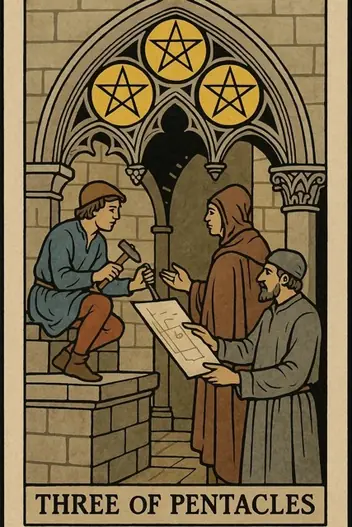
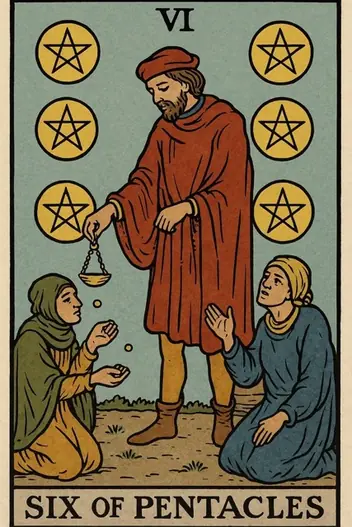
When the Three of Pentacles meets the Six of Pentacles, we witness a powerful convergence of craftsmanship and generosity. The Three represents the focused, collaborative effort of building expertise—the apprentice working with a master on a cathedral. The Six symbolizes the flow of resources, where one party gives and another receives with dignity. Together, they create a psychological framework where skill development is funded by equitable transactions, and talent is recognized through tangible reward.
This combination challenges the seeker to distinguish between healthy mentorship and codependency, and between fair compensation and exploitation. It asks: Are you building your skills in a system that values your contribution? And are you sharing your abundance in a way that empowers others, not just yourself?
Three of Pentacles and Six of Pentacles Card Meaning Explained
The psychological state created by this pairing is one of structured reciprocity. You are not working in isolation; your progress is tied to a network of exchanges. The Three of Pentacles provides the discipline of practice and the humility of learning, while the Six of Pentacles introduces the reality of power dynamics—who holds the resources, and who needs them. This creates a feedback loop: your competence attracts investment, and that investment accelerates your competence.
In practical terms, this combination often appears when you are receiving mentorship, training, or financial backing for a project. It signals a time to formalize agreements and set clear expectations. The key psychological insight here is avoiding the trap of over-giving. The Six of Pentacles can tempt you to trade your time or skill for approval, while the Three reminds you that your labor has objective value. Your growth depends on maintaining boundaries around your work.
This energy also supports team-based achievement. You are likely part of a group where roles are clearly defined, and contributions are fairly compensated. The risk is that you may mistake busyness for progress. Bold text: The true measure of success here is not how much you produce, but whether your output is recognized and rewarded by those with decision-making power.
Your pair is already on the table. Ask your question and draw the clarifying card
or simply focus on it
Three of Pentacles and Six of Pentacles in Love and Relationships
If you are single:
This combination suggests you are attracting partners who appreciate your competence and stability. Focus on building a connection based on mutual respect for each other’s skills and contributions, rather than on rescue fantasies.
If you are in a relationship:
You and your partner are likely negotiating roles and responsibilities. This is a healthy time to discuss who handles what, and how you can support each other’s personal growth without creating imbalance.
In relationships, the Three of Pentacles and Six of Pentacles point to a partnership of equals who are actively building a shared life. This is not the energy of passionate romance, but of steady, collaborative construction. You are both working on your own “cathedrals”—careers, hobbies, personal projects—and you support each other’s efforts. The psychological risk is transactional thinking: keeping score of who gave what. Bold text: The healthiest expression of this pair is when giving and receiving feel natural, not obligatory.
Key relationship advice:
Discuss your love languages and practical needs openly. If one partner is the primary earner (Six of Pentacles), ensure the other partner’s contributions—emotional labor, home management, creative work—are equally valued (Three of Pentacles). This prevents resentment and fosters genuine collaboration.
Three of Pentacles and Six of Pentacles for Career and Money
Strategic Opportunities:
This is an excellent time to seek formal training or certification. Your current skill base is recognized, and investing in it will yield returns. Consider asking for a raise or a promotion based on your demonstrated competence.
Strategic Opportunities:
Mentorship is a two-way street. Offer to teach a junior colleague or apprentice. Teaching solidifies your own mastery and builds your reputation as a leader.
Calculated Risks:
Avoid overextending your generosity. Do not give away your work for free or at a discount in hopes of future rewards. Bold text: If you are the one with resources, be wary of “charity cases” that drain your time without clear return.
From a financial perspective, this combination signals a healthy flow of income tied directly to your output. You are being paid for what you do, not for who you are. This is a pragmatic time to budget and allocate resources toward skill-building tools or education. The Six of Pentacles warns against impulsive giving—whether to others or to yourself. Bold text: Strategic reinvestment of your earnings into your craft will compound your value over time.
The shadow in career is imposter syndrome (Three of Pentacles) or martyr complex (Six of Pentacles). You may feel you are not skilled enough to ask for fair pay, or you may overcompensate by working for free. Objectively assess your market value by researching industry standards. Your expertise has a price; do not let insecurity or guilt devalue it.
Uncover hidden insights
Let our advanced Tarot system interpret these archetypes specifically for your personal path.
Three of Pentacles and Six of Pentacles Reversed: What Changes?
If the Three of Pentacles is reversed, it points to self-sabotage in learning or "imposter syndrome." You possess the resources (the Six), but refuse to learn something new or admit you need help. Advice: find an asymmetrical task where you are deliberately weaker, and agree to take on the role of a student. This will break down the barrier of pride.
If the Six of Pentacles is reversed, it concerns unhealthy dependency or hidden debts. You either demand help without wanting to give anything in return, or you give resources under the condition of total control. Warning: examine your relationships for manipulation through money or services. Healthy exchange is a voluntary act, not a transaction with a threat.
If BOTH cards are reversed, a complete imbalance arises: "a waste of time and resources." The student does not learn (Rev. Three), and the master does not teach but merely hands out handouts (Rev. Six). A logical way to correct this: temporarily halt all external projects and investments. Focus on the foundational level—restore discipline in one skill (Three) and give something valuable away for free, but with a clear request for feedback (Six).
When Three of Pentacles and Six of Pentacles Signal Trouble
The shadow of this combination emerges when the exchange becomes unbalanced or manipulative. The Three of Pentacles can devolve into perfectionism and gatekeeping—you refuse to share knowledge or collaborate because you fear losing status. The Six of Pentacles can turn into patronizing generosity where you give only to maintain control or feel superior.
Cognitive biases to watch for:
The Dunning-Kruger effect (overestimating your skill) or imposter syndrome (underestimating it) can distort your judgment. You may also fall into the sunk cost fallacy, continuing to invest time or money in a project or relationship that is no longer reciprocal. Self-sabotage appears when you refuse help (Six of Pentacles) because you believe you must do everything alone (Three of Pentacles).
Poor judgment manifests as agreeing to unfair terms in a contract or relationship. You might accept a low salary because you value the “learning opportunity,” but this combination warns that your time and skill are assets. Do not trade them for vague promises. Bold text: The shadow asks: Are you giving to empower, or to enable dependency? Are you learning, or just performing obedience?
Three of Pentacles and Six of Pentacles: The Combined Message
How can the energy of this combination be used constructively? Your task is to create a "Student-Master-Student" cycle. Begin by clearly defining your role in the current context. If you are in the position of the Three (the student), your goal is not merely to receive resources (the Six), but to transform them into autonomy. Every lesson, every ruble invested, should bring you closer to the moment when you can give independently.
If you are in the position of the Six (the master/investor), your strategy is "teaching through delegation". Do not do the work for your protégé. Give them a task, resources, and a clear deadline. Your generosity must be rigidly structured: "I give you X, but you must return Y to me in the form of a finished result." This turns charity into an investment.
A strategic tip for balance: introduce the "Rule of Three Steps". Before asking for help (the Six), take three independent actions to solve the problem yourself (the Three). Before giving advice or money (the Six), demand three pieces of evidence from the person that they have already tried to solve the problem on their own (the Three). This filter eliminates 90% of empty requests and lazy students.
Deep conclusion: The Three of Pentacles and the Six of Pentacles are not cards of fate, but cards of a system. They show how effectively your ecosystem of knowledge and resource exchange is structured. Your task is to make this system fair, transparent, and mutually beneficial. Only then can you move from the role of an eternal student or a controlling sponsor to the role of an equal partner.
Your Next Step: Personal Context Matters
The core message of Three of Pentacles and Six of Pentacles is build skill, trade fairly, grow together. Your progress depends on honest exchange—whether with a mentor, a partner, or yourself. Recognize your value, invest in your craft, and ensure that every transaction leaves both parties stronger.
While this analysis provides the archetypal dynamics, the true power of Tarot lies in personal context. Your specific question, timeline, and emotional landscape will shift the meaning of these cards. To get a deep, tailored interpretation of this exact combination for your unique situation, use the Fortune Cards app. It combines Jungian psychology, practical strategy, and Tarot wisdom to give you actionable insights. You can access it on the web or download it now to turn this knowledge into your next move.
Interpretation by the Fortune Cards editorial team, based on the Rider–Waite tradition and Jungian archetypes. About our methodology · Updated: 2026-08-26
Other Combinations with Three of Pentacles
Other Combinations with Six of Pentacles
Explore Individual Card Meanings
Table of Contents
- Three of Pentacles and Six of Pentacles Card Meaning Explained
- Three of Pentacles and Six of Pentacles in Love and Relationships
- Three of Pentacles and Six of Pentacles for Career and Money
- Three of Pentacles and Six of Pentacles Reversed: What Changes?
- When Three of Pentacles and Six of Pentacles Signal Trouble
- Three of Pentacles and Six of Pentacles: The Combined Message
- Your Next Step: Personal Context Matters
Ready to find answers to your questions?
Start your first reading now and look at your situation with fresh clarity. The cards are ready to reveal deeper meaning.