Love Tarot: Two of Cups and Three of Swords
- Arcana
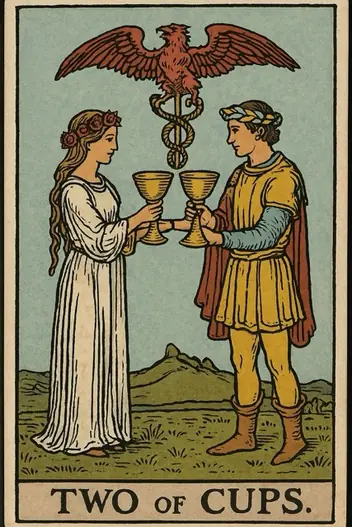
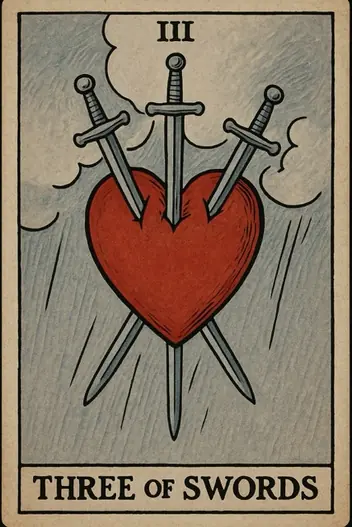
- Two of Cups — Minor Arcana, Cups; Three of Swords — Minor Arcana, Swords
- Elements
- Two of Cups — Water; Three of Swords — Air
- Elemental interaction
- Neutral elements — energies coexist without conflict
- Numerology
- 2 + 3 = 5
This card combination presents a profound psychological tension: the deep desire for connection (Two of Cups) colliding with the inevitable pain of separation or betrayal (Three of Swords). In real life, this often manifests as a relationship that feels destined but is marred by unresolved grief, a betrayal that tests your willingness to trust again, or the painful realization that a partnership you idealized is fundamentally flawed. The core conflict is between the heart’s wish for harmonious union and the mind’s recognition of a painful truth.
Strategically, this pairing signals a critical decision point. You are being asked to integrate the wound rather than ignore it. The Two of Cups offers the potential for genuine reciprocity, but the Three of Swords insists you first acknowledge the source of the pain—whether it’s past trauma, a current breach of trust, or a fundamental incompatibility. The path forward is not about bypassing the hurt, but about transforming it into a catalyst for deeper awareness.
Core Dynamics & Interpretation
The psychological state created by the Two of Cups and Three of Swords is one of ambivalent attachment. You feel a magnetic pull toward someone or something (a partner, a job, a creative project) while simultaneously experiencing a sharp undercurrent of anxiety, grief, or distrust. This is not a simple “good card, bad card” scenario. Instead, it reflects a Jungian shadow integration process: the light of union (Two of Cups) cannot shine without acknowledging the shadow of loss (Three of Swords).
In practical terms, this combination forces you to examine the cognitive dissonance between what you want to believe and what you know to be true. For instance, you may feel a deep soul connection with someone, yet their actions repeatedly cause you pain. The healthy response is not to cling to the fantasy of the Two of Cups, but to use the clarity of the Three of Swords to set boundaries or re-evaluate the relationship’s viability. The key insight is that real intimacy requires the courage to be vulnerable to being hurt, not the avoidance of it.
The real-world implication is a test of emotional maturity. Can you hold both the love and the loss in the same space? This combination suggests that the most profound connections often emerge from shared healing. If you can navigate this tension with honesty, you will build a bond that is far more resilient than one built on avoidance.
What Do Two of Cups and Three of Swords Indicate for Your Career?
Strategic Opportunities:
Use a recent professional setback as a learning tool. The Three of Swords can represent a failed project or a harsh critique; the Two of Cups says you can rebuild a stronger partnership or team.
Strategic Opportunities:
Negotiate from a place of healed confidence. If you’ve been burned by a colleague or client, this is the time to re-engage, but only after you’ve clarified your non-negotiables.
Calculated Risks:
Avoid making financial decisions based on emotional attachment. Do not invest in a business or partnership simply because you “feel connected” to the people involved. Verify the numbers and the contract.
In a career context, the Two of Cups represents collaboration, networking, and mutually beneficial alliances. The Three of Swords warns that this alliance may come with a hidden cost—a conflict of interest, a breach of confidentiality, or a painful learning curve. The pragmatic approach is to enter any partnership with eyes wide open. Conduct due diligence, set clear terms, and prepare a contingency plan for if things go south.
Financially, this combination cautions against using money to fix emotional problems. You might be tempted to spend on a partner or a project to “make things right,” but the Three of Swords indicates that the pain is emotional, not financial. The best investment right now is in therapy, coaching, or a clear-headed advisor who can help you separate feelings from facts.
Your pair is already on the table. Ask your question and draw the clarifying card
or simply focus on it
Two of Cups and Three of Swords in Love Tarot
If you are single:
This pairing warns against rushing into a new connection to soothe an old wound. Heal the heartbreak first before seeking a new partner, or you risk repeating the same painful patterns.
If you are in a relationship:
A painful truth needs to be addressed. Honest communication about a betrayal, disappointment, or unmet need is essential. Avoidance will only deepen the wound.
For those in a relationship, this combination often signals a crisis of trust. The Two of Cups represents the ideal of mutual respect and emotional giving, while the Three of Swords indicates that this ideal has been shattered by a specific event or a pattern of neglect. The psychological task here is to differentiate between a solvable problem and a fundamental incompatibility. If the issue is a single betrayal, the cards suggest that rebuilding trust is possible—but only through radical transparency and a willingness to feel the pain together.
If you are single, the dynamic is internal. You may be projecting the Two of Cups onto someone who is not ready or available, while the Three of Swords represents your own unresolved grief from a past relationship. The strategic move is to take a relationship detox—at least 30 days of no dating—to process the old pain before seeking a new partner. Emotional clarity is your greatest asset here.
Reversed Positions: What Changes?
Reversed cards intensify the internal conflict, making it less obvious but more dangerous.
If the Two of Cups is reversed:
The potential for harmony is blocked. This may indicate reckless stubbornness or an unwillingness to compromise. You or your partner are consciously destroying the connection, fearing intimacy. Advice: Stop playing the "silent game." Find out what you are truly afraid of in this relationship — losing control or repeating a trauma?
If the Three of Swords is reversed:
The pain is denied or repressed. The person wears a "mask" of calm but suffers internally. This is a dangerous scenario, leading to psychosomatic issues and depression. Warning: Do not suffer in silence. If you feel something is wrong but cannot put it into words, see a psychologist or write down your thoughts. Ignoring the pain will not make it weaker.
If BOTH are reversed:
Complete imbalance and self-deception. You are in a toxic relationship or work environment where both parties are lying to each other and themselves. The logical way to correct this: An abrupt halt. Do not try to "negotiate" or "save" the situation. You need to step out of the system to see it from the outside. A complete break in contact for 2-4 weeks is recommended to reassess your values.
Uncover hidden insights
Let our advanced Tarot system interpret these archetypes specifically for your personal path.
Two of Cups and Three of Swords: Warning Signs
The shadow manifestation of this pairing is codependency masquerading as love. You may convince yourself that the pain you feel is a sign of deep connection (the “no pain, no gain” fallacy), when in reality you are tolerating emotional abuse, neglect, or manipulation. The cognitive bias here is sunk cost fallacy—you’ve invested so much emotionally that you believe you must continue, even when the evidence says otherwise.
Another pitfall is intellectualizing the pain. The Three of Swords is about the heart, not the head. If you find yourself analyzing, rationalizing, or “understanding” why the other person hurt you without actually feeling the grief, you are avoiding the necessary healing. This shadow leads to repetition compulsion—you will attract the same painful dynamic again because you have not processed the emotional charge.
Finally, beware of premature forgiveness. The Two of Cups can rush to “make up” to restore the illusion of harmony. True reconciliation requires that the pain be fully acknowledged and addressed. Rushing back to connection without resolution is a recipe for resentment.
What Is the Overall Message of Two of Cups and Three of Swords?
Constructive use of this combination requires courage and intellectual honesty. The Two of Cups provides you with a resource — the desire to be close and to care. Your task is to direct this energy not toward "saving" the other, but toward creating a safe space for truth. Use the Three of Swords as a surgical instrument, not a double-edged blade. Instead of fearing pain, acknowledge it as an inevitable part of growth in mature relationships.
Strategic advice: Visualize the "third path." Imagine you are not choosing between "harmony at any cost" and "rupture." You are choosing transformation. Ask yourself: "What boundaries need to be set for this connection to become healthy? What truth must I acknowledge in order to stop suffering?" The answers to these questions are the energy of this combination, directed toward creation.
This synthesis teaches that true intimacy is only possible after passing a test of strength. You cannot build a lasting union if you are not ready to see each other as you truly are, with all the cracks and scars. The Two of Cups and the Three of Swords are not a verdict, but an invitation to maturity. If you accept the challenge, you will emerge from this situation not broken, but with a far deeper understanding of yourself and your partner.
Where to Go From Here
The Two of Cups and Three of Swords combination ultimately asks you to choose integrity over comfort. It is a call to honor both your desire for love and your need for truth. The core message is that the deepest bonds are forged not in the absence of pain, but in the courageous act of facing it together—or walking away with clarity. Your specific situation—whether it’s a romantic partner, a business colleague, or a family member—will dictate the exact strategy, but the principle remains: heal the wound before you seal the union.
Ready to apply this insight to your exact question? This article provides the general archetype, but the real power of Tarot lies in personal context. The Fortune Cards app uses advanced AI to give you a deep, personalized interpretation of the Two of Cups and Three of Swords based on your unique situation. You can use it on the web or download it now to get a tailored reading—complete with actionable steps—for your specific relationship, career, or personal growth question. Don’t guess; get clarity.
Interpretation by the Fortune Cards editorial team, based on the Rider–Waite tradition and Jungian archetypes. About our methodology · Updated: 2026-09-24
Other Combinations with Two of Cups
Other Combinations with Three of Swords
Explore Individual Card Meanings
Table of Contents
- Core Dynamics & Interpretation
- What Do Two of Cups and Three of Swords Indicate for Your Career?
- Two of Cups and Three of Swords in Love Tarot
- Reversed Positions: What Changes?
- Two of Cups and Three of Swords: Warning Signs
- What Is the Overall Message of Two of Cups and Three of Swords?
- Where to Go From Here
Ready to find answers to your questions?
Start your first reading now and look at your situation with fresh clarity. The cards are ready to reveal deeper meaning.