Three of Swords
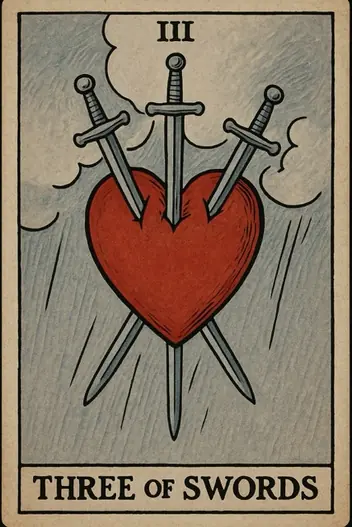
- Arcana
- Minor Arcana, Suit of Swords
- Element
- Air
- Decan
- Saturn in Libra
- Numerology
- 3
The Three of Swords is the Tarot’s archetype of cognitive dissonance resolved through painful clarity. In Jungian terms, it represents the moment when the conscious mind can no longer ignore a shadow truth—a betrayal, a lie, or a deep internal contradiction. This card does not bring the wound; it brings the realization of a wound that already exists.
This is a card of emotional hemorrhage, but not destruction. It signals the end of an illusion, forcing you to confront a reality you have been avoiding. The pain is sharp, localized, and temporary—a surgical cut rather than a chronic ache. The core challenge is accepting the cost of honesty over the comfort of denial.
What Does Three of Swords Mean in Tarot?
The central dynamic of the Three of Swords is the clash between objective facts and subjective emotional investment. You are holding a belief, a relationship, or a project that you have invested heavily in, but the evidence now contradicts your hope. The card forces a reckoning: continue bleeding from a slow lie, or accept a sharp, clean wound from the truth.
Psychologically, this is the ego’s deflation—the moment your self-narrative is challenged by external data. The resource this card provides is cognitive clarity at the expense of emotional comfort. It strips away rationalization and forces you to see the situation as it is, not as you wish it were. This is the necessary first step for post-traumatic growth.
In decision-making, the Three of Swords demands you stop investing further into a failing strategy. It is the card of cutting losses. The mindset required is stoic acceptance: acknowledge the pain, extract the lesson, and sever the emotional or contractual tie that is bleeding you dry. The shortest path to healing is through the wound, not around it.
Ask your question and flip the cards
or simply focus on it
Yes/No Answer
No.. The Three of Swords is the card of piercing pain, cognitive dissonance, and emotional rupture; it signals that the current path is blocked by unresolved grief or betrayal. In its upright position, the answer is a firm no because the energy is one of necessary catharsis rather than alignment—the heart has been wounded, and clarity is only possible through acceptance of loss. Reversed, the answer leans toward a tentative yes, but only after a period of painful confrontation with the truth; the swords are being removed, suggesting healing is underway, but the scar tissue remains. The critical condition is that any positive outcome depends on your willingness to sit with the discomfort of a hard truth rather than forcing a resolution—this card demands that you stop pretending the wound isn't there.
Get a personalized interpretation
Unlock the combined meaning of your cards in the context of your unique question — for free.
Three of Swords as the Card of the Day
The main vector of today is a sharp, unavoidable confrontation with a reality you have been avoiding, likely involving a relationship, a decision, or a self-deception. Your focus must be on naming the pain precisely—write down the thought that makes your chest tighten, because the swords are only as powerful as the denial that feeds them. Take the action of speaking the truth aloud to yourself or a trusted witness, even if your voice shakes; this is not about conflict, but about releasing the pressure of a sealed wound. Avoid the trap of blaming others or spiraling into self-pity, as the Three of Swords is a card of cleansing, not punishment—stay with the sensation of the ache without narrating a victim story. Also avoid numbing through distraction, overwork, or substances, because the pain will only return louder if postponed.
What Does Three of Swords Mean in a Love Reading?
If you are not in a relationship:
This card warns that you are likely attracted to unavailable or emotionally inconsistent partners. Your subconscious is choosing scenarios that confirm a pre-existing belief about unworthiness. You must recalibrate your selection criteria toward consistency, not intensity.
If you are in a relationship:
A painful truth is surfacing—infidelity, emotional neglect, or a fundamental value mismatch. The relationship is being tested by reality. Do not suppress the conflict; it is the only path to resolution or termination.
The behavioral pattern here is conflict avoidance turned toxic. You may be swallowing small grievances until they accumulate into a single, devastating rupture. The Three of Swords demands radical honesty in communication. Set a specific time to discuss the core issue without accusations—use “I” statements and focus on observable facts. If the relationship is salvageable, this clarity will be the foundation for rebuilding on truth. If not, the card grants you the courage to end it cleanly rather than prolonging mutual suffering.
What does he/she think of me?
Through the archetype of the Three of Swords, this person perceives you as the source or embodiment of a painful clarity they cannot escape—you are the mirror that reflects their own emotional wounds or a betrayal they have not processed. You evoke in them a complex mix of sharp admiration for your honesty and a defensive recoil; they associate you with a truth that cuts, even if that truth is simply your presence exposing their own inner conflict. Their hidden intention is to keep a safe emotional distance, because being close to you requires them to face a vulnerability they have armored against—they may test your boundaries or withdraw without explanation. Their deepest fear is that you will see through their masks and reject them for what they hide, yet a part of them desperately hopes you will stay and witness their full, flawed reality. There is an internal conflict between gratitude for your perceptiveness and resentment that you see them too clearly—this push-pull often manifests as hot-and-cold behavior, where they seek your validation while simultaneously bracing for the sting of your honesty.
Three of Swords in Career and Finance
Strategic Opportunities:
End a failing project or partnership. The resources you are pouring into a dead end can be redirected toward a venture with actual potential. This is the moment to pivot decisively.
Resource Management:
Conduct a brutal audit of your finances. Identify any recurring expenses, bad debts, or investments that are draining you. Cut them immediately. Cash flow health improves when you stop feeding losses.
Calculated Risks:
Avoid making any new agreements or major purchases until the emotional dust settles. The clarity from this card is intellectual, not emotional—do not confuse the two. Do not sign contracts while feeling betrayed or desperate.
Professionally, this card often appears when a trusted colleague or partner has acted against your interests, or when a strategy you championed has failed publicly. The correct response is forensic analysis, not blame. Ask: What data did I ignore? What assumption was flawed? Then communicate the failure transparently to your team to rebuild trust. Financially, treat this as a “stop-loss” order—set a hard limit on further expenditure related to the failing venture. The most expensive mistake is refusing to admit a mistake.
What Does Three of Swords Reversed Mean?
When reversed, the Three of Swords indicates the rejection of necessary pain. Instead of the clean cut, you are experiencing internal bleeding—the wound is festering because you refuse to acknowledge it. This manifests as passive-aggressive behavior, chronic resentment, or psychosomatic symptoms (headaches, fatigue) stemming from unexpressed grief or anger.
The blocked potential here is healing through acceptance. You are holding onto a relationship, job, or belief that has already died, hoping for resurrection. This is emotional self-harm. The internal resistance is a fear of being alone, of failure, or of starting over. To correct this imbalance, you must identify one concrete truth you are avoiding and write it down. Then, take one small, irreversible action that aligns with that truth—send the email, make the call, or remove the object that symbolizes the lie. The pain will be less than the relief of stopping the avoidance.
Shadow Side and Pitfalls
The shadow of the Three of Swords is masochistic rumination—the tendency to dwell on the wound as a form of identity. You may become the martyr or the victim, using the betrayal as a shield against future risk. This is a cognitive bias called catastrophizing, where you generalize one painful event into a belief that all trust is futile.
Another pitfall is over-intellectualizing the pain. You may dissect the situation endlessly, seeking a “perfect” understanding that will erase the hurt. This is a defense mechanism; analysis is not healing. The shadow also includes vengeful thinking—fantasies of revenge or public shaming that keep you emotionally tethered to the person who hurt you. The opposite of love is not hate, but indifference. The goal is to extract the lesson and detach from the source of pain, not to punish it.
Three of Swords: The Combined Message
To use the Three of Swords constructively, you must adopt the mindset of a surgeon, not a patient. The card’s energy is a tool for precision cutting—identify exactly what needs to be removed from your life: a toxic relationship, a failing business model, a self-limiting belief. Do not try to heal everything at once. Focus on the single most painful truth you are avoiding.
Strategically, this card is a catalyst for recalibration. Use the clarity it provides to redefine your boundaries and update your risk assessment model. Ask yourself: What did I miss? What warning signs did I ignore? Then build a decision-making protocol that prevents you from repeating the same error. For example, if you ignored red flags in a partner, create a list of non-negotiables for future relationships.
The long-term value of this card is emotional resilience. Each time you survive a clean cut, you become more capable of facing reality without flinching. The goal is not to avoid pain, but to ensure that every pain you experience teaches you something irreversible. Use the Three of Swords to burn the bridge behind you so you cannot return to the illusion. The truth, however painful, is the only solid ground on which to build your next move.
Where to Go From Here
This psychological and strategic breakdown provides a deep understanding of archetypes. However, Tarot is never universal for everyone. To understand exactly how this dynamic applies to your specific situation, a reading tailored exclusively to you is necessary.
Download the Fortune Cards app or visit our platform to get a deep AI interpretation of your unique spread. Don't just read about the cards—use Fortune Cards to find out exactly what step you need to take next.
Try Tarot Spreads with Three of Swords
Interpretation by the Fortune Cards editorial team, based on the Rider–Waite tradition and Jungian archetypes. About our methodology · Updated: 2026-08-26
Top Combinations with Three of Swords
Discover how Three of Swords interacts with other major cards in the deck to form powerful messages.
All 77 Combinations with Three of Swords
Discover how this card interacts with every other card in the Tarot deck and reveal hidden meanings.
Table of Contents
- What Does Three of Swords Mean in Tarot?
- Yes/No Answer
- Three of Swords as the Card of the Day
- What Does Three of Swords Mean in a Love Reading?
- What does he/she think of me?
- Three of Swords in Career and Finance
- What Does Three of Swords Reversed Mean?
- Shadow Side and Pitfalls
- Three of Swords: The Combined Message
- Where to Go From Here
Explore Tarot Universe
Ready to find answers to your questions?
Start your first reading now and look at your situation with fresh clarity. The cards are ready to reveal deeper meaning.