Love Tarot: Three of Swords and King of Swords
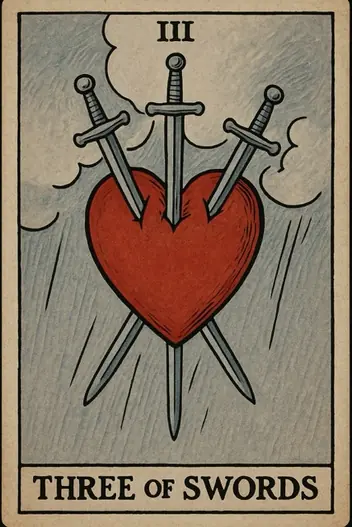

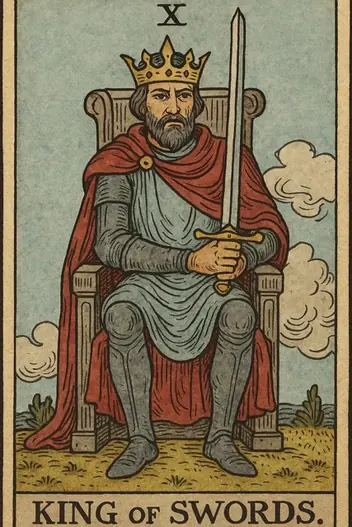
- Arcana
- Three of Swords — Minor Arcana, Swords; King of Swords — Minor Arcana, Swords
- Elements
- Three of Swords — Air; King of Swords — Air
- Elemental interaction
- Same element — energies intensify each other
- Numerology
- 3 + 14 = 17 → 8
When the Three of Swords—the card of heartbreak, betrayal, and piercing emotional truth—meets the King of Swords—the archetype of cold logic, authority, and decisive clarity—a powerful psychological collision occurs. This pairing represents the moment when raw emotional suffering is forced through the filter of rational analysis. It is not a gentle healing; it is a surgical dissection of pain. The King of Swords does not offer comfort; it offers truth, often delivered with brutal honesty. In real life, this combination appears when a seeker must make a difficult decision about a relationship, a career path, or a personal belief system that has caused them significant distress. The core challenge is to use intellectual rigor to process emotional wounds without becoming detached, cynical, or authoritarian in the process.
This combination signals a critical turning point where emotion must be translated into action. The Three of Swords represents the wound that demands acknowledgment, while the King of Swords provides the mental framework to analyze, judge, and move forward. The key psychological task is to distinguish between clarity and cruelty. The King of Swords can cut through deception, but it can also cut off empathy if wielded without awareness. For the seeker, this pairing demands a disciplined mind that can hold two truths simultaneously: the pain is real, and the decision must be logical.
Three of Swords and King of Swords Combination Meaning
The central dynamic of the Three of Swords and King of Swords is the tension between vulnerability and control. The Three of Swords brings a flood of emotional data—grief, betrayal, disillusionment—that threatens to overwhelm the ego. The King of Swords responds by imposing structure: it categorizes the pain, identifies causes, and formulates a verdict. This is a cognitive reappraisal strategy in psychological terms, where the mind reframes a traumatic event as a lesson or a problem to be solved. The danger lies in premature closure: the King of Swords may rush to a judgment before fully processing the emotional impact, leading to decisions that are technically correct but emotionally unsatisfying.
In practice, this combination often manifests as a confrontation with a difficult truth that has been avoided. The Three of Swords represents the inevitable pain of that confrontation, while the King of Swords provides the courage to face it. The seeker may feel a pressure to be objective about a deeply personal situation, which can feel like emotional numbness or coldness. However, this is not a sign of dysfunction; it is a necessary phase of psychological integration. The mind is using logic as a shield to survive the emotional storm. The key is to allow the King of Swords to lead the analysis without suppressing the heart's data. The most effective outcome is a clear-eyed decision that respects both the logic and the loss.
Career Meaning of Three of Swords and King of Swords
Strategic Opportunities:
Use this moment to conduct a ruthless audit of your professional relationships or projects. The King of Swords excels at identifying inefficiencies and cutting dead weight. If you have been enduring a toxic work environment or a failing business partnership, this is the time to gather data, consult experts, and make a decisive exit plan.
Strategic Opportunities:
Leverage your pain as a source of professional clarity. If a recent setback (e.g., a failed pitch, a lost client) has hurt your confidence, the King of Swords can help you analyze the failure objectively to extract a specific lesson. Create a SWOT analysis or a post-mortem document to convert emotional frustration into actionable intelligence.
Calculated Risks:
Avoid making major financial decisions while you are still emotionally raw. The King of Swords can become overconfident in its own logic, especially after a blow. Do not sign contracts, fire employees, or make large investments until you have slept on your decision for at least 48 hours. Bold important financial warning: the combination of hurt pride and sharp intellect can lead to retaliatory or punitive financial moves that backfire.
In a career context, this pairing signals a professional crossroads where you must choose between loyalty and logic. Perhaps you have been passed over for a promotion, or a trusted colleague has undermined you. The Three of Swords represents the emotional injury, while the King of Swords demands you evaluate the situation with detachment. Ask yourself: "What does the data say about my future here?" If the numbers, performance reviews, or market trends suggest a change, the King of Swords gives you the courage to act. However, beware of confirmation bias: you may selectively seek evidence that justifies a rash decision. Bold strategic tip: hire a mentor or a neutral third party to review your career plan before executing. This adds a layer of objectivity that the King of Swords respects.
Your pair is already on the table. Ask your question and draw the clarifying card
or simply focus on it
Three of Swords and King of Swords in Love Tarot
If you are single:
This pairing suggests you may be attracted to someone who is intellectually stimulating but emotionally guarded. Be cautious of idealizing a partner who seems "logical" but avoids emotional intimacy. The pain of past betrayals may be influencing your judgment, leading you to prioritize safety over connection.
If you are in a relationship:
You or your partner may be using logic to distance from emotional conflict. This could indicate a power struggle where one person's "rationality" is used to invalidate the other's feelings. Honest communication about the need for emotional processing is critical.
In a relationship reading, this combination often points to a crisis of trust or a betrayal that demands a difficult conversation. The King of Swords energy can be constructive if it is used to establish clear boundaries and expectations. For example, after a breach of trust, the couple might need to create a written agreement or verbal contract about future behavior. However, the shadow side is a cold, legalistic approach to love, where every interaction is analyzed for proof of loyalty. Bold key relationship advice: do not mistake intellectualizing the problem for resolving it. The Three of Swords requires emotional validation before the King of Swords can execute a clean solution. If you are in this dynamic, schedule a structured conversation where both partners speak without interruption, then write down the key points. This combines the King's need for order with the Three's need for expression.
Get a personalized interpretation
Unlock the combined meaning of your cards in the context of your unique question — for free.
Three of Swords and King of Swords: Warning Signs
The shadow of this combination is emotional suppression masquerading as wisdom. The King of Swords can become a tyrant of the mind, using intellectual superiority to dismiss feelings as "irrelevant" or "weak." This is a classic defense mechanism: the ego protects itself from the pain of the Three of Swords by retreating into pure rationality. The result is a person who appears calm and decisive but is actually disconnected from their own emotional life. This can lead to burnout, chronic dissatisfaction, or a sudden emotional breakdown when the suppressed pain eventually surfaces.
Another pitfall is cognitive distortion known as "emotional reasoning." The seeker may believe that because they feel betrayed, their logical conclusions must be correct. This can lead to overgeneralization ("All partners are untrustworthy") or jumping to conclusions ("This mistake proves I am incompetent"). The King of Swords must be tempered by humility and self-doubt. The most dangerous decision is one made with absolute certainty while still in pain. Watch for signs of arrogance or contempt toward others' emotions. If you find yourself using phrases like "You're being irrational" or "Just look at the facts," you have likely fallen into the shadow. The healthy path is to integrate the heart's data into the mind's decision, not to silence it.
Reversed Positions: What Changes?
When cards appear in a reversed position, the dynamic becomes distorted, and constructive potential shifts to destructive.
If the Three of Swords is reversed:
This indicates blocked suffering. The person does not allow themselves to feel the pain, suppresses it, or is in a state of denial. In combination with the King of Swords, this creates a dangerous cocktail: cold logic based on self-deception. You are building strategies while ignoring real emotional problems. Advice: acknowledge the fact of pain, even if it seems illogical.
If the King of Swords is reversed:
This manifests as the tyranny of the mind or, conversely, intellectual impotence. In the first case, it is a sadist who uses logic to humiliate. In the second, it is a person who cannot make a decision, torn between guilt (Three of Swords) and an inability to think clearly. Warning: Avoid making harsh decisions if you feel your mind is clouded by emotions.
If BOTH are reversed:
Complete imbalance. Emotional pain is not acknowledged, and intellect is used to mask it. This is a state of chronic self-deception and passive aggression. Remedial advice: You need an external observer—a psychologist or mentor—who can help you "ground" both energies. It is necessary to restore the connection between feelings and thoughts. Start simple: write down one of your emotions and one thought associated with it.
Synthesis: Strategic Conclusion
How can this challenging pair be used constructively? The key lies in dividing the roles. The Three of Swords provides you with data — information about what went wrong. The King of Swords provides you with the algorithm — how to fix it. Your task is not to let pain cloud your reason, nor to allow reason to destroy your capacity to feel.
Strategic advice:
Use the Three of Swords as a catalyst for re-evaluating your values and beliefs. The pain points to what was truly important to you (otherwise, you wouldn't be suffering). Take that insight and hand it over to the King of Swords. Let him create a new plan, a new system of protection that incorporates this experience. Not simply "forget and move on," but "analyze, extract the lesson, and rebuild your life with this new knowledge."
This union is not about harmony, but about effectiveness in a crisis. It provides you with a tool for transforming weakness into strategy. If you can endure the tension between sharp pain and cold calculation, you will emerge from the situation not merely intact, but significantly stronger and more conscious. Your primary task is to preserve your humanity without losing your sharpness of mind.
Your Next Step: Personal Context Matters
The Three of Swords and King of Swords is a powerful invitation to heal through clarity, not avoidance. The core message is that pain, when examined with disciplined intelligence, can become a catalyst for decisive change. This combination asks you to honor the wound without letting it define you, and to wield your intellect as a tool for liberation, not suppression. The general archetypes provide the map, but your unique situation—your specific relationship, career, or personal challenge—determines the true meaning.
To get a deep, personalized interpretation of this exact combination for your specific question right now, use the Fortune Cards app. While this article offers the psychological framework, the app applies it to your life with tailored insights and actionable steps. You can access it on the web or download it to receive a reading that respects your unique context. Your truth is waiting—cut through the noise and find it.
Interpretation by the Fortune Cards editorial team, based on the Rider–Waite tradition and Jungian archetypes. About our methodology · Updated: 2026-08-26
Other Combinations with Three of Swords
Other Combinations with King of Swords
Explore Individual Card Meanings
Table of Contents
- Three of Swords and King of Swords Combination Meaning
- Career Meaning of Three of Swords and King of Swords
- Three of Swords and King of Swords in Love Tarot
- Three of Swords and King of Swords: Warning Signs
- Reversed Positions: What Changes?
- Synthesis: Strategic Conclusion
- Your Next Step: Personal Context Matters
Ready to find answers to your questions?
Start your first reading now and look at your situation with fresh clarity. The cards are ready to reveal deeper meaning.