Death and Three of Swords Together in Tarot
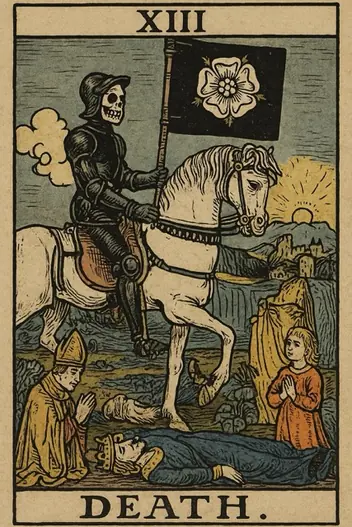
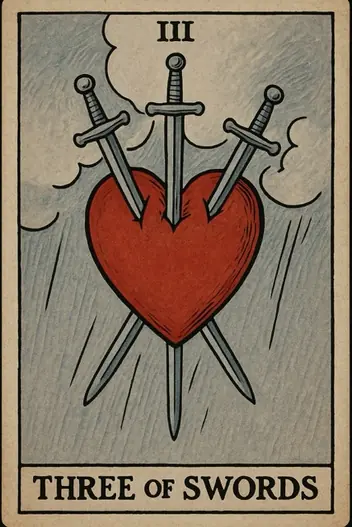
- Arcana
- Death — Major Arcana; Three of Swords — Minor Arcana, Swords
- Elements
- Death — Water; Three of Swords — Air
- Elemental interaction
- Neutral elements — energies coexist without conflict
- Numerology
- 13 + 3 = 16 → 7
When the Death card—a symbol of radical, non-negotiable transformation—collides with the Three of Swords—the archetype of piercing grief and cognitive dissonance—the result is not mere misfortune. It is a psychological surgery. This pairing signals the end of a delusion, the death of a story you told yourself to avoid pain. The Three of Swords brings the wound; Death demands you stop bleeding and start rebuilding with the truth.
In Jungian terms, this is the moment the Persona (the mask you wear for the world) is shattered by the Shadow (the painful truths you’ve suppressed). The combination asks you to move from enduring pain to using pain as fuel for transformation. It is not a card of loss for loss’s sake; it is a card of strategic surrender—knowing what must die so the core self can live.
Core Dynamics & Interpretation
The core dynamic here is catharsis through crisis. The Death card strips away the old structure, while the Three of Swords provides the clarity of why that structure had to fail. This is not random destruction; it is a targeted excision of a toxic belief, relationship, or career path. Psychologically, this pairing represents the integration of grief into identity—acknowledging that a part of you has died, and that’s not a tragedy, but a prerequisite for growth.
The mindset required is radical honesty. You cannot bargain with these cards. The Three of Swords demands you name the betrayal—whether it’s from a partner, a job, or your own self-deception. Death then insists you act on that knowledge. Denial is the only real danger here. If you avoid the pain, you avoid the transformation. The practical implication is clear: you must make a decision that hurts in the short term but liberates you in the long term.
This energy favors surgical precision over emotional chaos. Instead of spiraling into blame or despair, view this as a diagnostic moment. Ask: What belief system is dying? What relationship dynamic is no longer viable? The answer, however painful, is your map forward. The most strategic action is to cut cleanly. Prolonged mourning of the old only delays the new.
Your pair is already on the table. Ask your question and draw the clarifying card
or simply focus on it
Love and Relationships
If you are single:
This combination warns against rushing into a new connection to numb an old wound. Use the solitude to process a past betrayal fully; otherwise, you’ll repeat the pattern with a new partner.
If you are in a relationship:
A painful truth is surfacing—infidelity, incompatibility, or a fundamental mismatch in values. This is not a phase to “wait out.” It demands a direct conversation about whether the relationship can be rebuilt on a new foundation.
In relationships, the Death and Three of Swords pairing signals the end of a romantic illusion. You may have been avoiding a hard truth about your partner’s trustworthiness or your own needs. The Three of Swords represents the “ah-ha” moment of betrayal or deep disappointment. Death says: this version of the relationship cannot continue. The key relationship advice here is to stop trying to salvage the past. Focus on what is salvageable—your self-respect, your boundaries, and your capacity to love again after healing.
Emotional intelligence requires you to distinguish between pain that heals and pain that destroys. This card pair is the former. It hurts because it’s true. The strategic move is to have the difficult conversation, set the boundary, or even end the relationship—not out of revenge, but out of psychological necessity. If you stay, you risk hollowing out the relationship into a lifeless shell.
Deepen your understanding
Find out exactly what this reading means for your current life situation with our oracle.
Career and Finances
Strategic Opportunities:
Restructuring or pivoting your career path. A project or role that has been “dead” for months is finally being laid to rest. This frees up capital—both time and money—for a more aligned venture.
Strategic Opportunities:
Cutting a toxic business partnership or client. The pain of the split is temporary; the freedom from chronic stress is permanent. Use this to redefine your professional boundaries.
Calculated Risks:
Avoid making major financial decisions while emotionally raw. The risk is not the decision itself, but making it from a place of grief or vengeance. Wait 72 hours after the initial shock before signing anything.
In the professional realm, this combination is a strategic restructuring signal. It often appears when a company is downsizing, a project is failing, or a partnership is dissolving. The Three of Swords represents the hard data or feedback you’ve been ignoring. Death says: act on it now, before the situation becomes critical. The financial warning here is clear: do not throw good money after bad. Whether it’s a failing investment or a stalled career, the most profitable move is to cut losses and redirect resources.
Frame this as resource management. Your energy, reputation, and finances are finite. This pairing forces you to ask: What am I holding onto that is costing me more than it’s worth? The answer may be a specific project, a job title, or even a professional identity. The strategic tip is to treat this as a portfolio rebalance—divest from the underperforming asset (the pain) and reinvest in the growth area (the transformation).
Death and Three of Swords: Warning Signs
The shadow of Death and Three of Swords is masochistic stagnation. The seeker may become addicted to the pain, using the Three of Swords’ grief as an excuse to avoid the Death card’s demand for change. This manifests as replaying the betrayal endlessly—analyzing every detail without ever taking action. The cognitive bias here is rumination: mistaking thinking about the problem for solving it.
Another pitfall is premature closure. Some may interpret Death as a reason to cut ties impulsively, using the Three of Swords’ pain as justification for a rage-driven decision. This avoids the true work of grieving and integrating the lesson. The shadow is either wallowing in the wound or amputating before diagnosis. Both avoid the necessary middle ground: acknowledging the pain, understanding its source, and then choosing a deliberate, strategic transformation.
Watch for self-sabotage disguised as pragmatism. You might convince yourself that “this is just how it has to be” when, in reality, you are avoiding a difficult conversation or a creative solution. The shadow of this pair is the belief that pain equals truth—that because it hurts, it must be the right path. Not all pain is productive. Learn to distinguish between the pain of growth and the pain of self-destruction.
Reversed Death and Three of Swords Explained
When cards appear in a reversed position, the dynamics become more complex and less obvious. Your task is to recognize exactly where the breakdown in the natural process has occurred.
If Death is reversed:
This indicates blocked potential or recklessness. You are stuck in a phase of denial, clinging to the corpse of the past. Warning: you are wasting energy on what no longer works. Advice: deliberately provoke a crisis — quit your job, break a contract, do what you fear. Death reversed means you must actively destroy what is hindering you, otherwise it will destroy you.
If the Three of Swords is reversed:
This is internal resistance or weakness. You are not allowing yourself to feel the pain, suppressing grief, and pretending everything is fine. Risk: suppressed pain will turn into psychosomatic illness or depression. You need to legitimize your sorrow. Cry, write, talk to a psychologist. You cannot pass through Death without acknowledging the wound.
If BOTH are reversed:
This is complete imbalance of dynamics. You are denying both the end (Death) and the pain (Three of Swords). This is a state of chronic stagnation. The logical way to correct it: start with the smallest truth. Tell yourself: "This situation is hurting me." By acknowledging the pain, you activate the process of Death. Only by recognizing the suffering can you release what causes it.
Death and Three of Swords Combined Message
Constructive use of this pair requires cold calculation and emotional courage. The energy of Death is your scalpel, and the Three of Swords is the card of pain, indicating exactly where you need to cut. Your strategy is not to fight the pain, but to use it as a compass.
Understand the main point: Death does not come to punish you. It comes to make room. The Three of Swords is the anesthesia wearing off, and you finally feel the real wound. But only by feeling it can you begin the healing. A deep strategic advice: divide the process into two stages. The first stage (Death) involves harsh actions. Quit your job, break the contract, cease communication. The second stage (Three of Swords) is reflection. After you have destroyed the old, give yourself time to grieve. Do not try to do both simultaneously.
Arm yourself with clarity:
ask yourself the question: "What is it that I am currently mourning that I actually wanted to lose long ago?" The answer will give you the key to making the right decision. Death and the Three of Swords are not the end of the story, but its turning point. Your task is to write the next chapter, not to re-read the old one.
Applying This to Your Situation
The core message of Death and Three of Swords is that truth, however painful, is the only foundation for lasting change. You are being asked to stop managing a wound and start healing it. The transformation is not optional—but the way you navigate it is. You can be a passive victim of circumstance, or an active participant in your own rebirth. Choose the latter.
For a deep, personalized interpretation of this exact combination for your specific question, use the Fortune Cards app. While this article provides the general archetype, the true power of Tarot lies in its application to your unique situation. The app analyzes your specific question—whether about love, career, or personal growth—and delivers a tailored reading that accounts for your context, timing, and emotional landscape. Access it on the web or download it now to get your personalized insight.
Interpretation by the Fortune Cards editorial team, based on the Rider–Waite tradition and Jungian archetypes. About our methodology · Updated: 2026-08-26
Other Combinations with Death
Other Combinations with Three of Swords
Explore Individual Card Meanings
Ready to find answers to your questions?
Start your first reading now and look at your situation with fresh clarity. The cards are ready to reveal deeper meaning.