Death
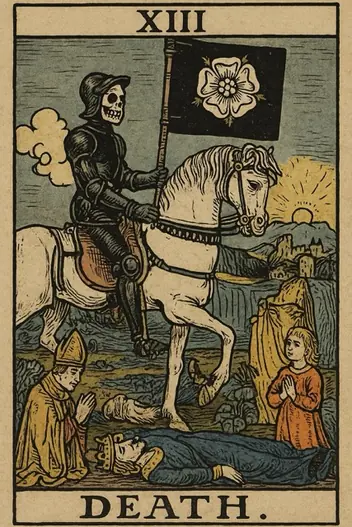
- Arcana
- Major Arcana · XIII
- Element
- Water
- Planet / Sign
- Scorpio
- Numerology
- 13 → 4
The Death card represents the Jungian archetype of transformation through dissolution. It does not predict a physical death, but rather the psychological necessity of ending a life stage, belief, or attachment that has become obsolete. The core challenge this card presents is confronting the ego’s resistance to change—the fear of losing identity, security, or control.
In a reading, Death signals that a critical juncture has arrived where clinging to the past creates more suffering than the unknown future. It demands a conscious sacrifice of what no longer serves your development. The energy here is not destructive for its own sake; it is clearing ground for new growth, much like a forest fire that enables seeds to germinate.
What Does Death Mean in Tarot?
The psychological state of the Death card is one of catalytic pressure. You are likely experiencing a crisis of meaning or a dead end in a particular area of life. The resource it offers is radical honesty—the ability to look at a situation without the filters of hope or denial. This mindset forces you to distinguish between what is essential and what is habitual.
In decision-making, this card advises decisive termination rather than gradual fading. Delaying the inevitable only compounds anxiety. The key insight is that you cannot negotiate with a necessary ending. Whether it’s a job, a relationship, or a personal identity, the psychological cost of staying is now higher than the cost of leaving. Real-world consequences include burnout, resentment, or stagnation if you ignore the signal.
Strategic action under Death means identifying one specific attachment to release within the next week. This could be a routine, a commitment, or a belief that drains your energy. The mindset to adopt is that of a surgeon removing dead tissue—clinical, focused, and without sentimentality. The reward is liberation from a weight you didn't realize you were carrying.
Ask your question and flip the cards
or simply focus on it
Yes/No Answer
Leaning no.. The Death card does not answer direct binary questions with a simple "yes" because its archetype is transformation, not affirmation or denial. Psychologically, this card signals that the current form of the question—or the framework you are using to ask it—must die before a real answer can emerge. In reversed position, the answer shifts toward a stubborn "no," indicating resistance to necessary endings that are already in motion. The critical condition is this: the outcome depends entirely on your willingness to release the attachment to the outcome itself. If you cannot let go of how you want the answer to look, the card will manifest as stagnation, not revelation.
Your unique Tarot reading
See how these cards interact with your destiny. Start a free personal reading now.
Death as the Card of the Day
The main vector of today is psychological death: something you have outgrown will surface for conscious burial. Focus on identifying one belief, habit, or relationship pattern that feels hollow or forced—this is the target for release. Take the specific action of journaling about what you are afraid to lose, then physically tear up the page as a ritual. Avoid the trap of dramatizing endings or seeking closure from others; the Death card demands internal, not external, processing. Steer clear of nostalgia, which is the mind’s attempt to resurrect what must stay buried.
What Does Death Mean in a Love Reading?
If you are not in a relationship:
This card suggests you are attracted to unavailable or emotionally stagnant partners because they mirror your own fear of change. Shift your criteria toward people who demonstrate adaptability and growth.
If you are in a relationship:
The relationship is at a pivot point where one or both partners must release a toxic pattern—codependency, avoidance, or power struggles—or the bond will decay.
Detailed breakdown: In a partnership, Death often manifests as a silent erosion of intimacy. One person may have already emotionally checked out, while the other clings to a memory of how things used to be. The behavioral pattern here is passive-aggressive withdrawal or explosive resentment. To resolve this, you must initiate a difficult conversation about what is ending and what, if anything, can be rebuilt.
The main practical relationship advice is to stop trying to save a version of the relationship that is already dead. Instead, ask: “What new form could this connection take if we both release our old expectations?” Emotional intelligence here means tolerating the discomfort of uncertainty without rushing to a false resolution. Healthy conflict resolution requires both partners to name their losses—the dreams they must surrender—before they can create new ones.
What does he/she think of me?
They perceive you as a catalyst for an ending they are not ready to name. You evoke a mix of awe and unease—you represent the threshold they must cross, and they associate you with the discomfort of personal transformation. Their hidden hope is that you will force a change they cannot initiate themselves, but their deeper fear is that you will abandon them mid-process. Psychologically, they project onto you the role of the "executioner" of their old self, which creates an internal conflict: they are drawn to your intensity while simultaneously resenting the pressure to evolve. If they seem distant or avoidant, it is not rejection of you, but a defense against the mirror you hold up to their stagnancy.
Death in Career and Finance
Strategic Opportunities:
Career pivot or industry shift. The card signals that your current role or sector is reaching its plateau. The breakthrough lies in retraining or repositioning into a field that aligns with your deeper values.
Resource Management:
Debt restructuring or financial detox. This is the time to cut losses on a failing investment, close a non-performing account, or eliminate a recurring expense that no longer adds value.
Calculated Risks:
Avoid doubling down on a failing strategy. Objectively, the warning is about sunk cost fallacy—the belief that more time or money will fix a fundamentally broken situation. Do not take out new loans to prop up a declining business.
Practical analysis: In professional activity, Death favors leaders who can execute layoffs, closures, or restructures with clarity and minimal emotional drag. For employees, it advises voluntary exit before a forced one. Financially, the card supports liquidity over growth—cash reserves are safer than speculative assets. The strategic advice is to sell or divest from anything that feels like a burden. The financial warning is clear: holding onto a depreciating asset out of sentimentality is a guaranteed loss.
What Does Death Reversed Mean?
When Death appears reversed, the natural process of transformation is blocked by internal resistance. The potential for growth is present, but you are clinging to the past out of fear, nostalgia, or a false sense of control. This manifests as chronic indecision, staying in a toxic job or relationship while complaining, or repeating the same mistakes in different contexts.
The warning here is that avoidance amplifies the cost. The universe will eventually force the change—through a layoff, breakup, or health issue—but on its terms, not yours. To correct this imbalance, you must identify the specific fear (e.g., fear of being alone, fear of financial insecurity) and take one irreversible action that breaks the pattern. Logical correction involves scheduling a deadline for a decision and telling a trusted person your commitment to enforce accountability.
Shadow Side and Pitfalls
The shadow of Death emerges when you resist the ending or embrace it destructively. The first pitfall is catastrophizing—believing that the end of a situation means the end of your worth or happiness. This cognitive bias leads to paralyzing anxiety and avoidance.
Conversely, the second shadow is impulsive demolition—cutting off ties or quitting with no plan, rationalizing it as “necessary death.” This is self-sabotage disguised as liberation. The error in judgment is confusing change with improvement. You may destroy something valuable because you lacked the patience to transform it.
Other pitfalls include perfectionism (waiting for the “perfect” time to end something) and overprotection (refusing to let go of a relationship or job because you believe you are the only one who can handle it). The core fear is of the unknown, which manifests as either clinging or fleeing—both avoid the true work of navigating transition consciously.
Death: The Combined Message
To constructively use the energy of the Death card, you must adopt the mindset of a strategist in a controlled demolition. The goal is not to destroy randomly, but to clear a specific area for new construction. This requires three deliberate actions: first, audit your life for three things—people, projects, or beliefs—that have been dead for months but you still maintain. Second, choose the one that has the highest emotional cost to keep and set a date for its termination. Third, prepare a transitional plan—financial, social, or psychological—that supports you during the void.
Deep strategic advice is to reframe the ending as a trade: you are exchanging a known but decaying situation for an unknown but fertile one. The Death card does not promise immediate happiness; it promises freedom from what was holding you back. The clarity it offers is brutal but clean: you cannot reach the next level of your life while carrying the baggage of the last one.
The final decision is not about whether to change, but how consciously you will execute the change. Will you be dragged through the transition by external events, or will you lead it with deliberate choice? The strategic advantage goes to those who act before the crisis forces their hand. Your next step is to write down one thing you will end this week—and do it.
Where to Go From Here
This psychological and strategic breakdown provides a deep understanding of archetypes. However, Tarot is never universal for everyone. To understand exactly how this dynamic applies to your specific situation, a reading tailored exclusively to you is necessary.
Download the Fortune Cards app or visit our platform to get a deep AI interpretation of your unique spread. Don't just read about the cards—use Fortune Cards to find out exactly what step you need to take next.
Try Tarot Spreads with Death
Interpretation by the Fortune Cards editorial team, based on the Rider–Waite tradition and Jungian archetypes. About our methodology · Updated: 2026-08-26
Top Combinations with Death
Discover how Death interacts with other major cards in the deck to form powerful messages.
All 77 Combinations with Death
Discover how this card interacts with every other card in the Tarot deck and reveal hidden meanings.
Table of Contents
Explore Tarot Universe
Ready to find answers to your questions?
Start your first reading now and look at your situation with fresh clarity. The cards are ready to reveal deeper meaning.