Death and Eight of Swords Reversed in Tarot
- Arcana
- Death — Major Arcana; Eight of Swords — Minor Arcana, Swords
- Elements
- Death — Water; Eight of Swords — Air
- Elemental interaction
- Neutral elements — energies coexist without conflict
- Numerology
- 13 + 8 = 21 → 3
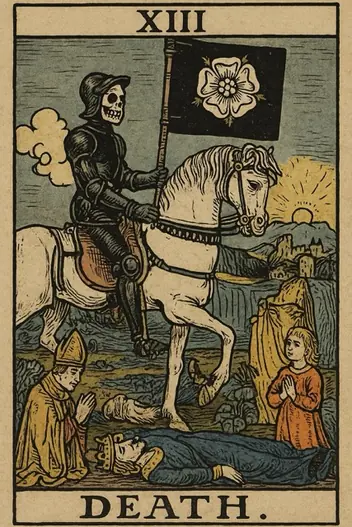
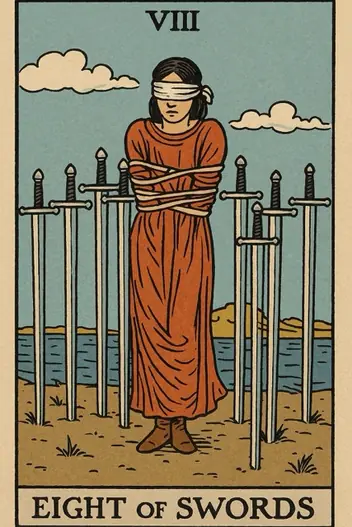
When the Death card meets the Eight of Swords, we encounter a profound psychological paradox: the need for transformation collides with a self-imposed mental prison. The Death card represents endings, deep transitions, and the stripping away of outdated structures. The Eight of Swords, conversely, depicts a figure bound and blindfolded, surrounded by swords—symbolizing entrapment by one’s own limiting beliefs, fear, and perceived helplessness. Together, they warn of a situation where a necessary change is being resisted, not by external forces, but by the seeker’s own cognitive distortions.
This combination highlights a critical moment where the universe is forcing a transition, yet the mind is crafting elaborate reasons why it cannot happen. The result is a state of paralyzing anxiety—you know something must end, but you feel powerless to act. This is not a passive warning; it’s a direct challenge to examine the stories you tell yourself about your limitations.
Death and Eight of Swords: How These Energies Interact
The core dynamic of Death and Eight of Swords is internal resistance to external inevitability. Psychologically, this mirrors the Kübler-Ross model of grief, specifically the bargaining and depression stages. The seeker may be intellectually aware that a relationship, job, or belief system is dead, but emotionally they remain trapped in the fantasy that they can control or reverse the process. The Eight of Swords’ blindfold represents denial as a defense mechanism, while the swords represent the sharp, painful thoughts that reinforce the prison.
This energy manifests as a cognitive loop of self-sabotage. You might find yourself saying, “I can’t leave because I’ll fail,” or “I can’t change because I’m not strong enough.” These are not objective truths; they are learned helplessness—a belief that no action will alter the outcome. The Death card demands radical acceptance: the old form must die. The Eight of Swords demands you untie your own bindings by challenging the validity of your fears. The key insight here is that the prison doors are unlocked; you simply refuse to see them.
For pragmatic action, this combination calls for cognitive restructuring. Identify the specific thought that feels most constricting. Ask: “Is this thought 100% true? What evidence contradicts it?” The Death card provides the energy to let go of the old, while the Eight of Swords shows you the exact mental trap to dismantle. The trap is not your circumstances; it is your interpretation of them.
Your pair is already on the table. Ask your question and draw the clarifying card
or simply focus on it
Death and Eight of Swords for Career and Money
Strategic Opportunities:
This is a prime moment to exit a dead-end job, project, or business model that no longer aligns with your values. The Death card clears the path for something new, but only if you stop doubting your capability.
Strategic Opportunities:
Use this energy to renegotiate your professional identity. If you feel trapped in a role (Eight of Swords), consider a lateral move, a sabbatical, or acquiring a new skill that redefines your market value.
Calculated Risks:
Avoid making rash financial decisions out of fear. The Eight of Swords can trigger panic-selling, quitting without a plan, or accepting a worse offer just to escape. Objectively assess your runway and leverage before acting.
In the career context, Death and Eight of Swords often appears for professionals who are burned out but afraid to pivot. The mind creates a narrative of impossibility: “I can’t change industries because I’m too old,” or “I can’t start my own business because I’ll fail.” These are cognitive distortions—specifically, catastrophizing and overgeneralization. The Death card is the market, the industry, or your own body signaling that the current path is unsustainable. The Eight of Swords is your ego’s attempt to maintain the status quo through fear.
Bold financial warning:
Do not let the fear of a temporary loss prevent you from a necessary long-term gain. For example, taking a pay cut to leave a toxic job may feel like a loss, but it preserves your mental capital and opens doors you cannot see from inside the prison. Financially, this is a time to prioritize liquidity and flexibility over rigid commitments. Sell off assets that anchor you to the past (e.g., a business you no longer love, a house that feels like a trap) and invest in your ability to adapt.
Death and Eight of Swords as Feelings
If you are single:
This pairing suggests you may be avoiding a necessary emotional reckoning. You might be holding onto the story that you are “not ready” or “unworthy” of love, when in reality, an old wound or identity needs to die first. Action: Identify one belief about yourself that keeps you from pursuing a connection, and actively challenge it.
If you are in a relationship:
The relationship is likely in a period of forced change—perhaps a breakup, a betrayal, or a major life shift. However, one or both partners are refusing to acknowledge the end of a phase, leading to passive-aggressive communication and emotional paralysis. Action: Initiate a direct, honest conversation about what must end, even if it feels frightening.
In relationships, this combination often signals a toxic dynamic of co-dependency masked as loyalty. One partner may feel victimized (Eight of Swords) while the other is already emotionally checked out (Death). The psychological trap is the belief that staying is safer than leaving, when in fact, staying prevents both parties from healing. The most compassionate act here is often the hardest: letting go. This does not always mean ending the relationship, but it does mean ending the pattern—such as the need to control, the fear of abandonment, or the role of the martyr.
Key relationship advice in bold:
Do not confuse familiarity with safety. The Eight of Swords’ bindings feel comfortable because you’ve worn them so long. The Death card offers liberation, but only if you are willing to be uncomfortable for a time. Your next step is to choose discomfort over stagnation.
Uncover hidden insights
Let our advanced Tarot system interpret these archetypes specifically for your personal path.
When Death and Eight of Swords Signal Trouble
The shadow manifestation of this combination is paralyzing fatalism. The seeker may misinterpret the Death card as a prophecy of doom, and the Eight of Swords as proof that they are a victim of fate. This leads to learned helplessness, where the individual stops trying altogether, believing that any action is futile. The cognitive bias at play is confirmation bias: you seek out evidence that supports your powerlessness while ignoring signs of agency.
A darker pitfall is self-sabotage through passive aggression. Instead of directly ending a situation, the seeker may unconsciously create crises that force an ending—e.g., picking a fight to justify a breakup, or deliberately underperforming at work to get fired. This is the shadow of the Death card (destruction without transformation) combined with the shadow of the Eight of Swords (playing the victim to avoid responsibility). The antidote is radical ownership: acknowledge that you are the one holding the key, and that the only way out is through conscious choice.
Death and Eight of Swords Reversed: How to Read It
When cards appear reversed, the dynamic is distorted but not eliminated. This is not a "cancellation" of the meaning, but its shadow version.
Death Reversed:
This is resistance to the inevitable and a prolonged death throes. The person clings to the corpse of the past, expending enormous resources to maintain an illusion. Paired with the upright Eight of Swords, this paints a picture of someone who knows they need to change but is afraid to take the first step, justifying their inaction with "unfinished business." Advice: Acknowledge that "it's not the right time yet" is a lie. Start small, without waiting for the perfect moment.
Eight of Swords Reversed:
Signifies internal resistance to liberation. The person sees the way out but subconsciously chooses to remain captive, gaining secondary benefits (pity, safety, relief from responsibility). Paired with the upright Death, this looks like sabotage of change. Warning: If you see the solution but do not act, you become a co-author of your own tragedy.
Both Reversed:
Complete imbalance. Death reversed (stagnation), Eight of Swords reversed (resistance to liberation). This is the deepest stagnation, where a person neither lives nor dies. They are stuck in a swamp of self-sabotage and denial. The only way to fix this is to artificially create a crisis. A drastic step, a voluntary renunciation of comfort, a public promise. You need to "activate" Death forcibly to break the paralysis.
Death and Eight of Swords: The Combined Message
Constructive use of this combination requires radical acceptance and immediate action. The energy of Death is not an enemy, but an ally that clears the rubble. The Eight of Swords is not a real prison, but a card that shows you exactly where the door you are afraid to open is located. Your task is to see in the paralysis not a sentence, but a signpost pointing to your zone of proximal growth.
Strategically, you need to do three things. First, diagnose the "corpse". What exactly must go? A job, a relationship, a belief? Name it out loud. Second, identify the "blindfold". What thought is holding you back? "I'm not good enough," "It's too late," "I have no choice"? Write it down. Third, perform one irreversible action that symbolizes the Death of the old. Delete a contact, write a resignation letter, throw away old belongings. This action will trigger a chain reaction that breaks the loop of the Eight of Swords.
Remember: Death does not ask for permission, and the Eight of Swords is merely an illusion of control. The only way to gain real control is to stop fearing the end and start acting, despite the fear. A crisis is not the end of the road, but its fork. Which path leads to freedom, and which to an endless circling in a labyrinth of fears, is for you alone to decide. Choosing to act is the only way to turn "death" into rebirth.
Your Next Step: Personal Context Matters
The Death and Eight of Swords combination is a powerful call to break free from the prison of your own making by embracing the inevitable end of a chapter. The core message is that your perceived limitations are not walls; they are thoughts you have mistaken for reality. The change you fear is not your enemy—it is the only path to freedom. To move forward, you must stop negotiating with fear and start acting from clarity.
While this article provides the general archetype, the true magic happens when Tarot is applied to your unique situation. Use the Fortune Cards app to get a deep, personalized interpretation of this exact combination for your specific question right now. Whether you access it on the web or download it, the app will help you untangle the specific beliefs and circumstances keeping you stuck, turning this abstract warning into a concrete, actionable plan for your life.
Interpretation by the Fortune Cards editorial team, based on the Rider–Waite tradition and Jungian archetypes. About our methodology · Updated: 2026-08-26
Other Combinations with Death
Other Combinations with Eight of Swords
Explore Individual Card Meanings
Table of Contents
- Death and Eight of Swords: How These Energies Interact
- Death and Eight of Swords for Career and Money
- Death and Eight of Swords as Feelings
- When Death and Eight of Swords Signal Trouble
- Death and Eight of Swords Reversed: How to Read It
- Death and Eight of Swords: The Combined Message
- Your Next Step: Personal Context Matters
Ready to find answers to your questions?
Start your first reading now and look at your situation with fresh clarity. The cards are ready to reveal deeper meaning.