Nine of Wands and Eight of Swords Tarot Combination
- Arcana
- Nine of Wands — Minor Arcana, Wands; Eight of Swords — Minor Arcana, Swords
- Elements
- Nine of Wands — Fire; Eight of Swords — Air
- Elemental interaction
- Friendly elements — energies support each other
- Numerology
- 9 + 8 = 17 → 8
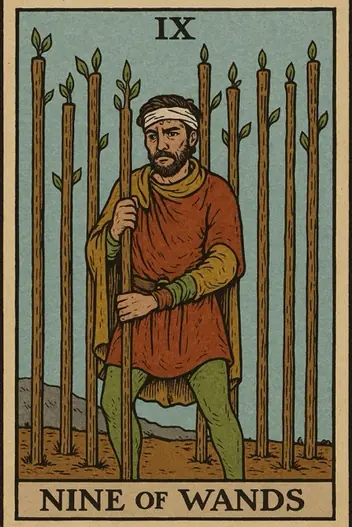
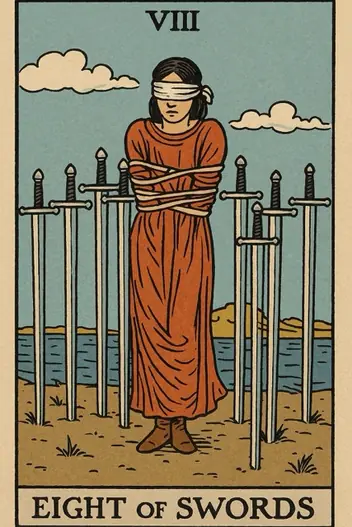
When the Nine of Wands—the card of guarded resilience and last-ditch defense—meets the Eight of Swords—the card of cognitive entrapment and self-imposed restriction—the result is a psychological standoff. The seeker is not merely tired; they are trapped in a cycle of defensive overthinking. They have the resources to fight, but their mind has built a prison of worst-case scenarios. This combination reveals a state where past wounds dictate present perception, creating a reality where the seeker feels both exhausted and incapable of escape.
The collision of these archetypes highlights a critical paradox: the more you brace for attack, the more you blind yourself to actual exits. The Nine of Wands demands vigilance, but the Eight of Swords shows that vigilance has curdled into paranoia and self-doubt. This is not a time for brute force; it is a time for cognitive reframing and strategic withdrawal to reassess the battlefield.
Nine of Wands and Eight of Swords Together: Meaning
The core dynamic here is a feedback loop of exhaustion and mental restriction. The Nine of Wands represents the last line of defense—a warrior who has been through multiple battles, bruised but standing. The Eight of Swords depicts a figure blindfolded and bound, surrounded by swords. Together, they show a person who is fighting a phantom war while ignoring the real chains they have accepted.
Psychologically, this combination signals hypervigilance combined with learned helplessness. The seeker may have legitimate reasons to be guarded (Nine of Wands), but they have internalized that guard as an unbreakable rule (Eight of Swords). They believe they cannot move because they are too tired or too constrained, but the truth is that the blindfold is self-applied. The swords (mental constructs) are not physical barriers—they are beliefs, such as "I can't trust anyone" or "I've already tried everything."
The key insight is that the seeker's greatest obstacle is not the external threat, but their own narrative of victimhood. The Nine of Wands warns against dropping your shield entirely, but the Eight of Swords demands you question which fears are real and which are projections. Practical action here requires a ruthless audit of assumptions: Is the enemy still there? Or are you fighting a ghost while standing at an open gate?
Your pair is already on the table. Ask your question and draw the clarifying card
or simply focus on it
Nine of Wands and Eight of Swords: Career and Money
Strategic Opportunities:
Use your hypervigilance as a risk-assessment tool in negotiations, not as a reason to avoid them. Your ability to spot potential pitfalls is a strength—apply it to due diligence, not to paralysis.
Strategic Opportunities:
Delegate or automate routine tasks to conserve your mental energy for high-stakes decisions. Your exhaustion is a signal that you are micromanaging fears instead of managing priorities.
Calculated Risks:
Avoid making decisions based on "worst-case" scenarios without evidence. The Eight of Swords warns against "catastrophizing" in financial planning. Do not turn down a reasonable opportunity because of an imagined failure.
In the professional realm, this combination speaks to burnout disguised as caution. The Nine of Wands suggests you have been working under high pressure for a long time, perhaps in a toxic environment or on a project with constant setbacks. The Eight of Swords warns that your fatigue is distorting your judgment. You may feel that you can't change jobs, ask for a raise, or pivot because of "the economy" or "company politics," but these are often mental swords. The bold strategic tip is to perform a "reality check" audit of your career constraints. List what is objectively blocking you versus what you assume is blocking you. Financially, avoid impulsive moves driven by scarcity mindset—this is not the time to liquidate assets or take on high-interest debt. Instead, focus on building a small emergency buffer to reduce the psychological pressure.
Nine of Wands and Eight of Swords in Love and Relationships
If you are single:
This pair suggests you are approaching potential partners with a defensive script from past hurts. You may be mistaking caution for wisdom, and your guardedness is creating the isolation you fear. Evaluate whether your standards are boundaries or walls.
If you are in a relationship:
This combination indicates a pattern of silent resentment and unspoken fears. One or both partners feel trapped by past conflicts, but neither is willing to initiate a direct conversation. The relationship is stable but stagnant.
In relationships, the Nine of Wands and Eight of Swords create a dynamic of emotional standoff. The seeker may feel they are constantly "on guard," waiting for the other person to disappoint them again. This leads to a self-fulfilling prophecy where the partner feels distrusted and withdraws, confirming the seeker's fears. The core relationship advice here is to distinguish between protecting your boundaries and building a prison. If you are in a relationship, ask yourself: "Am I defending my heart from a real threat, or am I replaying an old movie?" Bold action is required: initiate a structured conversation about past hurts, but do so with a clear goal of resolution, not blame. For singles, the advice is to practice vulnerability in low-stakes situations to rewire your trust reflexes.
Your unique Tarot reading
See how these cards interact with your destiny. Start a free personal reading now.
The Shadow Side of Nine of Wands and Eight of Swords
The shadow of this combination is a toxic cocktail of martyrdom and magical thinking. The seeker may unconsciously enjoy the identity of the victim—the one who has been wronged, the one who carries all the weight. The Nine of Wands' "battle-scarred warrior" archetype can become a self-serving narrative that justifies inaction. Meanwhile, the Eight of Swords' "trapped prisoner" archetype can lead to learned helplessness, where the seeker refuses to see obvious solutions because they require effort or vulnerability.
Common cognitive biases here include confirmation bias (only noticing evidence that supports your fear), catastrophizing (assuming the worst possible outcome is the most likely), and analysis paralysis (overthinking to avoid making a decision). The pitfall is becoming a professional sufferer—someone who discusses their problems endlessly but never acts. If you find yourself saying "I can't" more than "I won't," you are in the shadow. The antidote is radical responsibility: accept that your blindfold is self-tied, and that the first step to freedom is acknowledging you have the hands to untie it.
Nine of Wands and Eight of Swords Reversed: How to Read It
If the Nine of Wands is Reversed:
The defense crumbles, not from an enemy, but from exhaustion. Recklessness is your primary risk. You might quit without a plan B or end a relationship in a fit of anger. Advice: Do not make decisions in a state of extreme fatigue.
If the Eight of Swords is Reversed:
Internal resistance intensifies. You know what needs to be done, but you sabotage it. Weakness here is not a lack of strength, but a refusal to apply it. It is laziness disguised as anxiety.
If BOTH are Reversed:
Complete imbalance. Aggressive defense (Nine) combines with passive aggression (Eight). The dynamic becomes destructive and unpredictable. The way out is a complete halt to all projects and relationships that cause stress, for a period of at least 2 weeks. A "reboot" of the nervous system is needed.
Nine of Wands and Eight of Swords: The Combined Message
To constructively harness the energy of this pair, you must apply the "controlled experiment" method. The Nine of Wands grants you discipline and endurance. The Eight of Swords compels you to doubt. Your task is to direct those doubts not at yourself, but at hypotheses. Instead of thinking "I can't handle this," ask: "What three concrete steps can I take to test whether I can handle it?"
The "Defense with Reconnaissance" strategy is your key. Stop sitting in the trench waiting for an attack. Use your vigilance (the Nine) as a tool for gathering data (reconnaissance). The Eight of Swords is the card of "bound eyes." Remove the blindfold by employing rational analysis. Write your fears down on paper, and next to each one, write an objective piece of evidence for or against its validity.
Your main resource is the ability to tolerate uncertainty. The Nine of Wands demands certainty (guarantees of safety). The Eight of Swords fears uncertainty. The synthesis lies in accepting the fact that 100% guarantees do not exist. Your task is not to eliminate all risks, but to learn how to act under conditions of risk. Take one small step toward your fear today. This will shatter the paralysis of the Eight of Swords and give your Nine of Wands a new, productive purpose.
Where to Go From Here
The core message of the Nine of Wands and Eight of Swords is this: You are stronger than you think, but more trapped than you realize—and the trap is in your mind, not your circumstances. Your exhaustion and defensiveness are valid, but they are not permanent. The path forward requires you to distinguish between real threats and imagined ones, and then take one small, deliberate action to move toward the exit you cannot yet see.
While this analysis provides the archetypal blueprint, the true power of Tarot lies in its application to your specific situation. To get a deep, personalized interpretation of this exact combination for your unique question, use the Fortune Cards app. Available on the web or as a download, it analyzes your cards in the context of your life, offering actionable insights tailored to your relationship, career, or personal growth challenge. Stop reading about the trap—start finding your way out.
Interpretation by the Fortune Cards editorial team, based on the Rider–Waite tradition and Jungian archetypes. About our methodology · Updated: 2026-08-26
Other Combinations with Nine of Wands
Other Combinations with Eight of Swords
Explore Individual Card Meanings
Table of Contents
- Nine of Wands and Eight of Swords Together: Meaning
- Nine of Wands and Eight of Swords: Career and Money
- Nine of Wands and Eight of Swords in Love and Relationships
- The Shadow Side of Nine of Wands and Eight of Swords
- Nine of Wands and Eight of Swords Reversed: How to Read It
- Nine of Wands and Eight of Swords: The Combined Message
- Where to Go From Here
Ready to find answers to your questions?
Start your first reading now and look at your situation with fresh clarity. The cards are ready to reveal deeper meaning.