Nine of Wands
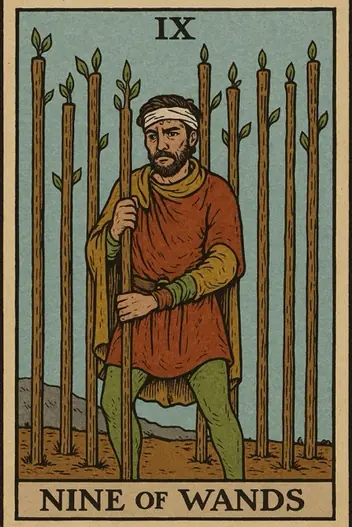
- Arcana
- Minor Arcana, Suit of Wands
- Element
- Fire
- Decan
- the Moon in Sagittarius
- Numerology
- 9
The Nine of Wands represents the psychological archetype of the Wounded Guardian—a state of high alert born from past battle scars. In Jungian terms, this card embodies the Sentinel complex: the part of the psyche that has learned, through direct experience, that threats are real and must be guarded against with vigilance. This is not a card of naive optimism; it is the card of strategic endurance.
The core challenge of this card is the tension between necessary defense and paralyzing paranoia. You have survived a significant conflict, but the cost is a hyper-vigilant mindset. The primary question it poses is: Are you protecting yourself from future harm, or are you preventing yourself from living fully? The answer determines whether this energy builds a fortress or a prison.
Main Dynamics and Interpretation
The Nine of Wands depicts a figure who is bandaged but standing, holding a wand as a staff of support and a weapon. This is the psychological state of post-traumatic resourcefulness. You have the strength to continue, but your energy reserves are low. The key dynamic here is calculated persistence: you are not charging forward; you are holding a line. This requires a strategic mindset where every action is weighed for its cost-benefit ratio.
The primary resource of this card is learned caution. You possess a deep, empirical understanding of your own limits and the nature of the obstacles you face. This is not theoretical wisdom; it is hard-won knowledge from failure. In decision-making, this card advises you to trust your instincts but to verify them with data. The danger is that your instincts are now biased toward threat detection, potentially causing you to overestimate risk and miss genuine opportunities. The correct action is to maintain your position but to actively scan for allies or resources that can lighten your load. Strategic patience is your greatest tool.
Ask your question and flip the cards
or simply focus on it
Nine of Wands: Yes or No?
Leaning yes. But with a crucial caveat. The Nine of Wands depicts a wounded yet vigilant figure—this is not a clear green light but a guarded affirmation. Psychologically, the card indicates that the outcome is possible only if you are willing to endure the last stretch of a challenge, maintaining your boundaries and resilience. The "yes" is conditional on your ability to stand your ground despite fatigue or past hurt. When reversed, the answer shifts to No—the defenses have crumbled, paranoia dominates, or you are too exhausted to proceed effectively. The critical condition: this answer depends on whether you can sustain a defensive posture without becoming rigid or aggressive, and whether the other party respects your need for cautious progress.
Get a personalized interpretation
Unlock the combined meaning of your cards in the context of your unique question — for free.
What Does Nine of Wands Mean for Your Day?
The Nine of Wands signals a day where you are on high alert, perhaps carrying residual tension from a previous struggle. Your main task is to hold your position—do not abandon your boundaries or compromise your hard-won ground, even if you feel isolated or tested. Focus on what you can control: your posture, your stamina, and your refusal to be provoked into unnecessary conflict. The trap today is hypervigilance that turns into paranoia or self-sabotage; avoid assuming every minor setback is a full-scale attack. A secondary energy to watch for is the temptation to isolate completely, mistrusting even genuine offers of support.
Love and Relationships
If you are not in a relationship:
This card suggests you are overly defensive in your approach to intimacy. Your past experiences have taught you to expect betrayal or disappointment, causing you to project walls before anyone has proven untrustworthy. You must consciously lower your guard to allow for genuine connection, even if it feels risky.
If you are in a relationship:
The dynamic is one of tested loyalty. You or your partner may be feeling the weight of past conflicts. The relationship is stable, but it requires active maintenance. Beware of the "silent treatment" or emotional withdrawal as a defense mechanism.
In a relationship, the Nine of Wands manifests as a boundary negotiation phase. One partner may feel the other is being too guarded, while the guarded partner feels they are being asked to be vulnerable too quickly. The practical advice is to establish a "safe word" or a clear protocol for conflict resolution. Instead of reacting to perceived threats, agree to pause and ask: "Is this a real threat, or is it my past speaking?" Emotional intelligence here means distinguishing between a genuine boundary and a wall built from fear. The healthiest outcome is a relationship where both partners feel protected by the bond, not from each other.
Nine of Wands as Feelings: What They Think of You
This person sees you as someone who is both formidable and slightly inaccessible—a protector of your own boundaries who has been through significant hardship. They associate you with resilience, but also with a certain wariness; they may feel you are testing them or keeping them at arm’s length to see if they prove trustworthy. Psychologically, they perceive you as a figure who demands proof of loyalty before allowing closeness, which can evoke both admiration and frustration. Their hidden intention is likely to gain your trust, but they fear your defensive posture means they will never be fully let in. There is an internal conflict: they respect your strength yet feel a subtle rejection from your guardedness, leading them to wonder if they are being judged or held responsible for past wounds you carry.
What Does Nine of Wands Mean for Work and Money?
Strategic Opportunities:
Defend your current position. This is not a time for aggressive expansion. Focus on consolidating gains, securing contracts, and shoring up your reputation. Your strength is in quality control and risk mitigation.
Resource Management:
Leverage your expertise in crisis management. Your experience with past failures makes you an invaluable asset in troubleshooting or turnaround situations. Offer your services as a "firefighter" within your organization or to clients.
Calculated Risks:
Avoid over-committing resources. Do not take on new debt or invest in high-risk ventures. The card warns against the "sunk cost fallacy" —holding onto a failing project simply because you've already invested so much. Objectively audit your current workload and cut any dead weight.
In your professional life, the Nine of Wands calls for a defensive strategy. This is the card of the seasoned manager who knows the system's weak points. Financially, this is a time for building an emergency fund and renegotiating terms. Your leadership style should be one of protective mentorship—guide your team by sharing the lessons from your own mistakes, but do not micromanage. The key financial warning is to not confuse loyalty with profitability. Just because you have worked hard for something does not mean you should continue to pour resources into it. Cut losses on any venture that is draining energy without a clear path to sustainability.
Reversed Positions: What Changes?
When the Nine of Wands appears reversed, the core dynamic of resilient defense becomes rigid paranoia or utter exhaustion. The "wounded guardian" archetype has become dysfunctional. The person is either too weak to hold the line (burnout) or has become so defensive that they are attacking allies, mistaking them for enemies. This is a state of blocked potential where the lessons of the past are not being integrated but are instead causing a freeze response.
In life, this manifests as chronic suspicion or passive-aggressive behavior. You may be refusing help because you don't trust anyone, or you may be physically and mentally depleted, unable to perform basic tasks. The warning here is clear: you are your own worst enemy. The imbalance is caused by a refusal to acknowledge your own vulnerability. The correction requires a strategic retreat: you must consciously lower your defenses in a safe environment (therapy, trusted friend, or a structured break) to recharge. The path forward is not to fight harder, but to heal first.
The Shadow Side of Nine of Wands
The shadow of the Nine of Wands is hyper-vigilance turned into a personality disorder. The cognitive bias at play is confirmation bias: you are only looking for evidence that confirms your fears, ignoring all data that suggests safety. This leads to self-sabotage where you push people away before they can hurt you, thereby fulfilling your own prophecy of isolation. The irrational behavior here is over-protection of the ego—you would rather be right about the world being dangerous than risk being wrong and vulnerable.
Other pitfalls include perfectionism (using high standards as a wall to avoid criticism) and martyr complex (suffering in silence to prove your strength). The deepest fear is not of failure, but of dependency. You believe that needing help is a sign of weakness. The error in judgment is conflating caution with control. You cannot control all variables. The shadow path leads to a lonely, brittle existence where you are safe but stagnant.
Synthesis: What It All Adds Up To
To constructively use the energy of the Nine of Wands, you must adopt a dual mindset of defense and discernment. Your primary task is to audit your defenses. Ask yourself: Which of my walls are still necessary for my safety, and which are now just obstacles to my growth? The card's energy is powerful when directed outward—protecting a legitimate boundary—but dangerous when directed inward, protecting a fragile ego.
Strategic advice: Create a "risk map" of your current life. List the areas where you feel threatened. Then, for each threat, ask: "Is this a real, present danger, or is it a ghost from my past?" If it is a ghost, your task is to consciously expose yourself to a low-stakes version of that fear to re-calibrate your threat-detection system. If it is a real danger, your task is to build a specific, time-bound plan to address it, not to remain in a state of perpetual vigilance.
The ultimate goal of this card is not to live in a fortress, but to become a skilled sentinel who knows when to stand watch and when to open the gate. Your endurance is a resource, not a lifestyle. Use it to achieve a specific goal, then rest. The most pragmatic interpretation of the Nine of Wands is this: You are stronger than you think, but you are also more tired than you admit. Acknowledge both truths, and you will navigate this phase with wisdom.
Your Next Step: Personal Context Matters
This psychological and strategic breakdown provides a deep understanding of archetypes. However, Tarot is never universal for everyone. To understand exactly how this dynamic applies to your specific situation, a reading tailored exclusively to you is necessary.
Download the Fortune Cards app or visit our platform to get a deep AI interpretation of your unique spread. Don't just read about the cards—use Fortune Cards to find out exactly what step you need to take next.
Try Tarot Spreads with Nine of Wands
Interpretation by the Fortune Cards editorial team, based on the Rider–Waite tradition and Jungian archetypes. About our methodology · Updated: 2026-08-26
Top Combinations with Nine of Wands
Discover how Nine of Wands interacts with other major cards in the deck to form powerful messages.
All 77 Combinations with Nine of Wands
Discover how this card interacts with every other card in the Tarot deck and reveal hidden meanings.
Table of Contents
- Main Dynamics and Interpretation
- Nine of Wands: Yes or No?
- What Does Nine of Wands Mean for Your Day?
- Love and Relationships
- Nine of Wands as Feelings: What They Think of You
- What Does Nine of Wands Mean for Work and Money?
- Reversed Positions: What Changes?
- The Shadow Side of Nine of Wands
- Synthesis: What It All Adds Up To
- Your Next Step: Personal Context Matters
Explore Tarot Universe
Ready to find answers to your questions?
Start your first reading now and look at your situation with fresh clarity. The cards are ready to reveal deeper meaning.