Eight of Swords
- Arcana
- Minor Arcana, Suit of Swords
- Element
- Air
- Decan
- Jupiter in Gemini
- Numerology
- 8
The Eight of Swords represents a profound psychological trap: the state of being bound not by external forces, but by your own perceptions, fears, and cognitive distortions. In Jungian terms, this card embodies the Shadow of the Victim Archetype—a mindset where you feel powerless, yet your restraints are largely self-imposed. It is the moment when your mind constructs a cage, and you mistake its bars for reality.
This card challenges you to confront a fundamental question: Are you truly trapped, or have you simply stopped looking for the exit? The Eight of Swords signals a crisis of agency, where learned helplessness and catastrophic thinking replace proactive problem-solving. It is not a card of external defeat, but of internal surrender.
Main Dynamics and Interpretation
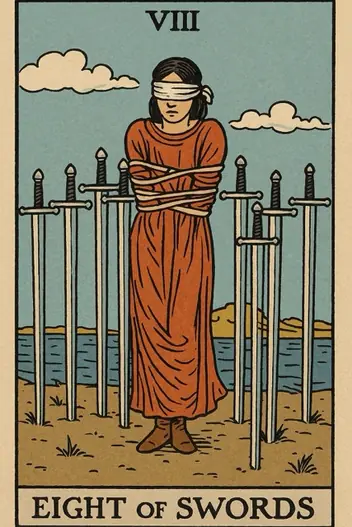
The Eight of Swords depicts a woman blindfolded and bound, surrounded by eight swords, standing on unstable ground. This imagery is a powerful metaphor for paralysis through over-analysis. The blindfold symbolizes willful ignorance—a refusal to see the options available because they contradict a deeply held narrative of victimhood. The swords represent the sharp, cutting thoughts that imprison you: "I can't," "I'm not good enough," "It's too late."
Psychologically, this card highlights the cognitive triad of depression: a negative view of the self, the world, and the future. The person in this card feels isolated and trapped, but note that the ground beneath her is not completely solid—it is a shoreline, meaning the water (emotion) is nearby, and the castle (security) is visible in the distance. The solution is not to fight the swords, but to remove the blindfold. The core dynamic here is the tension between perceived constraint and actual freedom. The card warns that you are likely overestimating the risks and underestimating your own capacity to act. Strategic action requires you to pause, inventory your actual resources, and challenge your assumptions before making any move.
Ask your question and flip the cards
or simply focus on it
Eight of Swords: Yes or No?
No.. The Eight of Swords represents a state of perceived entrapment, mental paralysis, and self-imposed limitation. Psychologically, this card signals that the querent is bound not by external forces but by their own cognitive distortions—negative thought patterns, catastrophic thinking, or a victim mindset. In a yes/no context, the answer is a firm “no” because the energy is one of obstruction and confusion, not alignment or forward momentum. Reversed, the card shifts toward Leaning Yes, as it indicates the beginning of breaking free from these mental binds, though the path remains fragile. The critical caveat: the outcome depends entirely on the querent’s willingness to examine their own beliefs and question the reality of the perceived barriers—no external change will occur without internal insight.
Uncover hidden insights
Let our advanced Tarot system interpret these archetypes specifically for your personal path.
What Does Eight of Swords Mean for Your Day?
The Eight of Swords as a Card of the Day signals a mental trap: you may feel stuck, indecisive, or overwhelmed by options that seem equally bad, but the actual cage is made of your own assumptions. Focus on identifying one specific fear or limiting belief that has been running on autopilot—write it down and ask yourself “Is this objectively true?” The action to take is to pause before reacting; do not make major decisions today, as your judgment is clouded by anxiety. Avoid ruminating alone, seeking reassurance from others, or blaming circumstances for your inertia—these traps reinforce the blindfold. The energy of this day is a call to sit with discomfort rather than escape it, because clarity will only emerge when you stop struggling against the ropes.
Love and Relationships
If you are not in a relationship:
You may be avoiding intimacy by believing you are unworthy or that no one suitable exists. This self-limiting narrative prevents you from taking even small social risks.
If you are in a relationship:
The relationship may feel suffocating due to a pattern of passive-aggressive communication or unspoken resentments. You or your partner feels trapped by unexamined expectations.
In relationships, the Eight of Swords often manifests as emotional gridlock. One or both partners feel stuck, repeating the same arguments without resolution. The blindfold here is the refusal to see the other person's perspective or your own contribution to the conflict. The most pragmatic advice is to explicitly state your fears out loud. Often, verbalizing "I'm afraid you'll leave me if I set this boundary" reveals the irrationality of the fear. The card urges you to break the silence and initiate a direct, honest conversation about what each of you actually needs, rather than assuming you already know the outcome. The path forward requires vulnerability as a strategic tool, not a weakness.
Eight of Swords as Feelings: What They Think of You
Through the archetype of the Eight of Swords, this person perceives you as someone who is intelligent yet trapped in your own head—they see a thinker who overcomplicates simplicity, often paralyzed by indecision or self-doubt. You evoke in them a mixture of empathy and frustration: they feel drawn to your depth but also sense you hold yourself back from what you truly want. Their hidden intention may be to nudge you toward action or clarity, but they fear that pushing too hard will make you retreat further into your mental fortress. There is a subtle hope that you will see the “blindfold” for what it is and choose to remove it yourself, as they respect autonomy. Internally, this person is conflicted: they admire your sensitivity and analytical mind, yet they worry that your self-imposed limitations make you emotionally unavailable or unreachable for genuine connection.
What Does Eight of Swords Mean for Work and Money?
Strategic Opportunities:
The key growth point is to identify one specific, small action you have been avoiding due to fear of failure. Taking it will break the paralysis.
Resource Management:
Use this card as a signal to audit your mental constraints. List three "impossible" tasks and ask: "What would I do if I knew I could not fail?" This reframes the problem.
Calculated Risks:
Do not make major financial decisions while feeling trapped. Your judgment is clouded by anxiety. Avoid signing contracts, making large investments, or quitting a job impulsively.
In a professional context, the Eight of Swords represents career stagnation driven by perfectionism or imposter syndrome. You may feel underqualified for a promotion or trapped in a role that no longer fits. The reality is that your skills are likely adequate, but your fear of judgment is blocking your progress. The strategic imperative is to seek objective feedback from a trusted mentor or colleague. Their external perspective will likely reveal that your "cage" is made of paper. Financially, this card warns against hoarding resources out of scarcity mindset. Instead, invest in skill development or networking—actions that expand your options rather than protect a shrinking comfort zone.
Reversed Positions: What Changes?
When reversed, the Eight of Swords signals a breakthrough from the prison of the mind. The blindfold is loosening, and the person begins to see the exits. However, this reversal is not always positive—it can also indicate a premature or chaotic release from constraint without proper planning. You may feel a sudden surge of energy to change everything, but this can lead to reckless decisions if not grounded in reality.
The reversed card warns of internal resistance to freedom. You know you are not truly trapped, but you cling to the victim narrative because it feels safe. This manifests as procrastination on a decision you've already made or self-sabotage just as you are about to succeed. The logical correction is to create a concrete action plan with deadlines. Break your escape into small, irreversible steps: send the email, make the call, sign the form. Do not wait for the "perfect moment." The reversed Eight of Swords asks you to choose discomfort over paralysis and to trust that imperfect action is better than no action at all.
The Shadow Side of Eight of Swords
The shadow of the Eight of Swords is the seduction of helplessness. When this archetype takes over, you may unconsciously prefer the certainty of suffering over the uncertainty of freedom. This leads to chronic victimhood—a pattern where you repeatedly tell yourself and others why you cannot act, thereby avoiding responsibility for your own life. Cognitive biases at play include confirmation bias (seeking only evidence that supports your powerlessness) and catastrophizing (imagining worst-case scenarios as inevitable).
In irrational behavior, this card manifests as passive aggression or silent martyrdom. You may punish others by suffering in silence, expecting them to read your mind. This is a form of emotional blackmail that destroys trust. The pitfall is that by refusing to act, you abdicate your agency and hand control to external circumstances. The shadow warns: do not mistake comfort for safety. The prison of the Eight of Swords is comfortable because it requires no risk. The price is your growth, your relationships, and your self-respect.
Synthesis: What It All Adds Up To
To constructively use the energy of the Eight of Swords, you must first acknowledge that the primary barrier is internal. This is not a card of external misfortune—it is a card of perception management. The most powerful action you can take is to systematically challenge every "I can't" thought that arises. Write down three limiting beliefs, then write a rational counterargument for each. This exercise re-engages your prefrontal cortex and breaks the loop of emotional paralysis.
Second, take one small, irreversible action today. The goal is not to solve the entire problem, but to prove to yourself that movement is possible. This action could be as simple as cleaning your desk, sending a text, or researching a new skill. Action generates momentum, and momentum breaks the trance of helplessness. The Eight of Swords rewards strategic, low-risk experimentation over grandiose plans.
Finally, adopt a pragmatic, iterative mindset. You are not escaping a dungeon in one leap; you are taking steps on a path that reveals itself as you move. The card's ultimate lesson is that freedom is a decision, not a destination. By choosing to see the exits—even if they are small—you reclaim your agency. This is the essence of psychological maturity: the courage to act despite uncertainty, and the wisdom to know that your mind is both your prison and your key.
Your Next Step: Personal Context Matters
This psychological and strategic breakdown provides a deep understanding of archetypes. However, Tarot is never universal for everyone. To understand exactly how this dynamic applies to your specific situation, a reading tailored exclusively to you is necessary.
Download the Fortune Cards app or visit our platform to get a deep AI interpretation of your unique spread. Don't just read about the cards—use Fortune Cards to find out exactly what step you need to take next.
Try Tarot Spreads with Eight of Swords
Interpretation by the Fortune Cards editorial team, based on the Rider–Waite tradition and Jungian archetypes. About our methodology · Updated: 2026-08-26
Top Combinations with Eight of Swords
Discover how Eight of Swords interacts with other major cards in the deck to form powerful messages.
All 77 Combinations with Eight of Swords
Discover how this card interacts with every other card in the Tarot deck and reveal hidden meanings.
Table of Contents
- Main Dynamics and Interpretation
- Eight of Swords: Yes or No?
- What Does Eight of Swords Mean for Your Day?
- Love and Relationships
- Eight of Swords as Feelings: What They Think of You
- What Does Eight of Swords Mean for Work and Money?
- Reversed Positions: What Changes?
- The Shadow Side of Eight of Swords
- Synthesis: What It All Adds Up To
- Your Next Step: Personal Context Matters
Explore Tarot Universe
Ready to find answers to your questions?
Start your first reading now and look at your situation with fresh clarity. The cards are ready to reveal deeper meaning.