Page of Cups and Eight of Swords Together in Tarot
- Arcana
- Page of Cups — Minor Arcana, Cups; Eight of Swords — Minor Arcana, Swords
- Elements
- Page of Cups — Water; Eight of Swords — Air
- Elemental interaction
- Neutral elements — energies coexist without conflict
- Numerology
- 11 + 8 = 19 → 1
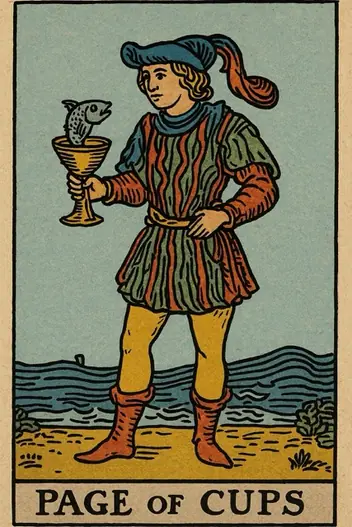
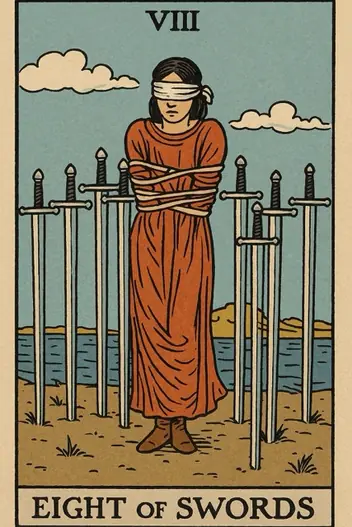
The Page of Cups introduces a raw, open emotional state—a willingness to feel, to offer, or to receive something tender. In stark contrast, the Eight of Swords depicts a person bound and blindfolded, surrounded by swords, representing self-imposed mental restrictions and victim mentality. When these two cards collide, we witness a fascinating psychological conflict: a genuine emotional impulse (Page of Cups) being immediately stifled or distorted by the seeker’s own rigid thought patterns (Eight of Swords).
The real-world implication is often a state of paralysis. You may have a clear feeling—a desire to express love, to start a creative project, to forgive—but your inner critic, fear of failure, or past trauma (the Eight of Swords) ties your hands before you can act. This combination demands that we examine the gap between authentic feeling and self-sabotaging belief.
What Do Page of Cups and Eight of Swords Mean Together?
The core dynamic here is the tension between emotional authenticity (Page of Cups) and cognitive rigidity (Eight of Swords) . The Page of Cups represents the childlike, open heart—the part of you that is curious, vulnerable, and willing to offer unconditional positive regard. The Eight of Swords represents the adult mind that has learned to protect itself through overthinking, catastrophic predictions, and self-criticism. When these two meet, the result is a person who feels deeply but cannot act on those feelings due to a self-constructed prison of doubt.
Psychologically, this is a classic case of emotional dissonance. The seeker knows what they want to feel (Page of Cups) but their internal narrative (Eight of Swords) tells them they are not allowed, not ready, or not worthy. The swords are not real obstacles—they are beliefs. The blindfold is not physical—it is a refusal to see alternative paths. The key insight here is that the Page of Cups energy is not weak; it is simply suppressed. The solution lies not in ignoring the swords, but in questioning their validity.
Strategically, this combination warns against acting on emotion without first dismantling the mental blocks. A classic mistake is to push forward with a grand romantic gesture or career leap while still feeling “trapped” inside. The result is often shallow or impulsive action. Instead, the Page of Cups and Eight of Swords together advise: First, remove the blindfold. Then, let the heart speak.
Your pair is already on the table. Ask your question and draw the clarifying card
or simply focus on it
What Do Page of Cups and Eight of Swords Say About Love?
If you are single:
This combination suggests you may be feeling a genuine attraction or emotional pull toward someone, but you are holding back due to fear of rejection, past hurt, or social anxiety. The feeling is real—the obstacle is in your mind.
If you are in a relationship:
You or your partner may be offering emotional vulnerability (Page of Cups) while the other partner feels trapped by unspoken rules, guilt, or a sense of being “backed into a corner” (Eight of Swords). This is a call for clear, non-judgmental communication.
In relationships, this pair reveals a power dynamic where one person is ready to give emotionally, but the other is paralyzed by their own internal scripts. The Page of Cups partner may feel confused or rejected, not realizing the other is not rejecting them—they are rejecting their own self-doubt. The most important action here is to verbalize the feeling of being “trapped” without blaming the other person. For example: “I feel drawn to you, but I also feel scared because I’ve been hurt before. Can we talk about this slowly?”
Key relationship advice in bold:
Do not mistake silence for indifference. The Eight of Swords often manifests as a partner who wants to connect but cannot find the words. Create a safe container for that vulnerability. Conversely, if you are the one feeling trapped, recognize that your blindfold is self-imposed—ask for reassurance or time, but do not withdraw entirely.
What Do Page of Cups and Eight of Swords Indicate for Your Career?
Strategic Opportunities:
Use your emotional intelligence (Page of Cups) to read the room in negotiations or team dynamics. Your sensitivity is a data point, not a weakness.
Strategic Opportunities:
This is an excellent time to propose a creative idea or project that you have been quietly nurturing. The Page of Cups brings innovation, but you must first dismantle the belief that your idea will fail.
Calculated Risks:
Avoid making major financial decisions while feeling overwhelmed or victimized by circumstances. The Eight of Swords can lead to impulsive “escape” moves (quitting a job without a plan) or freezing entirely (missing a deadline).
In a professional context, this combination often appears when someone has a genuine passion or creative vision (Page of Cups) but feels stuck in a role, industry, or financial situation that feels like a trap (Eight of Swords) . The danger is that you may try to “fix” the feeling of being trapped by making an emotional decision—quitting abruptly, spending money to feel better, or confronting a boss without strategy. The pragmatically wise approach is to first map out your mental constraints. Write down the specific fears or beliefs that are holding you back. Are they based on facts or assumptions? Often, the Eight of Swords represents a perceived lack of options rather than a real one.
Bold financial warnings or strategic tips:
Do not invest money or time into a venture solely because it “feels right” (Page of Cups) while ignoring red flags (Eight of Swords). Conversely, do not reject a promising opportunity because you have convinced yourself you are not capable. Seek a third opinion—a mentor, coach, or trusted colleague—to help you see the swords for what they are: removable.
Deepen your understanding
Find out exactly what this reading means for your current life situation with our oracle.
What If Page of Cups or Eight of Swords Appears Reversed?
If the Page of Cups is reversed:
The emotional impulse becomes distorted. Instead of genuine feeling, manipulation, infantilism, or emotional blackmail emerges. A person may "drown" their fears (the Eight) in unhealthy ways, for example, by dramatizing the situation. Advice: Examine the motives—yours and others'. This isn't about feelings, but about a game.
If the Eight of Swords is reversed:
The limitations become even more rigid, but now conscious. The person knows they have locked themselves in, but they don't want to or are afraid to leave. This is a state of chronic victimhood, where suffering has become a habit. Warning: This is a dangerous position of denial that requires rigorous psychological work.
If BOTH are reversed:
Complete imbalance. Emotional immaturity (reversed Page) meets total self-limitation (reversed Eight). This is a scenario of "doing nothing" and complaining about fate. Method of correction: Stop looking for external causes of problems and acknowledge that you yourself are the author of your situation. Only then will there be a chance for change.
Shadow Side & Pitfalls
The shadow manifestation of this combination is emotional manipulation disguised as vulnerability. The Page of Cups can be immature or overly sentimental, while the Eight of Swords can be used as a victim narrative. Together, they can create a person who says, “I have so much love to give, but I’m too broken/trapped/scared to act.” This is a form of self-sabotage that avoids responsibility. The cognitive bias at play is learned helplessness—the belief that because you have been hurt before, you are powerless now. The pitfall is that you may mistake feeling for doing. You feel the love, so you assume the relationship is working. You feel the passion, so you assume the career is on track. Feeling is not action. The Eight of Swords demands you act despite the fear.
Another shadow element is projection. The seeker may see the “trapped” energy in their partner or boss, refusing to acknowledge that they themselves are the one wearing the blindfold. This leads to blaming others for their own paralysis. The hard truth: The swords are your own thoughts. The blindfold is your own choice. Until you remove it, no amount of emotional openness (Page of Cups) will set you free.
Synthesis: Strategic Conclusion
How can the energy of the Page of Cups be used constructively to balance the Eight of Swords? The key lies in action, not in thought. The Page of Cups is an impulse, and it must be realized before the mind (the Eight) has a chance to block it. The strategy is to take one small, concrete step that disrupts the stasis of self-limitation. There is no need to solve the entire problem at once—simply send a message, sign up for a course, or confess a feeling.
Your primary task is to translate irrational fear into rational risk. Ask yourself: "What is the worst that could happen if I follow my impulse?" The answer is almost always less frightening than a lifetime of regret over inaction. The Page of Cups offers you a chance for growth through vulnerability, while the Eight of Swords is the illusion that safety equals stillness.
The deep strategic advice: use intuition (the Page) as a compass, and reason (the Eight) as a map—not as a jailer. Allow yourself to feel first, and then to analyze. If you reverse this order, you will remain forever trapped in the cage of your own thoughts. True strength lies not in controlling your feelings, but in the courage to act despite fear.
Where to Go From Here
The Page of Cups and Eight of Swords together deliver a clear message: Your heart knows what it wants, but your mind has built a prison around it. The path forward is not to ignore the feeling or to smash through the walls blindly. It is to examine each sword—each fear, each limiting belief—and ask, “Is this actually true?” The core message is one of liberation through self-awareness. You are not stuck; you are simply blindfolded.
While this article provides the general archetype, the true magic happens when Tarot is applied to your unique situation. Your specific question, your personal history, and the other cards in your spread will reveal exactly why you feel trapped and what your next step should be. To get a deep, personalized interpretation of this exact combination for your specific question right now, use the Fortune Cards app on the web or download it. Let the cards speak directly to your life.
Interpretation by the Fortune Cards editorial team, based on the Rider–Waite tradition and Jungian archetypes. About our methodology · Updated: 2026-08-26
Other Combinations with Page of Cups
Other Combinations with Eight of Swords
Explore Individual Card Meanings
Table of Contents
- What Do Page of Cups and Eight of Swords Mean Together?
- What Do Page of Cups and Eight of Swords Say About Love?
- What Do Page of Cups and Eight of Swords Indicate for Your Career?
- What If Page of Cups or Eight of Swords Appears Reversed?
- Shadow Side & Pitfalls
- Synthesis: Strategic Conclusion
- Where to Go From Here
Ready to find answers to your questions?
Start your first reading now and look at your situation with fresh clarity. The cards are ready to reveal deeper meaning.