Page of Cups and Ten of Swords Together in Tarot
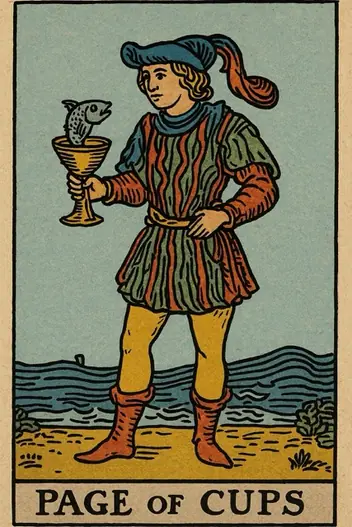
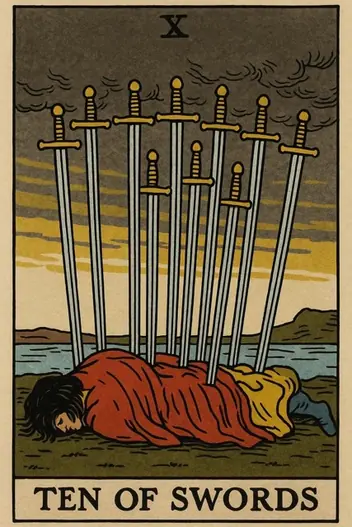
- Arcana
- Page of Cups — Minor Arcana, Cups; Ten of Swords — Minor Arcana, Swords
- Elements
- Page of Cups — Water; Ten of Swords — Air
- Elemental interaction
- Neutral elements — energies coexist without conflict
- Numerology
- 11 + 10 = 21 → 3
The Page of Cups embodies the archetype of the innocent emotional initiate—a state of open-hearted curiosity, creative intuition, and vulnerability to new feelings. The Ten of Swords, by contrast, represents the crisis of finality—a painful but necessary ending, often marked by betrayal, exhaustion, or a mental breaking point. When these two cards collide in a reading, they reveal a powerful psychological tension: the urge to feel deeply and trust your emotions is being forced to confront a stark, rational conclusion.
This combination is not a prophecy of doom, but a strategic crossroads. It suggests that a prior emotional investment—perhaps a naive hope or a creative project—has led to a harsh lesson. The Page of Cups’ desire to explore and connect is being overridden by the Ten of Swords’ demand for closure and objective assessment. The key insight here is that this ending is not the death of emotion itself, but the death of a specific emotional pattern that no longer serves you. The question becomes: can you honor the pain of the ending without letting it freeze your capacity for future feeling?
Page of Cups and Ten of Swords Combination Meaning
The core dynamic of this pairing is a psychological collision between innocence and disillusionment. The Page of Cups represents a part of you that still wants to believe in the purity of an idea, a person, or a creative impulse. The Ten of Swords represents the brutal reality that this belief has been shattered—often by overthinking, harsh words, or a clear-cut failure. The resulting mindset is one of bittersweet clarity: you can see the truth with painful precision, but you also feel the loss of the dream.
This creates a specific psychological state: cognitive dissonance between hope and evidence. You may feel a strong pull to retreat into the Page’s fantasy—to rationalize the pain away or to seek comfort in another emotional adventure. However, the Ten of Swords demands that you stop and analyze the corpse of the situation. Practically, this means you must resist the urge to “fix” the ending with more emotion. Instead, use the Page’s intuition to sense what was truly authentic, and the Ten’s logic to accept what is objectively over. The real-world implication is a strategic pause: you are being asked to mourn the loss, not to resurrect it. This is a time for journaling, therapy, or a hard conversation that closes a loop, not for chasing new emotional highs.
Your pair is already on the table. Ask your question and draw the clarifying card
or simply focus on it
Love and Relationships
If you are single:
This combination warns against projecting your emotional needs onto a new person who hasn’t earned your trust. Evaluate the connection based on actions, not fantasies. The Page’s excitement may be a rebound from a recent hurt.
If you are in a relationship:
A painful argument or a long-buried truth has come to light. This is a moment for clear, non-defensive communication about what is truly ending or changing.
In relationships, the Page of Cups and Ten of Swords often signal the end of a romanticized phase. You may have been “in love with love” (Page) but now face a harsh reality (Ten) that forces a re-evaluation of the partnership’s foundation. The key advice here is to distinguish between the person and the pattern. Are you ending a relationship, or are you ending a toxic dynamic that you both contributed to? Bold boundary-setting is required. If you are the Page, you may feel betrayed; if you are the Ten, you may feel like the “bad guy” for delivering the news. Neither role is inherently wrong. The healthiest path is to acknowledge the emotional wound (Page) without letting it cloud your judgment about the objective incompatibility (Ten). Avoid the trap of “saving” the other person or begging for another chance. Instead, ask: What specific belief about love is dying here, and what is the lesson I must learn?
Deepen your understanding
Find out exactly what this reading means for your current life situation with our oracle.
Career Meaning of Page of Cups and Ten of Swords
Strategic Opportunities:
Use your intuition to spot a creative project that has actually run its course. Free up resources by ending a failing initiative.
Strategic Opportunities:
Leverage the “clean slate” of the Ten of Swords to start a new, emotionally fulfilling venture. The Page’s curiosity can now be directed toward a healthier outlet.
Calculated Risks:
Do not invest further money or time into a venture that is clearly dead. The Page’s optimism can lead to throwing good money after bad.
In a professional context, this combination is a red flag for emotional decision-making in business. You may have been overly attached to a creative idea, a team member, or a career path (Page of Cups), but the market, your boss, or the data has delivered a clear verdict (Ten of Swords). The strategic move is to perform a post-mortem analysis. What did you learn from this failure? What emotional bias (e.g., fear of rejection, need for approval) kept you clinging to the situation? Financially, this is a time for consolidation, not expansion. The Ten of Swords suggests a necessary write-off—a loss that must be accepted to clear the books. Do not make new investments based on the Page’s hope alone. Instead, use the Page’s creativity to brainstorm a new approach, but only after you have fully documented the lessons of the previous failure. This is a powerful moment to pivot, but only if you can separate your ego from the outcome.
What If Page of Cups or Ten of Swords Appears Reversed?
When cards appear in a reversed position, the dynamic shifts, but it doesn't become easier.
If the Page of Cups is reversed:
This indicates a blocked emotional potential or passive aggression. You are not offering love openly, but manipulating through silence and resentment. In combination with the upright Ten of Swords, this means you provoked the crisis yourself through your inaction or insincerity. Advice: acknowledge your role in creating the problem, otherwise healing will be impossible.
If the Ten of Swords is reversed:
The classic card of the "delayed ending." This is an internal resistance to the inevitable. You know the relationship or project is dead, but you refuse to admit it. You are grasping at straws (the Page) and trying to postpone the agony. Warning: such resistance will only intensify the pain. It is better to accept the blow now and begin recovery than to drag out the agonizing process.
If BOTH are reversed:
Complete imbalance and chaos. Emotional offers (the Page) become false and inadequate, and the crisis (the Ten) turns into a prolonged depression or passive decline. This is a state of "emotional stagnation", where there is no strength for either struggle or closure. The logical way to correct this: strict discipline. You need an external manager—a coach, psychotherapist, or mentor—who will force you to accept reality and take the first step out of the stupor.
Page of Cups and Ten of Swords: Warning Signs
The shadow manifestation of this combination is emotional masochism or cynical detachment. The Page of Cups’ vulnerability can turn into a victim narrative, where you wallow in the pain of the ending rather than using it as a learning experience. You might find yourself re-reading old texts, replaying the betrayal in your mind, or seeking out dramatic conversations to “feel” the pain again. This is a cognitive bias known as rumination, where the emotional brain (Page) gets stuck in a loop, refusing to let the rational mind (Ten) conclude the story.
Conversely, the Ten of Swords’ shadow can lead to premature coldness. To protect yourself from the Page’s hurt, you might shut down all emotional expression, declaring that “feelings are useless” or that you will never trust again. This is a form of emotional avoidance that denies the Page’s valid need for connection and creativity. The pitfall is a false dichotomy: believing you must either be a naive romantic or a hardened cynic. The truth is that you can honor the pain of the ending while still choosing to remain open to life. Poor judgment arises when you act impulsively on the Page’s hurt (e.g., sending an angry text) or the Ten’s despair (e.g., quitting a job without a plan). The key is to feel the feelings without letting them dictate your next action.
Page of Cups and Ten of Swords Combined Message
How to constructively use the energy of the Page of Cups to balance the Ten of Swords? The key lies in redefining the goal. You cannot use tenderness to overturn a verdict of reality. But you can use your emotional sensitivity and creative potential to bring the cycle to a beautiful close. Instead of trying to "heal" the pain (the Ten), use the Page's energy to create a farewell ritual, write a goodbye letter, or find an elegant exit from a business venture. This transforms defeat into art.
The deep strategic advice is to integrate the lessons of pain into your personality. The Ten of Swords is not just an ending; it is liberation from the burden of the past. The Page of Cups is your capacity to feel. After passing through this combination, you must not become a cynic. Your task is to become a "vulnerable realist." You retain your capacity for empathy and creativity, but now you clearly see boundaries and risks. You offer your feelings (the Page) only where there is solid ground, not over an abyss (the Ten).
Accept the loss as a tuition fee for learning. This combination brings clarity: you have paid a high price for an illusion. Now, armed with this knowledge, you can move forward without repeating old mistakes. Your heart is still open, but it is now protected by experience. This is true wisdom.
Where to Go From Here
The core message of the Page of Cups and Ten of Swords is this: a painful ending is clearing the ground for a new emotional beginning, but only if you can process the loss without losing your heart. You are being asked to integrate the raw data of your failure with the wisdom of your intuition. The ending is real, but so is your capacity to feel again—just more wisely this time.
While this article provides a deep analysis of the general archetype, the true power of Tarot lies in its application to your unique situation. The specific details of your question—who is involved, what you stand to lose, and how your personal history shapes this moment—matter immensely. That’s why we built the Fortune Cards app. You can use it on the web or download it to get a deep, personalized interpretation of this exact combination for your specific question right now. Let the cards speak directly to your life, not just to the theory.
Interpretation by the Fortune Cards editorial team, based on the Rider–Waite tradition and Jungian archetypes. About our methodology · Updated: 2026-08-26
Other Combinations with Page of Cups
Other Combinations with Ten of Swords
Explore Individual Card Meanings
Table of Contents
Ready to find answers to your questions?
Start your first reading now and look at your situation with fresh clarity. The cards are ready to reveal deeper meaning.