Ten of Swords and Three of Pentacles Reversed in Tarot
- Arcana
- Ten of Swords — Minor Arcana, Swords; Three of Pentacles — Minor Arcana, Pentacles
- Elements
- Ten of Swords — Air; Three of Pentacles — Earth
- Elemental interaction
- Opposing elements — energies create tension
- Numerology
- 10 + 3 = 13 → 4
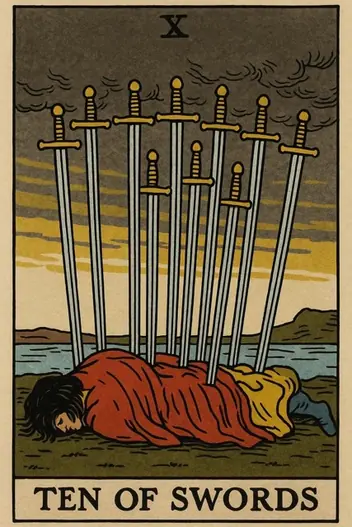
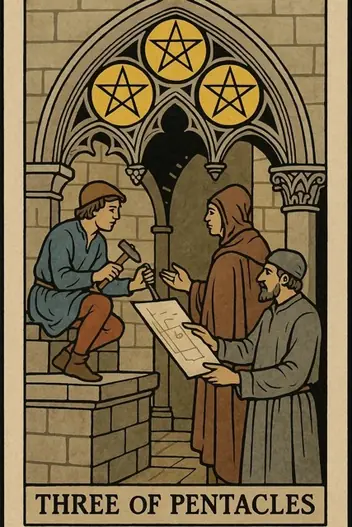
When the Ten of Swords meets the Three of Pentacles, we witness a psychological pivot from catastrophic ending to meticulous reconstruction. The Ten of Swords represents a painful conclusion—often a betrayal, failure, or rock-bottom moment that forces a complete mental reset. The Three of Pentacles, in stark contrast, embodies collaboration, skill-building, and disciplined craftsmanship. Together, they suggest that the ego’s "death" (Ten of Swords) creates the necessary space for humble, practical work (Three of Pentacles). This is not a card of instant recovery, but of methodical healing through action.
Psychologically, this pairing activates the Wounded Healer archetype: someone who transforms personal trauma into professional expertise. The pain is not ignored or spiritualized away—it is examined, cataloged, and then used as raw material for a new project or relationship. The key insight here is that the most devastating endings often provide the clearest blueprints for what to build next.
Ten of Swords and Three of Pentacles: How These Energies Interact
The core dynamic of this combination is a shift from victimhood to craftsmanship. The Ten of Swords often leaves a person feeling paralyzed, betrayed, or unfairly targeted. The Three of Pentacles demands that they pick up their tools and join a team. This is an uncomfortable transition: one moment you are lying on the ground, the next you are being asked to contribute to a shared goal. The psychological bridge between these states is cognitive reframing—choosing to see the "death" not as an end, but as an initiation into a more competent version of yourself.
In practical terms, this pairing often appears when someone has just experienced a professional failure, a public humiliation, or the end of a long-term project. Instead of retreating into isolation, the Three of Pentacles urges them to seek out mentors, join a mastermind group, or accept help from a skilled colleague. The energy is not about grand visions or new beginnings; it is about showing up, doing the work, and trusting the process. The most important takeaway is that recovery is a collaborative skill, not a solo act of willpower.
This combination also warns against the trap of over-intellectualizing pain. The Ten of Swords is a mental card (Swords), and the Three of Pentacles is a practical card (Pentacles). If you spend too long analyzing the "why" of your failure, you will miss the "how" of rebuilding. The cards demand that you stop narrating the story of your defeat and start drafting the plan for your next project.
Your pair is already on the table. Ask your question and draw the clarifying card
or simply focus on it
Ten of Swords and Three of Pentacles as Feelings
If you are single:
This combination suggests that a recent heartbreak or rejection is actually clearing the way for a more grounded partnership. Don't look for a savior; look for a collaborator. Focus on shared interests, practical compatibility, and mutual respect rather than dramatic chemistry.
If you are in a relationship:
You and your partner may be recovering from a serious conflict or breach of trust. The healing process requires shared labor, not just apologies. Work on a joint project—renovating a room, planning a budget, or learning a new skill together.
In relationships, the Ten of Swords and Three of Pentacles together indicate a post-crisis phase where the relationship is being rebuilt from the ground up. This is not about romance or passion; it is about functional repair. The betrayed partner (Ten of Swords) must be willing to engage in the tedious work of rebuilding trust, while the offending partner must demonstrate consistent, skilled effort. Emotional intelligence here means recognizing that trust is not restored through words, but through repeated, reliable actions. The relationship will survive only if both parties can shift from a narrative of "what went wrong" to a plan for "how we work together now."
Key relationship advice in bold:
Do not rush the healing process. The Three of Pentacles requires time, patience, and a shared blueprint. If you try to skip to the "happy ending" without doing the work, the Ten of Swords will repeat.
Your unique Tarot reading
See how these cards interact with your destiny. Start a free personal reading now.
Ten of Swords and Three of Pentacles in Career Readings
Strategic Opportunities:
Use a recent failure as a case study. Document what went wrong and present it as a learning tool to your team. This reframes your "lowest point" as a valuable asset.
Strategic Opportunities:
Seek out a mentor or a collaborative project. Your credibility may be damaged, but your willingness to learn and contribute will rebuild it faster than any solo effort.
Calculated Risks:
Avoid taking on a leadership role too soon. The energy here is about being a team player, not a hero. Overreaching now could trigger another collapse.
In a career context, this combination is a powerful indicator of professional reinvention after a major setback. You may have been fired, made a costly error, or been publicly criticized. The Three of Pentacles advises you to return to the fundamentals: improve your skills, ask for feedback, and contribute to a team effort without demanding credit. This is a time for humility and competence, not for ego-driven ambition. Financially, the message is clear: do not make big investments or risky moves. Focus on stable, incremental income—a side project, a consulting gig, or a part-time role that rebuilds your cash flow and your reputation.
The psychological key here is separating your identity from your failure. The Ten of Swords can make you feel like a "loser," but the Three of Pentacles reminds you that your skills are still valuable. The most strategic move is to join a group where your expertise is needed, even if it means taking a demotion or a pay cut. Over the next 3-6 months, your focus should be on consistency, reliability, and collaboration.
The Shadow Side of Ten of Swords and Three of Pentacles
The shadow side of this combination manifests as compulsive overworking or perfectionism as a defense mechanism. Instead of processing the emotional pain of the Ten of Swords, the seeker may bury themselves in the busywork of the Three of Pentacles. This leads to burnout, resentment, and a hollow sense of accomplishment. You might appear productive, but you are actually avoiding the real work of grieving and learning from the failure.
Another common pitfall is seeking false validation through collaboration. The seeker may join a team or project not because it aligns with their values, but because they need external approval to feel "good enough" again. This creates a dependency on others' opinions that is fragile and unsustainable. The cognitive bias at play here is the halo effect: assuming that because you are working hard with others, you are automatically healing. In reality, you may just be distracting yourself from the difficult inner work.
Finally, there is a risk of over-identifying with the role of "the survivor." The seeker may start to romanticize their pain, telling the story of their "rock bottom" as a badge of honor. This turns the Three of Pentacles into a performance of recovery, rather than a genuine process. Authentic growth requires you to eventually stop talking about the past and simply focus on the present work.
Ten of Swords and Three of Pentacles Reversed: What Changes?
If the Ten of Swords is Reversed:
The crisis is prolonged or denied. You refuse to acknowledge the end, clinging to illusions. Risk: wasting resources on a lost cause. Advice: The upright Three of Pentacles demands an honest audit — acknowledge the loss so you can begin to rebuild.
If the Three of Pentacles is Reversed:
Internal resistance to work and the plan. You know what needs to be done, but you sabotage the process out of fear or laziness. Weakness: an inability to ask for help or ignoring the experience of others. Advice: The upright Ten of Swords is the blow that has already struck you. The reversed Three of Pentacles means you are refusing the only lifeline — systematic work.
If BOTH are Reversed:
Complete imbalance and chaos. The crisis is unacknowledged, and there is no plan for escape. This is a state of "suspension" between the past and the future. Method for Correction: Artificially create structure. Start small: write down three concrete actions for the day. Regain control through discipline, even if it seems meaningless. The main thing is to break the cycle of inaction.
Overall Meaning of Ten of Swords and Three of Pentacles
Constructive use of the Ten of Swords' energy in alliance with the Three of Pentacles requires cold pragmatism. Your task is to acknowledge that the "old world" has been destroyed (Ten of Swords) and immediately switch into "architect and builder" mode (Three of Pentacles). Do not waste time mourning losses—use them as raw material for a new project. Every mistake is a blueprint. Every pain is an instruction on "how not to do it."
A deep strategic advice: apply the principle of "divide and restore." Break down the consequences of the crisis into separate tasks. For example, if it's a relationship breakup, one task is to sort out financial obligations, another is to reassess your social circle, and a third is to work with a psychologist on behavioral patterns. The Three of Pentacles does not tolerate chaos—it demands specialization and phased progression. The Ten of Swords gives you permission to end. The Three of Pentacles gives you the tool to begin. Combine them, and you will achieve not just an escape from the crisis, but a qualitative leap in development.
Your Next Step: Personal Context Matters
The Ten of Swords and Three of Pentacles together deliver a stark but hopeful message: your worst moment is not your final chapter. The pain you carry is real, but it is also the raw material for a more grounded, capable version of yourself. The path forward is not about transcendence or magic—it is about showing up, learning, and working alongside others. The question is not "Why did this happen?" but "What am I building next?"
To fully understand how this combination applies to your specific situation—your relationship, your career, or your personal crisis—you need a reading that accounts for your unique context. The Fortune Cards app offers deep, personalized interpretations of this exact card pairing for your exact question. Use it on the web or download it now to get a tailored analysis that turns this general advice into a concrete action plan for your life.
Interpretation by the Fortune Cards editorial team, based on the Rider–Waite tradition and Jungian archetypes. About our methodology · Updated: 2026-09-17
Other Combinations with Ten of Swords
Other Combinations with Three of Pentacles
Explore Individual Card Meanings
Table of Contents
- Ten of Swords and Three of Pentacles: How These Energies Interact
- Ten of Swords and Three of Pentacles as Feelings
- Ten of Swords and Three of Pentacles in Career Readings
- The Shadow Side of Ten of Swords and Three of Pentacles
- Ten of Swords and Three of Pentacles Reversed: What Changes?
- Overall Meaning of Ten of Swords and Three of Pentacles
- Your Next Step: Personal Context Matters
Ready to find answers to your questions?
Start your first reading now and look at your situation with fresh clarity. The cards are ready to reveal deeper meaning.