Four of Cups and Three of Pentacles Tarot Combination
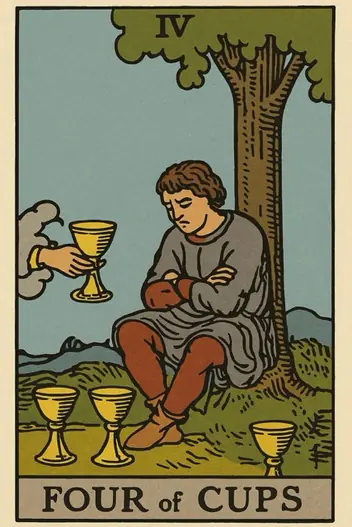

- Arcana
- Four of Cups — Minor Arcana, Cups; Three of Pentacles — Minor Arcana, Pentacles
- Elements
- Four of Cups — Water; Three of Pentacles — Earth
- Elemental interaction
- Friendly elements — energies support each other
- Numerology
- 4 + 3 = 7
The Four of Cups archetype embodies a state of emotional withdrawal, apathy, or missed opportunity—a sense that what is being offered is not enough. The Three of Pentacles, in contrast, represents mastery, collaboration, and the disciplined building of a skill or project. When these two cards collide, we see a specific psychological tension: the seeker has access to a path of growth and tangible success, yet they are reluctant to engage because it doesn't meet an unspoken emotional need. This combination often surfaces when a person is underestimating the value of consistent effort or rejecting a viable team dynamic due to internal dissatisfaction.
This is not a card pair of dramatic conflict, but of quiet stagnation. The Four of Cups says "I am not interested," while the Three of Pentacles asks "Can you see the work that is already being done?" The core challenge here is bridging the gap between emotional fulfillment and practical achievement. The seeker must decide whether to invest in the mundane steps of progress or remain in a state of passive resistance.
Four of Cups and Three of Pentacles: How These Energies Interact
The psychological state created by Four of Cups and Three of Pentacles is one of ambivalent competence. On one hand, the Three of Pentacles indicates that the seeker likely has the skills, resources, or a supportive team to move forward. On the other hand, the Four of Cups suggests a deep-seated reluctance to accept the current offer or path. This is not a lack of ability, but a crisis of meaning—the seeker may feel that the work is beneath them, or that they are not receiving the recognition they deserve.
In real-world terms, this often manifests as rejecting a job offer because it feels "too simple," ignoring a mentor's advice because it feels patronizing, or withdrawing from a collaborative project because the emotional payoff isn't immediate. The key insight here is that the Four of Cups energy is a defense mechanism—a way to protect the ego from disappointment by rejecting the opportunity before it can fail. The Three of Pentacles energy offers a counterbalance: it demands that you show up, do the work, and trust the process.
To move forward, the seeker must confront their own entitlement or boredom. The cards ask: Is your dissatisfaction truly about the quality of the opportunity, or about an unmet internal standard? Practical action is the antidote to apathy. Even a small, committed step toward the project can break the spell of emotional withdrawal.
Four of Cups and Three of Pentacles as Feelings
If you are single:
This pair suggests you may be dismissing a potential partner because they seem "too ordinary" or "too available." The Three of Pentacles indicates this person has stable qualities and is willing to invest effort, but your Four of Cups energy is causing you to overlook their value. Ask yourself: are you bored, or are you afraid of being disappointed?
If you are in a relationship:
The dynamic here often involves one partner feeling unappreciated or taken for granted (Three of Pentacles), while the other partner withdraws emotionally (Four of Cups). The Four of Cups partner may feel the relationship has become "routine" or lacks excitement, while the Three of Pentacles partner is focused on building a stable life together.
In relationship dynamics, this combination points to a disconnect between effort and appreciation. The Three of Pentacles partner is actively contributing—whether through chores, emotional support, or financial planning—but the Four of Cups partner is failing to acknowledge these contributions because they are fixated on what they perceive as missing. This is a classic "grass is greener" scenario. The psychological work here is to shift from passive dissatisfaction to active gratitude. Bold key relationship advice: If you feel bored, investigate the boredom. It is often a mask for unexpressed needs or unrealistic expectations. The solution is not to leave, but to communicate what you truly want, while also recognizing the value of what is already being built.
Your pair is already on the table. Ask your question and draw the clarifying card
or simply focus on it
Four of Cups and Three of Pentacles in Career Readings
Strategic Opportunities:
Accept the project, even if it feels beneath you. The Three of Pentacles rewards consistent, collaborative effort. Your boredom may be a sign that you need to learn more, not that you need to leave.
Strategic Opportunities:
Ask for feedback from a mentor or colleague. The Four of Cups often isolates you; the Three of Pentacles thrives on input. Use external perspective to see the value you are missing.
Calculated Risks:
Avoid rejecting an offer out of hand due to ego or pride. The real risk here is burning a bridge with a reliable team or client because you are chasing a fantasy of "perfect" work.
In a career context, this combination is a powerful warning against professional complacency disguised as discontent. You may be in a role where you are competent but under-challenged, and your mind is telling you to leave. However, the Three of Pentacles suggests that the solution is often to deepen your involvement, not to abandon the structure. Ask for more responsibility, train a junior colleague, or propose a new initiative. Bold important financial warning: The Four of Cups can lead to missed financial opportunities. If you reject a stable income stream because it feels "boring," you may find yourself in a less secure position later. The smart play is to use the current platform to build leverage—learn a new skill, network, or save capital—while you still have the safety net.
The Shadow Side of Four of Cups and Three of Pentacles
The shadow side of this pairing is self-sabotage through passive resistance. The seeker may convince themselves that they are "too good" for the work, or that the opportunity is "not meant for them," when in reality they are avoiding the discomfort of effort. This is a cognitive bias known as the "illusion of uniqueness" —the belief that one's situation is so special that ordinary rules don't apply. In practice, this leads to procrastination, missed deadlines, and strained professional relationships.
Another pitfall is resentment toward those who are actively working. The Four of Cups energy can cause the seeker to judge others for being "too focused on the details" or "too eager," while the Three of Pentacles energy is actually the path to mastery. This is a dangerous form of emotional superiority. The seeker must watch for signs of cynicism, withdrawal from group efforts, or a tendency to criticize without contributing. The antidote is humility and engagement—acknowledging that even tedious work has value, and that collaboration requires showing up, even when you don't feel inspired.
Uncover hidden insights
Let our advanced Tarot system interpret these archetypes specifically for your personal path.
Four of Cups and Three of Pentacles Reversed: How to Read It
If the Four of Cups is reversed:
Apathy shifts to an impulsive craving for novelty. Risk of abandoning what you've started for a fleeting interest. Advice: Don't burn bridges until you've completed your current project to 80%.
If the Three of Pentacles is reversed:
Points to chaos in projects and a refusal to learn. You don't want to study or listen to experts. Warning: Your overconfidence will lead to shoddy work. Return to the basics.
If BOTH are reversed:
Complete imbalance — you are simultaneously irritated with your current situation and sabotaging any attempts to fix it. The only way to correct this is an external deadline or mentor who will force you to act, ignoring your internal state.
Overall Meaning of Four of Cups and Three of Pentacles
Constructive use of this energy requires a shift in focus from "why I don't want this" to "how I can do this better". The Four of Cups is a signal that your emotional battery is drained. The Three of Pentacles is an instruction for recharging through action and mastery. The paradox is that inspiration comes not before work, but during it.
Your strategy is to break the big task into micro-steps. Don't try to love the entire project. Find one detail within it that you can improve. This activates the archetype of the Master (Three of Pentacles) and provides a sense of control that reduces apathy. A deep strategic counsel: use the Four of Cups as a filter for insincere offers, and the Three of Pentacles as a tool for creating value where you already are. Don't seek the perfect job—make your current one a step toward it.
Applying This to Your Situation
The core message of Four of Cups and Three of Pentacles is this: Your dissatisfaction may be a signal to deepen your commitment, not to walk away. The work is already in front of you—the question is whether you have the courage to see its value and the discipline to engage. This combination asks you to replace passive judgment with active participation. The path to fulfillment is not found by waiting for a better offer, but by investing in the present opportunity with focus and intention.
Ready to see exactly how this applies to your unique situation? While this article gives you the universal archetype, the true power of Tarot comes from personalized context. The Fortune Cards app allows you to input your specific question—about a relationship, a career move, or a personal block—and receive a deep, tailored interpretation of this exact card combination. Don't rely on generic meanings. Get the insight that speaks directly to your life. Use the app on the web or download it now to unlock your personalized reading.
Interpretation by the Fortune Cards editorial team, based on the Rider–Waite tradition and Jungian archetypes. About our methodology · Updated: 2026-10-15
Other Combinations with Four of Cups
Other Combinations with Three of Pentacles
Explore Individual Card Meanings
Table of Contents
- Four of Cups and Three of Pentacles: How These Energies Interact
- Four of Cups and Three of Pentacles as Feelings
- Four of Cups and Three of Pentacles in Career Readings
- The Shadow Side of Four of Cups and Three of Pentacles
- Four of Cups and Three of Pentacles Reversed: How to Read It
- Overall Meaning of Four of Cups and Three of Pentacles
- Applying This to Your Situation
Ready to find answers to your questions?
Start your first reading now and look at your situation with fresh clarity. The cards are ready to reveal deeper meaning.