Five of Wands and Four of Cups Meaning in Tarot
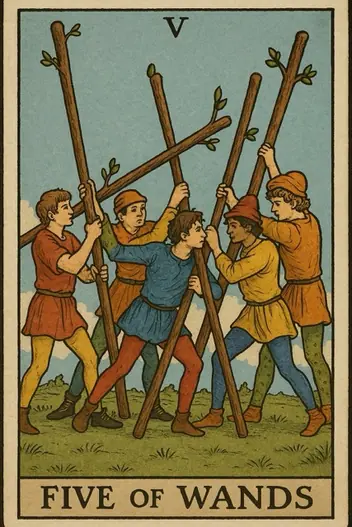

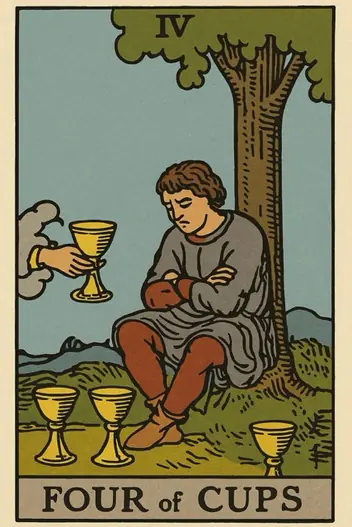
- Arcana
- Five of Wands — Minor Arcana, Wands; Four of Cups — Minor Arcana, Cups
- Elements
- Five of Wands — Fire; Four of Cups — Water
- Elemental interaction
- Opposing elements — energies create tension
- Numerology
- 5 + 4 = 9
When the Five of Wands—a card of competitive friction, scattered energy, and ego-driven clashes—meets the Four of Cups—a card of emotional withdrawal, apathy, and missed opportunities—the result is a peculiar psychological paradox. You are simultaneously overwhelmed by external conflict and disconnected from your own desires. This isn't simply a "bad" combination; it is a signal of cognitive dissonance where you fight battles you no longer care about.
Psychologically, this pair often emerges when a person is stuck in a loop of reactive behavior without clear intention. The Five of Wands represents the noise of daily life: arguments, deadlines, competing priorities. The Four of Cups represents the mind's defense mechanism—shutting down to avoid feeling the stress. The danger is that you mistake exhaustion for clarity, withdrawing from situations that actually require decisive action. The strategic insight here is to differentiate between conflicts worth engaging and those that are merely distractions from a deeper dissatisfaction.
Five of Wands and Four of Cups: How These Energies Interact
The core tension between the Five of Wands and Four of Cups is the battle between action and inertia. The Five of Wands pushes you into the arena, forcing you to compete, assert yourself, and defend your position. The Four of Cups pulls you back into a state of emotional neutrality, where nothing seems worth the effort. This creates a psychological stalemate: you are too tired to fight effectively, but too restless to truly rest.
In practical terms, this combination often appears when you are engaging in conflict for the wrong reasons. You might be arguing out of habit rather than conviction, or competing in areas that no longer align with your values. The Four of Cups asks you to pause and examine why you are fighting. Are you defending a principle, or just defending your ego? The key insight is that not all battles are necessary, and not all withdrawals are wise. The wise path is to conserve your energy for conflicts that matter and to actively disengage from those that don't.
This dynamic also highlights a tendency toward passive-aggression. Instead of directly addressing a problem, you may withdraw (Four of Cups) while simultaneously fueling resentment or subtle competition (Five of Wands). Recognize this pattern: it drains your resources without resolving the underlying issue. The healthier approach is to choose one stance consciously—either engage fully with clear boundaries, or disengage completely to reassess your priorities.
Five of Wands and Four of Cups Love Outcome
If you are single:
This combination warns against pursuing connections out of boredom or competition. You may be drawn to someone simply because they are "hard to get" or because others are interested. Ask yourself: is this genuine attraction, or just the thrill of the chase?
If you are in a relationship:
You may be withdrawing emotionally while engaging in petty arguments. The Four of Cups suggests you feel disconnected, but instead of communicating this, you find fault in small issues (Five of Wands). This creates a cycle of distance and conflict.
In relationships, the Five of Wands and Four of Cups often signal a power struggle masked by emotional apathy. One partner may feel neglected (Four of Cups) while the other feels attacked (Five of Wands). The result is a lack of genuine connection—you are physically present but emotionally checked out. The most important relationship advice here is to stop pretending you don't care. If you are withdrawing, name it. If you are frustrated, say it directly. Avoid the trap of using silence as a weapon or conflict as a cry for attention. Instead, schedule a neutral time to discuss your underlying needs without blame. The goal is not to win the argument, but to understand why you are arguing at all.
Your pair is already on the table. Ask your question and draw the clarifying card
or simply focus on it
Five of Wands and Four of Cups in Career Readings
Strategic Opportunities:
Use this energy to renegotiate your role or boundaries at work. The conflict (Five of Wands) can clarify what you truly want, while the apathy (Four of Cups) helps you let go of what doesn't matter.
Strategic Opportunities:
This is an ideal time to delegate or automate tasks that drain your energy. Focus only on high-impact work that aligns with your long-term goals.
Calculated Risks:
Avoid making major financial decisions while feeling disconnected. The Four of Cups can lead to missed opportunities (e.g., ignoring a good investment) or impulsive spending to escape boredom. Do not quit your job out of sheer frustration without a concrete plan.
Professionally, this combination often signals burnout or misalignment. You may be fighting for a promotion, project, or recognition that, deep down, you no longer value. The Five of Wands represents the daily grind—office politics, competition with peers, conflicting deadlines. The Four of Cups warns that you are becoming numb to your own ambition. To break this cycle, audit your workload and priorities. Identify which tasks are truly necessary and which are just noise. A critical financial warning: if you feel "meh" about a business deal or investment, do not proceed. This combination often precedes costly mistakes made out of indifference. Instead, take a temporary step back—delegate the conflicts, ignore the distractions, and focus only on what genuinely moves you forward.
Five of Wands and Four of Cups Reversed Meaning
Reversed cards in this pair shift the dynamic from external struggle to internal crisis, or conversely, to an unexpected breakthrough.
If the Five of Wands is reversed:
The conflict goes underground. Instead of open struggle, passive aggression, sabotage, and hidden rivalry emerge. This is a more dangerous form, as the energy finds no outlet and destroys from within. Advice: conduct an "inventory of grievances" and bring unresolved issues into the open.
If the Four of Cups is reversed:
Apathy gives way to an impulsive desire to escape reality. A person may abruptly quit their job or relationship without a Plan B. This is an "all or nothing" reaction that often leads to even greater problems. Warning: avoid rash decisions in the midst of emotional exhaustion.
If BOTH are reversed:
A complete imbalance arises — neither struggle nor resource. The person is in a state of total stupor and denial. This is the most severe scenario, requiring external intervention. Recommendation: seek professional help (coach, psychologist), as it is nearly impossible to break out of this cycle on your own.
Get a personalized interpretation
Unlock the combined meaning of your cards in the context of your unique question — for free.
The Shadow Side of Five of Wands and Four of Cups
The shadow of this combination is self-sabotage through disengagement. When these energies are blocked or misdirected, you may find yourself creating conflict just to feel something, or withdrawing so completely that you miss critical information. A common cognitive bias here is the sunk cost fallacy: you continue fighting a losing battle because you've already invested so much, even though you no longer care about the outcome. Another pitfall is emotional avoidance disguised as stoicism—convincing yourself that you "don't care" when in reality you are afraid of losing.
The worst case scenario with this pair is a cycle of resentment and passive resistance. You may start to blame others for your dissatisfaction (Five of Wands) while refusing to take action (Four of Cups). This leads to stagnation, missed opportunities, and damaged relationships. The shadow path is to become the "difficult" person who is simultaneously combative and unresponsive. To avoid this, practice radical honesty with yourself about what you actually want. If you don't know, that's okay—but admit it. The goal is to stop pretending that your withdrawal is wisdom when it is actually fear.
Overall Meaning of Five of Wands and Four of Cups
Constructive use of this combination requires a radical revision of strategy. The energy of the Five of Wands is a powerful fuel resource, but without a meaningful goal, it leads to burnout. Your task is to use conflict not as an end in itself, but as a diagnostic tool. Each skirmish should answer the question: "What exactly am I defending, and why is this valuable to me?"
The Four of Cups in this pair plays the role of a "red warning light", signaling the need to stop. If you feel apathy and indifference toward the outcomes of your struggle, this is not laziness, but a protective mechanism of the psyche. It indicates that your current goals are not your true ones. The deep strategic advice: conduct an audit of your "battlefields". List all areas of life where you feel competition or conflict, and rate them on a scale of "importance to me" from 1 to 10. Anything below 7 should either be delegated or abandoned. This will free up energy for truly meaningful goals.
Key takeaway: not every battle is worth fighting, especially if you can't remember why you started the war.
Applying This to Your Situation
The Five of Wands and Four of Cups together deliver a clear message: stop fighting battles you don't believe in, and stop withdrawing from decisions you need to make. The path forward requires you to choose your stance deliberately—either engage with full intention or disengage with clarity. This combination is not a verdict; it is a call to align your actions with your values. The core message is that your energy is finite, and how you spend it determines your future.
Ready to see what this combination means for your specific situation? While this article explains the general archetype, the true power of Tarot lies in personal context. The Fortune Cards app offers a deep, personalized interpretation of this exact card pair for your unique question—whether it’s about love, career, or personal growth. You can use it on the web or download it now to get immediate, actionable insights tailored to your life. Stop guessing; start understanding.
Interpretation by the Fortune Cards editorial team, based on the Rider–Waite tradition and Jungian archetypes. About our methodology · Updated: 2026-08-26
Other Combinations with Five of Wands
Other Combinations with Four of Cups
Explore Individual Card Meanings
Table of Contents
- Five of Wands and Four of Cups: How These Energies Interact
- Five of Wands and Four of Cups Love Outcome
- Five of Wands and Four of Cups in Career Readings
- Five of Wands and Four of Cups Reversed Meaning
- The Shadow Side of Five of Wands and Four of Cups
- Overall Meaning of Five of Wands and Four of Cups
- Applying This to Your Situation
Ready to find answers to your questions?
Start your first reading now and look at your situation with fresh clarity. The cards are ready to reveal deeper meaning.