The Fool and Five of Wands Reversed in Tarot
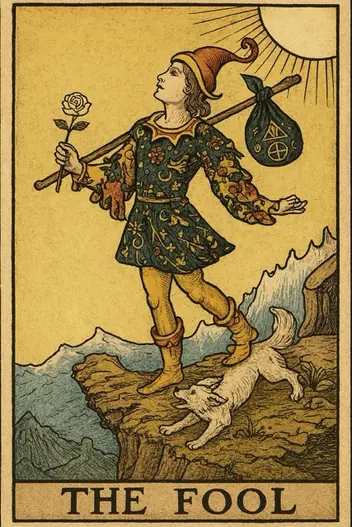

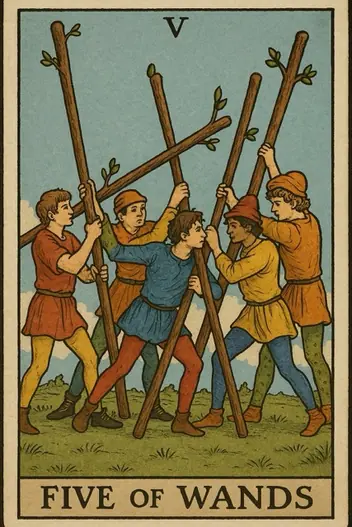
- Arcana
- The Fool — Major Arcana; Five of Wands — Minor Arcana, Wands
- Elements
- The Fool — Air; Five of Wands — Fire
- Elemental interaction
- Friendly elements — energies support each other
- Numerology
- 0 + 5 = 5
When the boundless optimism of The Fool collides with the chaotic friction of the Five of Wands, you get a psychological state of high-stakes experimentation. The Fool represents a leap into the unknown, unburdened by past experience or fear of failure. The Five of Wands, however, introduces immediate opposition, competition, or scattered energy. This is not a gentle combination; it is the tension between a pure, unformed idea and the messy reality of having to fight for it. The seeker is likely walking into a situation where their naive enthusiasm will be tested, challenged, and forced to adapt. The core question here is: Are you being brave, or are you being reckless?
This pairing often appears when a person is about to launch a new venture, start a relationship, or make a significant life change, but they are doing so into a field of conflict. The Five of Wands suggests that the path forward is not clear—it is crowded, noisy, and full of competing voices. The Fool’s energy says "just go," but the Five of Wands demands that you first clarify your position. Psychologically, this creates a cognitive dissonance: the desire for pure freedom versus the reality of needing to compete for space. The healthy response is to channel the Fool’s courage into strategic assertiveness, not blind aggression.
The Fool and Five of Wands Together: Meaning
The psychological state of this combination is best described as "optimistic friction." The Fool provides the raw, unrefined motivation to start something new, while the Five of Wands provides the immediate obstacles that refine that motivation into a usable skill. This is not a warning to stop; it is a warning to prepare for resistance. In Jungian terms, this is the encounter between the Puer Aeternus (the eternal child, symbolized by The Fool) and the Shadow of Competition (the Five of Wands). The Puer wants to fly; the Shadow wants to wrestle. The result is a person who feels both exhilarated and anxious.
The key dynamic is boundary testing. The Fool does not know where the limits are, and the Five of Wands exists precisely to define them. In practice, this means the seeker will likely face situations where their initial approach is met with pushback, disagreement, or outright rivalry. This is not inherently negative. In fact, this combination often signals a necessary trial by fire that will sharpen the seeker’s instincts and clarify their true intentions. The danger is that the Fool’s lack of foresight leads to entering a conflict that could have been avoided with better planning. The strategic move is to embrace the chaos as a training ground, not a battlefield.
The Fool and Five of Wands in Love and Relationships
If you are single:
This combination suggests you are attracted to someone who presents a challenge—perhaps they are argumentative, unavailable, or part of a competitive social circle. Be wary of mistaking conflict for chemistry. The thrill of the chase may be clouding your judgment.
If you are in a relationship:
You or your partner may be starting a new chapter (e.g., moving in, having a child, changing jobs) that is creating friction. The energy is not malicious, but it is chaotic. Expect disagreements over logistics, values, or roles.
In relationships, this pair often indicates a power struggle disguised as excitement. The Fool wants to explore and experiment; the Five of Wands wants to dominate or debate. This can lead to passionate but volatile dynamics. The psychological driver here is often a fear of intimacy—the Fool avoids commitment by constantly seeking novelty, while the Five of Wands uses conflict to create distance. The healthy path is to recognize that not every disagreement is a threat. Instead, channel the competitive energy into collaborative problem-solving. Set clear boundaries about what is a healthy debate and what is an attack. If you are single, ask yourself: Is this person actually a good match, or am I just addicted to the adrenaline of the chase?
Your pair is already on the table. Ask your question and draw the clarifying card
or simply focus on it
The Fool and Five of Wands for Career and Money
Strategic Opportunities:
Pursue roles or projects that require rapid problem-solving and high adaptability. Startups, crisis management, or creative fields where conflict is a catalyst for innovation are ideal.
Strategic Opportunities:
Use the Fool’s optimism to pitch bold, unconventional ideas. The Five of Wands energy means you will face skepticism, but that resistance can validate your idea if you can defend it.
Calculated Risks:
Avoid entering a saturated market or a hostile workplace without a clear differentiator. Do not assume your enthusiasm alone will win people over. Prepare for direct competition and have a backup plan.
In a professional context, this combination is a double-edged sword for career growth. On one hand, it is the energy of the disruptive innovator—someone who enters a field, challenges the status quo, and forces change. On the other hand, it is the energy of the naive entrepreneur who burns through capital and goodwill because they refuse to listen to feedback. Financially, this is a high-risk, high-reward scenario. The Fool wants to bet everything on a new idea; the Five of Wands warns that others are betting against you. The pragmatic approach is to test your idea on a small scale first. Use the competitive energy to refine your offering, not to exhaust your resources. Consider this a "beta test" phase, not a full launch.
Ask your specific question
Don't rely on generic meanings. Get a customized reading tailored specifically to your energies.
The Fool and Five of Wands Reversed: What Changes?
If The Fool is reversed, potential is blocked by fear. You want to start a new venture but are afraid of looking foolish. Paired with the Five of Wands, this creates passive-aggressive behavior: you avoid direct confrontation but sabotage the actions of others. Warning: do not mistake indecisiveness for wisdom. You need to consciously take the first, even if awkward, step.
If the Five of Wands is reversed, external struggle turns inward. This is internal resistance, self-criticism, and guilt. You are not fighting the world, but fighting yourself. Advice: stop the internal debate. The Fool in the upright position says that action is more important than the perfect plan. You simply need to start, and the inner doubts (reversed Five) will only subside in the process.
If BOTH cards are reversed, a complete imbalance sets in. This is a state of paralysis of the will. You cannot move forward (reversed Fool) and cannot assert your interests (reversed Five). The logical way to correct this is to lower the bar of expectations. You don't need to "start a great undertaking," but simply take one small, concrete action that you have been putting off for a long time. This will activate the mechanism of The Fool and give you the first "victory" to break out of the stupor.
The Shadow Side of The Fool and Five of Wands
The shadow of this combination is impulsive aggression. The Fool’s lack of caution combined with the Five of Wands’ combative energy can create a person who starts fights for the sake of feeling alive. This manifests as cognitive bias known as the "Dunning-Kruger effect"—the seeker overestimates their competence and underestimates the complexity of the situation. They may burn bridges, alienate allies, and create unnecessary enemies. The deeper psychological trap is self-sabotage through chaos. If the seeker fears success or commitment, they may unconsciously create conflict to justify retreat. Watch for patterns of starting projects with great enthusiasm, only to abandon them when the first real obstacle appears. The shadow here is not the conflict itself, but the inability to learn from it.
Overall Meaning of The Fool and Five of Wands
The constructive use of The Fool and Five of Wands energy requires a shift in mindset from "blind leap" to "calibrated charge." The Fool’s gift is the courage to begin; the Five of Wands’ gift is the pressure to improve. To synthesize these forces, you must become a strategic amateur—someone who enters new territory with humility, but also with a clear plan for how to handle resistance. The key is to separate your ego from your idea. When the Five of Wands brings opposition, do not take it personally. Instead, treat it as data. Every competitor, every critic, every obstacle is refining your path.
Practically, this means adopting an iterative, experimental approach. Do not commit all your resources to a single, grand launch. Instead, enter the arena small, observe the dynamics, and adjust. Use the Fool’s optimism to keep going, but use the Five of Wands’ conflict to sharpen your strategy, not your anger. If you are in a relationship, use disagreements to understand your partner better, not to win. If you are in a career, use competition to identify your unique value, not to destroy others. The ultimate psychological lesson is that freedom is not the absence of obstacles; it is the mastery of them. This combination invites you to become a person who can hold both the excitement of a new beginning and the grit of a hard fight, and emerge stronger for it.
Interpretation by the Fortune Cards editorial team, based on the Rider–Waite tradition and Jungian archetypes. About our methodology · Updated: 2026-08-26
Other Combinations with The Fool
Other Combinations with Five of Wands
Explore Individual Card Meanings
Table of Contents
Ready to find answers to your questions?
Start your first reading now and look at your situation with fresh clarity. The cards are ready to reveal deeper meaning.