Love Tarot: The Fool and Three of Swords
- Arcana
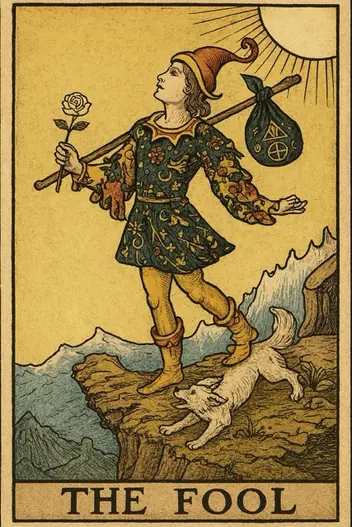
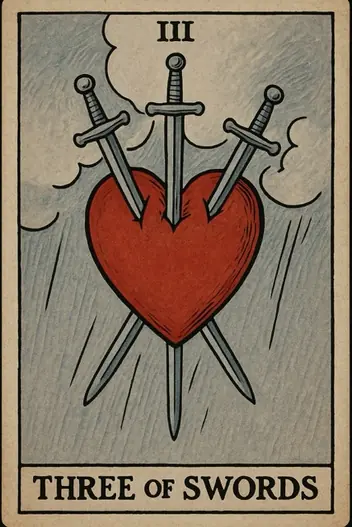
- The Fool — Major Arcana; Three of Swords — Minor Arcana, Swords
- Elements
- The Fool — Air; Three of Swords — Air
- Elemental interaction
- Same element — energies intensify each other
- Numerology
- 0 + 3 = 3
These two archetypes create a powerful tension. The Fool represents a fresh start, blind optimism, and a leap of faith into the unknown. The Three of Swords represents heartbreak, painful truth, and the mental clarity that comes from suffering. When combined, they describe a situation where a naive or hopeful beginning is directly confronted by a harsh reality. This is not a passive card pairing; it demands a conscious decision. You must choose whether to retreat from the pain or to integrate the lesson and continue your journey with newfound wisdom.
The Fool and Three of Swords Combination Meaning
The core psychological dynamic here is the collision between idealistic naivety and necessary disillusionment. The Fool energy wants to move forward with pure intention, ignoring red flags or past trauma. The Three of Swords energy forces a painful reckoning. This often manifests as a "betrayal of trust" that occurs right at the start of a new venture or relationship. The key insight is that this pain is not a punishment, but a corrective signal. Your subconscious is forcing you to see what your conscious mind refused to acknowledge.
This combination often appears when you have been overly trusting or reckless in a way that now feels foolish. The Three of Swords acts as a sharp, surgical cut, severing the illusion that everything will work out without effort or caution. The strategic move is not to become cynical, but to develop a "pragmatic optimism." You must keep the Fool's courage but add the Swords' capacity for critical analysis. Ask yourself: "What truth am I avoiding, and how can I accept it without losing my forward momentum?" The answer is to treat the heartbreak as data, not as a verdict on your worth.
Your pair is already on the table. Ask your question and draw the clarifying card
or simply focus on it
Love and Relationships
If you are single:
This pairing warns against projecting a fantasy onto a new person. A promising first date or initial attraction may be hiding a fundamental incompatibility or a past wound they are not ready to heal. Do not ignore small inconsistencies.
If you are in a relationship:
You or your partner may have made a "leap of faith" (moving in together, getting engaged) that is now revealing a deep-seated betrayal or a painful truth that was previously hidden. This is a critical moment for radical honesty.
In a relationship context, The Fool and Three of Swords points to a crisis of trust. One partner may have acted impulsively (The Fool), and the other is now feeling the sharp sting of betrayal or disappointment (Three of Swords). The psychological work here is to distinguish between a genuine mistake and a pattern of self-sabotage. Do not rush to forgive without understanding the root cause. The relationship can survive only if both parties are willing to walk through the pain together, using the conflict as a catalyst for deeper intimacy. The ultimate relationship advice here is to stop pretending the wound isn't there. Acknowledge the hurt, set a new boundary, and then decide if the journey is still worth taking.
What Do The Fool and Three of Swords Indicate for Your Career?
Strategic Opportunities:
This is a moment to audit your professional assumptions. A failed project or a critical piece of feedback (Three of Swords) can reveal a flaw in your business plan or career strategy that you were too optimistic to see. Use this pain to pivot with precision.
Strategic Opportunities:
The combination suggests that a "naive" risk you took is now paying off with a painful but valuable lesson. This is an opportunity to build a more resilient career foundation. The lesson is worth more than the immediate loss.
Calculated Risks:
Do not make any major financial commitments or career changes while feeling wounded or betrayed. The Fool's impulsivity combined with Three of Swords' emotional pain can lead to a "revenge spending" or a rash decision to quit a job. Wait 72 hours before acting.
Professionally, this is a high-risk, high-insight pairing. It often appears when you have started a new job, project, or business venture with too much hope and not enough due diligence. The Three of Swords reveals the hidden flaw: a toxic boss, a dishonest partner, or a flawed market assumption. The strategic advice is to treat this as a "post-mortem" on your decision-making process. What data did you ignore? What gut feelings did you suppress? The financial warning is clear: do not double down on a losing bet just because you are emotionally invested in the original idea. Cut your losses, extract the lesson, and use that intelligence to make a smarter, more grounded next move.
Ask your specific question
Don't rely on generic meanings. Get a customized reading tailored specifically to your energies.
Reversed Positions: What Changes?
When cards appear reversed, the dynamic becomes more complex, yet also more manageable.
If The Fool is reversed:
Blocked potential or recklessness. The person either fears taking the first step (fear of making a mistake) or, conversely, acts impulsively but without awareness. In this case, the Three of Swords (upright) indicates that the pain is a consequence of inaction, not action. Advice: start small, but start, otherwise the pain of missed opportunities will be stronger.
If the Three of Swords is reversed:
Internal resistance and emotional suppression. The pain is not lived through but driven inward. The Fool (upright) here can signify an attempt to "jump over" the trauma, pretending nothing happened. This is a path to psychosomatics and repeating a negative scenario. Advice: give yourself time to grieve, do not try to "heal" with a new adventure.
If BOTH are reversed:
Complete imbalance of dynamics. The person is stuck between the fear of starting (The Fool reversed) and the unwillingness to feel pain (Three of Swords reversed). This is a state of apathy and denial. Advice: focus on one step. Acknowledge that the problem exists (activate the Three of Swords), and only then seek a new path (The Fool). Attempting to ignore both aspects leads to stagnation.
What Are the Risks of The Fool and Three of Swords?
The shadow side of this combination is masochistic optimism—a refusal to learn from pain. You may find yourself repeating the same "leap of faith" into situations that inevitably lead to heartbreak or failure. This is a cognitive bias known as the "illusion of invulnerability." You believe that because the last wound was painful, the next risk will be safe. This is a dangerous fantasy. Alternatively, the shadow can manifest as cynical paralysis. The pain from the Three of Swords completely extinguishes the Fool's spark, leaving you unable to trust or take any risk at all. You become stuck in a state of learned helplessness, believing that any new beginning will only lead to more pain. The key pitfall is confusing the lesson with the loss. The loss is temporary; the lesson is permanent. Do not throw away the lesson.
The Fool and Three of Swords Combined Message
How can the Fool's energy be used constructively to balance the pain of the Three of Swords? The answer is paradoxical: you must accept vulnerability as part of growth. The Fool teaches us to move forward, but the Three of Swords reminds us that every step can be painful. The constructive strategy is "conscious risk." Before you leap, you must acknowledge that you may fall, and prepare for it.
Practical synthesis: use the Three of Swords as a filter card for the Fool. Before starting a new project or relationship, ask yourself: "What is the worst that could happen? Can I survive it?" If the answer is "yes," then the Fool will give you the courage to act. If "no" — then the risk is unjustified. This is not about abandoning spontaneity, but about strategic naivety, where faith is backed by a plan of action.
Ultimately, this combination teaches the courage to be vulnerable. It says: you can start anew, even if your previous experience was devastating. But you must begin not from zero, but from an understanding that pain is not a punishment, but information. Your next step is not an escape from the past, but an integration of its lessons into a new beginning.
Applying This to Your Situation
The Fool and Three of Swords is a call to mature your innocence. It asks you to accept that not all new beginnings are safe, and that pain is often the price of genuine growth. Your core task is to hold the courage of The Fool while respecting the truth of the Three of Swords. This is not about becoming bitter; it is about becoming wise.
While this article provides the general archetype, the true power of Tarot lies in how it applies to your specific situation. Are you asking about a relationship, a career move, or a personal transformation? The meaning changes dramatically based on your context. Get a deep, personalized interpretation of The Fool and Three of Swords for your exact question right now. Use the Fortune Cards app on the web or download it to unlock the precise psychological insight and strategic advice you need to turn this painful moment into a powerful turning point.
Interpretation by the Fortune Cards editorial team, based on the Rider–Waite tradition and Jungian archetypes. About our methodology · Updated: 2026-08-26
Other Combinations with The Fool
Other Combinations with Three of Swords
Explore Individual Card Meanings
Table of Contents
Ready to find answers to your questions?
Start your first reading now and look at your situation with fresh clarity. The cards are ready to reveal deeper meaning.