Three of Swords and Six of Pentacles Tarot as Feelings
- Arcana
- Three of Swords — Minor Arcana, Swords; Six of Pentacles — Minor Arcana, Pentacles
- Elements
- Three of Swords — Air; Six of Pentacles — Earth
- Elemental interaction
- Opposing elements — energies create tension
- Numerology
- 3 + 6 = 9
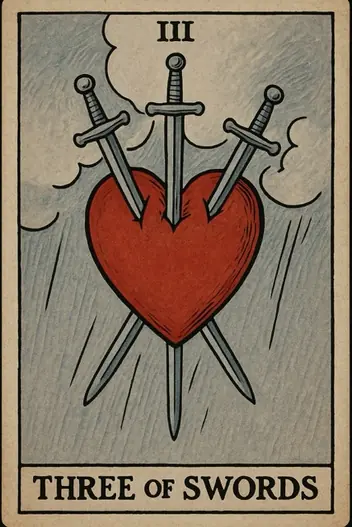
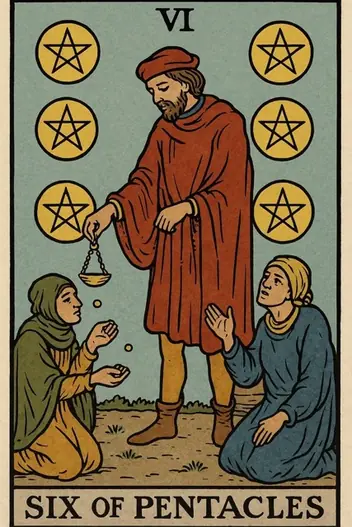
The Three of Swords represents the archetype of the Wounded Heart—a moment of acute emotional pain, betrayal, or the painful clarity that follows a harsh truth. The Six of Pentacles, by contrast, embodies the archetype of the Balanced Exchanger—the act of giving and receiving resources, favors, or support within a structured, often hierarchical, dynamic. When these two collide, the reading shifts from pure emotional turbulence to a strategic question: How do you manage your resources—financial, emotional, or social—while nursing a wound?
This combination forces you to confront a pragmatic reality: pain often requires resources to heal, and generosity can be a double-edged sword. The Three of Swords demands you acknowledge the loss, while the Six of Pentacles asks you to evaluate the terms of any support you give or receive. This is not a romantic pairing; it is a calculated negotiation with your own vulnerability.
Three of Swords and Six of Pentacles Combination Meaning
The psychological state created by this duo is one of calculated vulnerability. You are likely experiencing a period where emotional clarity (Three of Swords) forces you to reassess the transactional nature of your relationships—both personal and professional. The pain isn't abstract; it has a concrete cost. The Six of Pentacles introduces a power dynamic: someone may be offering help, or you may feel compelled to give, but the underlying motivation is tainted by recent hurt. This is not a time for unconditional generosity.
The key insight here is self-preservation through resource management. The Three of Swords reveals the emotional debt you carry. The Six of Pentacles shows the currency—time, money, attention, or loyalty—you must now allocate wisely. You may feel a pull to "fix" the pain by giving more, but this risks compounding the loss if the exchange is not reciprocal. The pragmatic takeaway: evaluate every offer of help for hidden strings, and every act of giving for its true cost to your recovery. This is a period for strategic detachment, not open-hearted charity.
Career and Finances
Strategic Opportunities:
Use your current emotional clarity to renegotiate contracts, salaries, or project roles. The pain of past professional disappointments can sharpen your negotiation skills.
Strategic Opportunities:
Seek mentorship or structured support from a senior colleague or advisor. This is a time to accept help that comes with clear terms, not vague promises.
Calculated Risks:
Avoid overextending yourself financially to please a boss, client, or team. Do not use money or favors to mask professional insecurity or past failures.
In the professional arena, this combination signals a critical decision point regarding resource allocation. The Three of Swords may represent a recent professional loss—a failed project, a missed promotion, or a toxic work environment. The Six of Pentacles asks you to assess who holds the real power in your current situation. Are you being "kept" in a role out of guilt or obligation? Are you giving more than you receive? The bold financial warning is this: do not accept a "helping hand" that comes with a hidden cost to your autonomy or self-respect. Instead, focus on structured exchanges—clear deliverables, defined timelines, and mutual benefit. This is the time to build a safety net, not to take a leap of faith. If you are in a position to give, do so only when you can detach from the outcome and not expect emotional repayment.
Your pair is already on the table. Ask your question and draw the clarifying card
or simply focus on it
What Do Three of Swords and Six of Pentacles Say About Love?
If you are single:
This pair suggests you are attracted to someone who appears generous or stable, but your own unresolved heartache may cloud your judgment. Be wary of confusing financial or practical support for genuine emotional connection.
If you are in a relationship:
A power imbalance is likely at play. One partner may feel they are giving more (time, patience, money) while the other is processing emotional pain. Transparency about needs and limits is non-negotiable.
The relationship dynamic here is fraught with unspoken expectations. The Three of Swords brings a history of hurt—perhaps infidelity, a painful argument, or a betrayal of trust. The Six of Pentacles then enters as the attempt to restore balance through material or practical means. Beware of buying peace with gestures or gifts. This is a classic shadow pattern: one partner tries to "pay" for their mistake, and the other accepts the payment while the wound festers. The bold advice is to insist on emotional honesty over transactional appeasement. If you are the wounded party, state clearly what you need beyond material support. If you are the one giving, ask yourself: Am I trying to buy forgiveness? The only sustainable path is to renegotiate the terms of the relationship with both parties fully aware of the underlying pain.
Reversed Three of Swords and Six of Pentacles Explained
If the Three of Swords is reversed, the pain is not acknowledged or is repressed. Instead of a crisis, there is blocked potential and emotional numbness. The person does not ask for help, even though they desperately need it, or conversely, transforms their unexpressed pain into cold indifference. Warning: do not ignore the symptoms of emotional exhaustion in order to save face.
If the Six of Pentacles is reversed, there is an internal resistance to help. This can manifest as pride ("I don't owe anyone anything"), an inability to receive resources, or, conversely, as compulsive rescuing that suffocates the object of care. Advice: check whether you are confusing asking for support with an admission of your own inadequacy.
If BOTH cards are reversed, a complete imbalance in the dynamic arises. The person simultaneously suffers and rejects any possibility of healing. This is pathological self-sufficiency in a crisis. The way out is to acknowledge that your self-help system has failed. The logical way to correct this: take the first step toward trust by asking for the smallest, but most concrete, favor to break the cycle of isolation and pain.
Uncover hidden insights
Let our advanced Tarot system interpret these archetypes specifically for your personal path.
Shadow Side & Pitfalls
The shadow of this pairing manifests as transactional guilt and martyrdom. You may believe that by giving more—time, money, emotional labor—you can "earn" your way out of pain. This is a cognitive distortion: the Three of Swords' wound cannot be healed by the Six of Pentacles' currency. Beware of the "helper complex," where you take on the role of the generous one to avoid facing your own vulnerability. Alternatively, you might exploit someone else's guilt, accepting help you don't need to maintain a sense of victimhood. The key pitfall is confusing generosity with healing. Another shadow pattern is hoarding resources out of fear, using the pain of the Three of Swords as an excuse to become miserly or suspicious of all exchanges. Self-sabotage may also appear: you might reject legitimate support because you feel you "don't deserve" it, or you might give excessively to prove you are "over" the hurt. The objective truth is that neither card offers a permanent resolution—only a temporary management of pain and resources. The real work is to name the wound without using resources as a bandage.
What Is the Overall Message of Three of Swords and Six of Pentacles?
Constructive use of this pair's energy requires iron discipline in separating emotions from actions. Your pain (Three of Swords) is a signal, not a guide to action. Your ability to give or ask (Six of Pentacles) is a tool, not a measure of your worth. Strategic advice: turn the crisis into a structured project. Write down: what exactly your loss consists of, what specific resource you need for recovery, from whom you can request it, and what you are prepared to offer in return.
The energy of the Three of Swords, directed toward analyzing mistakes, helps balance the Six of Pentacles by stripping it of illusions about "selfless help." You do not give or receive for nothing—you participate in a conscious exchange of values, even if one side is currently weaker. This lifts the burden of guilt and obligation, making support sustainable.
The deep strategic conclusion is that vulnerability, when acknowledged and shaped into a concrete request, ceases to be a weakness. It becomes an entry point into a new network of contacts and resources. Use the pain as a scalpel to cut away the excess, not as an excuse for endless lament. Your task is to emerge from this cycle not with a sense of "debt," but with a sense of a "deal" that has strengthened your resilience against future crises.
Applying This to Your Situation
The core message of the Three of Swords and Six of Pentacles is clear: your pain has a price, and your generosity has a limit. This combination is not about finding a perfect balance; it is about making a conscious choice about how you allocate your emotional and material resources while you heal. The archetypes are universal, but your situation is not. The most powerful insight comes when you apply this dynamic to your specific question—your unique wound, your specific resources, and your exact relationship dynamics.
To get a deep, personalized interpretation of this exact combination for your specific question right now, use the Fortune Cards app. Whether you access it on the web or download it, the app will guide you through a tailored reading that considers your context, not just the archetypes. Stop guessing—get the clarity you need to act with both heart and strategy.
Interpretation by the Fortune Cards editorial team, based on the Rider–Waite tradition and Jungian archetypes. About our methodology · Updated: 2026-08-26
Other Combinations with Three of Swords
Other Combinations with Six of Pentacles
Explore Individual Card Meanings
Table of Contents
- Three of Swords and Six of Pentacles Combination Meaning
- Career and Finances
- What Do Three of Swords and Six of Pentacles Say About Love?
- Reversed Three of Swords and Six of Pentacles Explained
- Shadow Side & Pitfalls
- What Is the Overall Message of Three of Swords and Six of Pentacles?
- Applying This to Your Situation
Ready to find answers to your questions?
Start your first reading now and look at your situation with fresh clarity. The cards are ready to reveal deeper meaning.