Three of Swords and Two of Pentacles Tarot as Feelings
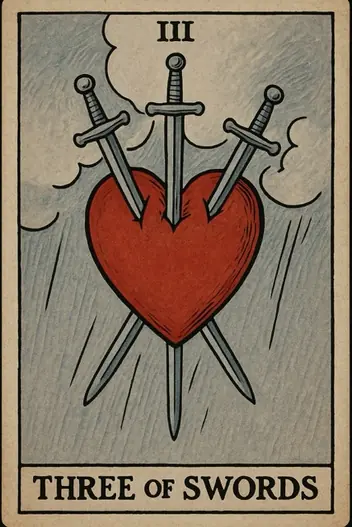
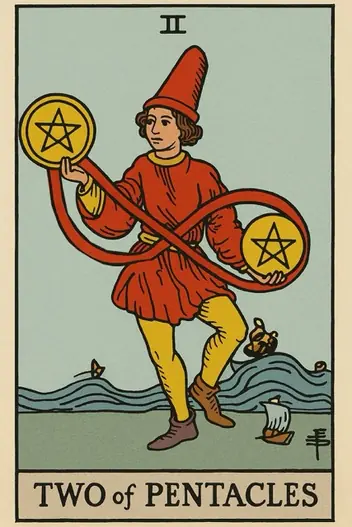
- Arcana
- Three of Swords — Minor Arcana, Swords; Two of Pentacles — Minor Arcana, Pentacles
- Elements
- Three of Swords — Air; Two of Pentacles — Earth
- Elemental interaction
- Opposing elements — energies create tension
- Numerology
- 3 + 2 = 5
The collision of the Three of Swords and the Two of Pentacles represents a critical juncture where emotional pain meets the demands of daily life. Psychologically, this pairing forces you to manage grief or betrayal while simultaneously juggling your responsibilities, finances, and routines. It is not a card of collapse, but of strategic compartmentalization—the mind must process heartbreak while the hands continue to work.
Jungian analysis sees this as the tension between the Wounded Healer archetype and the Juggler archetype. You are being asked to hold two opposing truths: the need to grieve and the need to function. The key insight here is that avoiding the pain won't make it disappear, but neither will letting it derail your entire life. The path forward requires a disciplined emotional triage—acknowledging the wound without letting it bleed into every aspect of your existence.
Core Dynamics & Interpretation
The core dynamic of the Three of Swords and Two of Pentacles is cognitive dissonance in action. On one level, you are experiencing a sharp, piercing emotional truth—a betrayal, a painful realization, or the end of a cherished illusion. On another level, you are actively balancing multiple commitments: work deadlines, bills, family obligations, or health routines. The psychological risk is dissociation—you may numb yourself through busywork, avoiding the necessary emotional processing that true healing requires.
This combination often appears when a seeker is trying to outrun their pain through productivity. They throw themselves into work, side hustles, or social obligations, believing that staying busy will dilute the sting of the Three of Swords. However, the Two of Pentacles warns that this juggling act has a limited capacity for denial. Eventually, the weight of unprocessed grief will cause you to drop a ball—miss a deadline, snap at a loved one, or suffer a health setback. The mature response is to schedule time for grief, just as you would schedule a meeting or a workout.
From a pragmatic standpoint, this pairing demands radical prioritization. You cannot do everything at once. The Two of Pentacles asks you to choose which tasks are truly essential and which can be delegated or postponed. Meanwhile, the Three of Swords insists you allocate a specific, bounded time each day to feel the pain—journal, cry, talk to a therapist—and then return to your duties. This is not suppression; it is conscious emotional management.
Your pair is already on the table. Ask your question and draw the clarifying card
or simply focus on it
What Do Three of Swords and Two of Pentacles Say About Love?
If you are single:
This combination suggests you are carrying unhealed wounds from a past relationship that are interfering with your ability to evaluate new connections objectively. Do not rush into a rebound relationship to distract yourself; instead, focus on stabilizing your own life first.
If you are in a relationship:
You or your partner may be withdrawing emotionally due to hurt or resentment, while simultaneously over-functioning in practical areas (work, chores) to avoid confrontation. This creates a dangerous imbalance.
The relationship dynamics here are characterized by emotional distance masked by busyness. One partner may be using work or social obligations as an excuse to avoid addressing a recent betrayal, a painful secret, or a fundamental mismatch in values. The other partner may feel invisible or unimportant, sensing the disconnection but unable to break through the wall of activity. The key relationship advice is to schedule a "no-distractions" conversation—put away phones, cancel non-essential plans, and sit with the discomfort.
Psychologically, this pairing points to a power struggle between vulnerability and control. The person embodying the Two of Pentacles energy is trying to control the environment to avoid feeling the pain of the Three of Swords. The partner must gently insist on emotional transparency, not through accusation, but through setting a boundary: "I need to understand what's really going on between us, or I cannot continue to support this busy schedule." Without this honest exchange, the relationship will become a hollow performance of stability while the heart decays.
Get a personalized interpretation
Unlock the combined meaning of your cards in the context of your unique question — for free.
Career and Finances
Strategic Opportunities:
Use this period to restructure your workload—delegate tasks, automate payments, or renegotiate deadlines. The pain is a signal that your current system is unsustainable.
Strategic Opportunities:
Consider outsourcing emotional labor—hire a coach, therapist, or mentor to help you process the professional setback or conflict that is causing the heartache.
Calculated Risks:
Avoid major financial decisions while emotionally compromised. Do not quit your job impulsively, take out a loan to escape, or invest in high-risk ventures to "feel in control."
In a career context, the Three of Swords and Two of Pentacles often appears when a professional disappointment—a failed project, a toxic colleague, a missed promotion—coincides with a period of high workload. You are expected to perform at your peak while nursing a bruised ego or shattered confidence. The pragmatic approach is to separate the emotional injury from the operational task. For example, if you were passed over for a promotion, you can still execute your current duties competently while privately strategizing your next move. Do not let hurt pride lead to rash resignations.
Financially, this combination warns against emotional spending as a coping mechanism. The Two of Pentacles represents balance, but the Three of Swords can tempt you to "buy happiness" or "fund a distraction." Bold financial warning: do not use credit cards, loans, or savings to numb the pain. Instead, create a "grief budget" —allocate a small, fixed amount for self-care (a therapy session, a nice meal) while keeping the rest of your finances locked down. The goal is to manage the emotional crisis without creating a financial one.
Reversed Positions: What Changes?
When cards appear in a reversed position, the dynamic becomes more complex, yet also more manageable, as the energy shifts from an acute phase to a chronic one.
If the Three of Swords is Reversed:
This indicates blocked pain. You are not crying, not angry; you have "frozen" the emotion. This is a dangerous state, as suppressed pain (Three of Swords) will seek an outlet through passive aggression or psychosomatics. Advice: allow yourself to experience the emotion, even if it feels inappropriate. Without this, you will not be able to skillfully "juggle" your affairs.
If the Two of Pentacles is Reversed:
This is a signal of internal resistance to change. You know you need to change your schedule, work, or approach, but you are sabotaging it. Instead of flexibility, there is chaos and procrastination. Advice: simplify the task. Instead of trying to do everything at once, choose one key area for focus.
If BOTH are Reversed:
Complete imbalance. You are simultaneously denying the pain (Three of Swords reversed) and refusing to adapt to reality (Two of Pentacles reversed). This leads to total stagnation. Method for correction: emergency revision. Write down on a sheet of paper the three most painful truths and the three most urgent tasks. Acknowledge the truth and take one, very small, step on a task. Only this will set the healing mechanism in motion.
What Are the Risks of Three of Swords and Two of Pentacles?
The shadow manifestation of this pairing is self-sabotage through over-commitment. The seeker may unconsciously agree to more projects, more social obligations, or more financial responsibilities as a way to avoid sitting with the pain of the Three of Swords. This leads to burnout, resentment, and a deepening of the original wound. The cognitive bias at play is "action bias" —the false belief that doing more will make you feel better, when in reality, it only postpones the necessary grief.
Another pitfall is victimhood disguised as martyrdom. The seeker may adopt a "I have no choice but to keep going" narrative, using their busy schedule as a shield against accountability. This prevents them from asking for help, setting boundaries, or acknowledging that they are in pain. The shadow side of the Two of Pentacles is the illusion of control; the shadow side of the Three of Swords is the refusal to heal. Together, they create a toxic cycle of suffering and avoidance.
What Is the Overall Message of Three of Swords and Two of Pentacles?
Constructive use of this pair's energy requires a paradoxical approach: you must simultaneously accept the pain and keep moving, not as an escape, but as a conscious action. The strategic advice is "conscious multitasking." Set aside time for grief (Three of Swords)—15 minutes a day when you allow yourself to feel, cry, and be angry. The rest of the time, you work (Two of Pentacles), but with a clear understanding that this is a temporary refuge, not a solution.
To balance these archetypes, use the "anchor principle." Find one stable element in your life (sport, hobby, ritual) that depends neither on your pain nor on your work. This is an anchor that will keep you afloat while you weather the crisis and redistribute resources. The Three of Swords gives you clarity—you finally see exactly what is broken. The Two of Pentacles gives you flexibility—you can restructure your life around this truth.
The deep conclusion: this combination is not a curse, but an instrument of differentiation. It forces you to separate the important from the trivial. The pain cuts away everything superfluous, and the need to adapt teaches you to value what truly matters. Your decision should be based on the question: "What am I willing to sacrifice to preserve my integrity?"
Applying This to Your Situation
The core message of the Three of Swords and Two of Pentacles is that you can hold pain and productivity in the same hands, but only if you are honest about both. You do not have to choose between grieving and functioning—you simply must learn to allocate time and energy to each with intention. The wound is real, but so are your responsibilities. The mature path is to honor both without letting either consume you.
While this article provides the general archetype, the true power of Tarot lies in its application to your unique situation. The Fortune Cards app offers a deep, personalized interpretation of this exact combination for your specific question—whether about a relationship, a career decision, or a personal crossroads. You can use it on the web or download it to get a reading that considers your context, your timing, and your emotional state. Stop guessing. Get clarity tailored to you.
Interpretation by the Fortune Cards editorial team, based on the Rider–Waite tradition and Jungian archetypes. About our methodology · Updated: 2026-08-26
Other Combinations with Three of Swords
Other Combinations with Two of Pentacles
Explore Individual Card Meanings
Table of Contents
- Core Dynamics & Interpretation
- What Do Three of Swords and Two of Pentacles Say About Love?
- Career and Finances
- Reversed Positions: What Changes?
- What Are the Risks of Three of Swords and Two of Pentacles?
- What Is the Overall Message of Three of Swords and Two of Pentacles?
- Applying This to Your Situation
Ready to find answers to your questions?
Start your first reading now and look at your situation with fresh clarity. The cards are ready to reveal deeper meaning.