Five of Wands and Three of Swords Tarot as Feelings
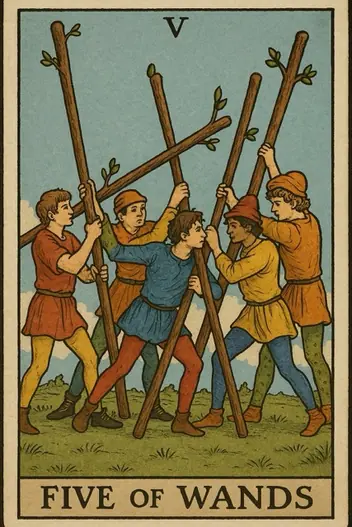
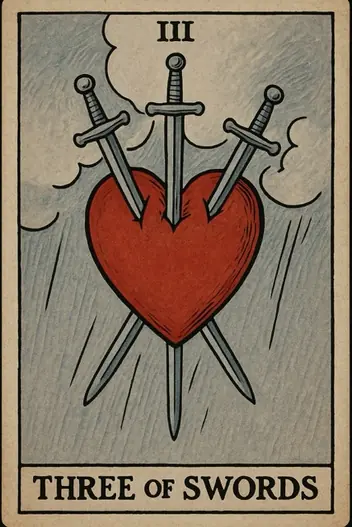
- Arcana
- Five of Wands — Minor Arcana, Wands; Three of Swords — Minor Arcana, Swords
- Elements
- Five of Wands — Fire; Three of Swords — Air
- Elemental interaction
- Friendly elements — energies support each other
- Numerology
- 5 + 3 = 8
The collision of the Five of Wands and the Three of Swords represents a psychological pressure cooker: the raw, competitive tension of the Wands meets the piercing, sorrowful clarity of the Swords. This is not a passive combination. It signals a situation where active conflict is causing emotional injury, or where a painful truth is being fought over rather than accepted.
From a Jungian perspective, this pairing often emerges when the Shadow of the Warrior (the Five of Wands) is unchecked. The drive to win, prove a point, or dominate a fray blinds the seeker to the emotional casualties—including their own. The Three of Swords here acts as a reality check: the pain is real, and it demands integration, not escalation. The core dynamic is a battle for meaning that has turned toxic.
Core Dynamics & Interpretation
The psychological state created by this combination is one of defensive fragmentation. The seeker feels under attack (Five of Wands) and simultaneously wounded (Three of Swords). This often leads to a cognitive distortion where every disagreement feels like a personal betrayal, and every criticism cuts to the bone. The key insight is that the conflict is rarely about the surface issue; it is about a deeper, unacknowledged pain that is being acted out.
In real-world terms, this manifests as protracted arguments that go nowhere. The energy of the Five of Wands keeps the fight alive, while the Three of Swords ensures that each exchange leaves a scar. The most important takeaway is that escalation is a trap. The path forward requires a radical shift from "winning the argument" to understanding the wound. Until the emotional truth behind the conflict is named, the cycle of attack and injury will repeat.
The strategic action here is controlled disengagement. This does not mean avoiding the problem, but rather stepping back to analyze the pattern. Ask yourself: Am I defending a position, or am I protecting a vulnerability? The answer will reveal whether the battle is worth fighting or if it is a projection of past hurt onto a current situation.
Your pair is already on the table. Ask your question and draw the clarifying card
or simply focus on it
Career and Finances
Strategic Opportunities:
Use this tension to audit your team dynamics. Identify where competition is healthy and where it is causing attrition. This is a chance to renegotiate roles or set clearer boundaries.
Strategic Opportunities:
The pain of a failed project or critique can be fuel for a more resilient strategy. Analyze the "wound" objectively to find the structural flaw in your plan.
Calculated Risks:
Avoid public confrontations or aggressive negotiations. This combination suggests that a power play will backfire, damaging your reputation and relationships. Do not escalate a dispute over credit or resources without a cooling-off period.
In a professional context, this pairing often appears during turf wars or hostile takeovers—not necessarily of companies, but of ideas. The seeker may feel their work is being attacked, leading to a defensive posture that invites more criticism. The practical advice is to separate your ego from your output. The Three of Swords indicates that a painful truth (e.g., a budget cut, a failed pitch) must be accepted before you can move forward.
Bold important financial warnings:
Do not make revenge investments or impulsive career moves out of spite. The competitive energy of the Five of Wands can lead to poor financial decisions aimed at "winning" rather than building. A temporary retreat or strategic silence is often the most powerful move.
Deepen your understanding
Find out exactly what this reading means for your current life situation with our oracle.
Love and Relationships
If you are single:
This combination warns against entering a dynamic where you feel you must constantly prove your worth. A connection that feels like a fight for validation is likely to leave you emotionally drained. Prioritize mutual respect over competitive chemistry.
If you are in a relationship:
This pairing signals a cycle of verbal sparring that has become emotionally abusive. The goal is no longer connection, but victory. Seek professional mediation or a structured pause to break the pattern of reactive cruelty.
In relationships, the Five of Wands and Three of Swords is a red flag for emotional burnout. The couple may be locked in a power struggle where the "truth" is used as a weapon. One partner may be withholding affection as a tactical move, while the other responds with passive-aggressive jabs. The key relationship advice here is to distinguish between healthy debate and destructive criticism. If every conversation leaves you feeling stabbed, the environment is toxic.
Bold key relationship advice:
The most loving action you can take is to name the pattern aloud without blame. For example: "We are fighting about money, but I think we are really fighting about feeling unheard." This breaks the spell of the Five of Wands and invites the healing potential of the Three of Swords—acknowledging the pain rather than fighting over it.
Reversed Positions: What Changes?
If the cards appear reversed, the dynamic shifts from external to internal, making the situation more complex to diagnose, but potentially less destructive.
If the Five of Wands is reversed:
The conflict is suppressed or blocked. You are avoiding direct confrontation, but the tension has not gone anywhere. This is a state of "smoldering conflict" that could explode at the most inopportune moment. Advice: do not try to keep the peace at any cost—find a safe channel for releasing aggression (the gym, a reasoned letter, a therapy session).
If the Three of Swords is reversed:
The pain is denied or repressed. You do not acknowledge that you have been hurt, or you do not allow yourself time to grieve. This is a path to emotional anesthesia and cynicism. Advice: allow yourself to feel the pain. If you do not mourn the loss (of a relationship, a project, illusions), you will not be able to move forward.
If BOTH are reversed:
A complete imbalance—you are simultaneously avoiding conflict and not acknowledging your pain. This leads to passive aggression and psychosomatics. A logical way to correct this: start by acknowledging your vulnerability. Say to yourself: "Yes, I am in pain, and yes, I am angry, but I will not express this destructively." Channel the energy into written reflection or creativity.
What Are the Risks of Five of Wands and Three of Swords?
The shadow manifestation of this combination is self-sabotage through chronic conflict. The seeker may unconsciously create fights to avoid facing a deeper loneliness or inadequacy (the shadow of the Three of Swords). They become the architect of their own heartbreak, mistaking drama for passion. A key cognitive bias here is the fundamental attribution error: blaming the other person's character for the conflict while excusing your own reactive behavior.
Another pitfall is masochistic persistence—staying in a fight that is clearly causing harm because leaving feels like losing. This is the shadow of the Five of Wands: the warrior who cannot lay down their sword. The result is emotional scar tissue that blocks future intimacy or collaboration. If you find yourself feeling more alive in the argument than in the resolution, you are in the shadow.
Five of Wands and Three of Swords Combined Message
How can the energy of the Five of Wands be used constructively to balance the painful Three of Swords? The answer is paradoxical: you need to direct the aggression not at others, but at the problem itself. The Three of Swords is the pain of a rupture. The Five of Wands is the energy to make that rupture cleanly and quickly, like a surgical intervention, rather than hacking away with a dull blade. Your strategic task is to transform chaotic struggle into a structured conflict with clear rules.
Instead of hashing things out emotionally, agree on a format. For example: "We have 30 minutes to discuss three specific points of contention. After that, we take a 24-hour break." This turns the destructive energy of the Five of Wands into a manageable discussion. And the Three of Swords ceases to be a stab in the back and becomes a conscious acknowledgment of fact: "Yes, we have hurt each other. What are we going to do about it?" A profound strategic piece of advice: use this combination as a catalyst for a "clean break." If a relationship, job, or project has run its course, this pair of cards gives you the strength and clarity to end it once and for all, rather than languishing in uncertainty. Accept the pain as the price for freedom.
Applying This to Your Situation
The core message of the Five of Wands and Three of Swords is that not all battles are worth fighting, and not all pain is a sign of failure. This combination asks you to distinguish between a conflict that refines you and one that wounds you. The path forward requires emotional honesty—naming your hurt without using it as a weapon.
While this analysis provides a deep understanding of the archetypal dynamics, the true power of Tarot lies in its application to your unique situation. A single combination can mean drastically different things depending on your question, life stage, and surrounding cards. To get a personalized, in-depth interpretation of this exact combination for your specific relationship, career, or personal growth question, use the Fortune Cards app. You can access it on the web or download it now to receive a custom reading that cuts through the generalities and speaks directly to your life.
Interpretation by the Fortune Cards editorial team, based on the Rider–Waite tradition and Jungian archetypes. About our methodology · Updated: 2026-08-26
Other Combinations with Five of Wands
Other Combinations with Three of Swords
Explore Individual Card Meanings
Ready to find answers to your questions?
Start your first reading now and look at your situation with fresh clarity. The cards are ready to reveal deeper meaning.