Seven of Cups and Three of Swords Meaning in Tarot
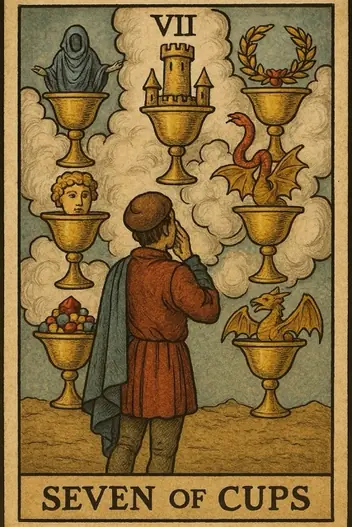
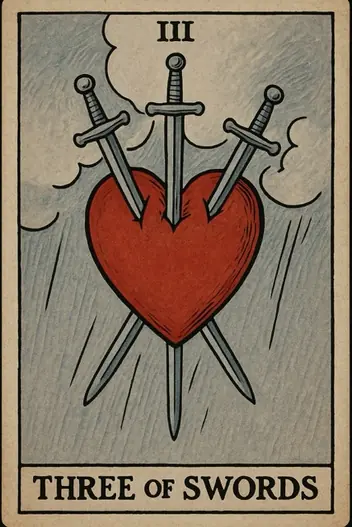
- Arcana
- Seven of Cups — Minor Arcana, Cups; Three of Swords — Minor Arcana, Swords
- Elements
- Seven of Cups — Water; Three of Swords — Air
- Elemental interaction
- Neutral elements — energies coexist without conflict
- Numerology
- 7 + 3 = 10 → 1
When the Seven of Cups—the card of fantasies, wishful thinking, and endless possibilities—collides with the Three of Swords—the archetype of heartbreak, piercing truth, and sorrow—the result is a profound psychological wake-up call. This combination signals a moment when the bubble of self-deception bursts, and reality cuts through with sharp clarity. The dreamer is forced to confront the cost of chasing illusions, whether in love, career, or personal identity.
Psychologically, this pairing represents the tension between the shadow of wishful thinking and the necessary pain of differentiation. The Seven of Cups tempts you to over-invest in a fantasy, while the Three of Swords demands you face the emotional consequence of ignoring red flags. The key insight here is that the pain is not the enemy—it is the surgeon. It cuts away what is not real so you can rebuild on solid ground.
Seven of Cups and Three of Swords Together: Meaning
The core dynamic of the Seven of Cups and Three of Swords is a psychological collision between inflated expectations and harsh reality. The Seven of Cups represents a state of cognitive overload: multiple options, each glittering with promise, but none grounded in objective truth. This card is the archetype of the puer aeternus—the eternal child who avoids commitment by keeping all doors open. When the Three of Swords enters the scene, it shatters this illusion with the weight of lived experience. The result is a moment of cognitive dissonance that can either lead to growth or to deeper self-sabotage.
In practical terms, this combination often appears when you have been projecting idealized qualities onto a person, opportunity, or goal, ignoring clear evidence that it is not what it seems. The Three of Swords forces you to see the cracks in the facade. This is not a time for more fantasy—it is a time for forensic self-examination. Ask yourself: What emotional payoff have I been getting from this illusion? The answer often reveals a fear of scarcity, a need for validation, or a refusal to grieve a past loss.
The strategic implication is clear: stop chasing the mirage and start managing the wound. The Seven of Cups offers a menu of distractions; the Three of Swords forces you to choose one painful truth. The most effective response is to narrow your focus to one concrete, measurable goal and accept the emotional cost of abandoning the others. This is the path of integration: acknowledging the loss of what never was, so you can invest in what actually could be.
Seven of Cups and Three of Swords in Career Readings
Strategic Opportunities:
Cut your losses on a failing project or investment. The Three of Swords validates the pain of letting go, but the Seven of Cups insists there are other options. Redirect your energy toward one clear, data-backed opportunity rather than spreading yourself thin across multiple fantasies.
Strategic Opportunities:
Use the emotional clarity from this combination to renegotiate a relationship at work. If you have been over-promising or under-delivering due to wishful thinking, now is the time to reset expectations with brutal honesty. This builds credibility.
Calculated Risks:
Avoid any new venture that requires you to ignore red flags. If a business partner, client, or investment opportunity feels “too good to be true,” it is. Do not confuse optimism with due diligence. The Seven of Cups’ allure of quick success is a trap; the Three of Swords guarantees the eventual crash.
From a career and financial perspective, this pairing is a powerful signal to audit your professional narratives. You may have been telling yourself a story about your career path that is no longer true—for example, believing you are on track for a promotion when performance reviews say otherwise, or assuming a side hustle will replace your income without a realistic plan. The Three of Swords forces you to confront the gap between your self-story and objective reality.
Bold financial warning:
Do not invest money or time into a “dream” that has not been stress-tested. The Seven of Cups is the archetype of the speculator who buys on hype; the Three of Swords is the margin call. If you are considering a major financial move, such as quitting a job to start a business or making a large purchase based on future expectations, create a worst-case scenario plan first. The pain of a failed fantasy is far worse than the discomfort of delayed gratification.
Your pair is already on the table. Ask your question and draw the clarifying card
or simply focus on it
Seven of Cups and Three of Swords as Feelings
If you are single:
This combination warns against projecting a fantasy onto a new romantic interest. You may be seeing only what you want to see, ignoring signs of incompatibility or emotional unavailability. Take off the rose-colored glasses and ask a trusted friend for an objective reality check.
If you are in a relationship:
The pairing signals that a painful truth must be spoken or heard. This could be an admission of betrayal, a realization of unmet needs, or the end of a cycle of mutual deception. Silence will deepen the wound; honest confrontation is the only path to repair or release.
In relationship dynamics, the Seven of Cups and Three of Swords often points to a pattern of emotional avoidance. One partner may be using fantasies about the future (e.g., “things will get better when...”) to avoid addressing present problems. The Three of Swords demands that these issues be brought into the open. The most critical relationship advice here is to distinguish between constructive pain and destructive suffering. Constructive pain comes from telling the truth; destructive suffering comes from staying in a lie.
Bold key relationship advice:
Do not mistake intensity for intimacy. The Three of Swords can create a dramatic emotional atmosphere that feels like deep connection, but it may actually be a trauma bond. If you are feeling a sharp sting in your chest when you think of your partner, ask yourself: Is this grief for what we had, or relief that the illusion is ending? The answer will guide your next move. For couples, this combination suggests a need for structured communication—perhaps a mediator or a written exchange—to prevent the conversation from devolving into blame.
Your unique Tarot reading
See how these cards interact with your destiny. Start a free personal reading now.
Negative Meaning of Seven of Cups and Three of Swords
The shadow of the Seven of Cups and Three of Swords is a dangerous cycle of self-sabotage. On the surface, you may feel like a victim of circumstances—betrayed by a partner, misled by a colleague, or let down by a dream. But the deeper shadow is the refusal to see your own role in creating the illusion. Cognitive biases like confirmation bias (seeking evidence that supports the fantasy) and optimism bias (underestimating risk) are the engines of this dynamic.
The most common pitfall is using the pain of the Three of Swords as an excuse to retreat into more fantasy. After a heartbreak or professional failure, the Seven of Cups tempts you to escape into a new, even more unrealistic dream—a new relationship, a new career, a new identity. This is psychological avoidance disguised as hope. Another major pitfall is over-identification with the victim archetype, which can lead to chronic bitterness, cynicism, or a refusal to trust anyone again.
The shadow path looks like this:
You get hurt → you fantasize about a perfect solution → you ignore the lessons of the pain → you repeat the pattern. To break this cycle, you must stay in the discomfort of the Three of Swords long enough to extract its wisdom. This means journaling about what you ignored, what you feared, and what you need to change in your decision-making process. The shadow does not disappear by dreaming brighter dreams; it dissolves only when you face the truth with courage.
Seven of Cups and Three of Swords Reversed Meaning
Reversed cards shift the emphasis but do not negate the core conflict between illusion and pain.
If the Seven of Cups is reversed:
This points to blocked potential and a fear of dreams. The individual is so afraid of disappointment that they refuse to even dream. This leads to apathy and depression, where the Three of Swords manifests as a chronic, dull ache of unrealized potential. Advice: allow yourself at least one "frivolous" fantasy to jumpstart the energy of desire.
If the Three of Swords is reversed:
The classic "dagger in the heart" finds no outlet. This is suppressed pain and an internal resistance to healing. The person denies that they are hurting or is stuck in a state of "frozen grief." They continue to cling to the illusions of the Seven of Cups to avoid feeling this pain. Warning: suppressed emotion turns into psychosomatic illness or chronic stress.
If BOTH are reversed:
Complete imbalance and stagnation. Illusions provide no energy, and pain provides no motivation for change. This is a state of "chronic dissatisfaction," where a person lives neither in reality nor in dreams. Remedy: an external, rigid structure (an action plan, therapy, a mentor) is necessary to force at least one small action that breaks this vicious cycle.
Overall Meaning of Seven of Cups and Three of Swords
How can the energy of this painful pair be used constructively? The answer is paradoxical: you must accept the pain as a tool for calibrating reality. The Seven of Cups is your creative potential and ability to see possibilities. The Three of Swords is your internal auditor, stress-testing those possibilities for durability. The problem arises when you disconnect the auditor and let creativity run wild.
The strategic advice is to create an "illusion-checking protocol." Every time you feel euphoria about a new idea or person (Seven of Cups), you must sit down and outline three scenarios: optimistic, realistic, and pessimistic. In this context, the Three of Swords is not a punishment but feedback. If you feel the pain of disappointment, ask yourself: "What exactly am I learning right now? Which of my beliefs was false?"
Your task is not to get rid of the Seven of Cups (that would kill your creativity), but to learn to integrate it with the Three of Swords. Make pain your ally. Each heartbeat you experience as a "rupture" is, in reality, an expansion of your consciousness. You can no longer live in your former illusion, and that is frightening, but it is the only path to maturity. Use this combination as a catalyst for the transition from naive optimism to conscious realism.
Where to Go From Here
The core message of the Seven of Cups and Three of Swords is that illusion is the true source of your pain. The fantasy you are clinging to is not protecting you—it is prolonging your suffering. The only way forward is to let the truth cut through, grieve what was never real, and then choose one grounded path to invest in. This is not a time for more options; it is a time for decisive action based on reality.
While this article has provided the general archetype of this combination, the true power of Tarot lies in how it applies to your specific situation. Your question, your context, and your emotional state change the meaning dramatically. To get a deep, personalized interpretation of this exact pairing for your unique question, use the Fortune Cards app. Available on the web or as a download, it offers a tailored analysis that considers your personal history, relationship dynamics, and career stage. Stop guessing—get the clarity you need to turn pain into power.
Interpretation by the Fortune Cards editorial team, based on the Rider–Waite tradition and Jungian archetypes. About our methodology · Updated: 2026-08-26
Other Combinations with Seven of Cups
Other Combinations with Three of Swords
Explore Individual Card Meanings
Table of Contents
- Seven of Cups and Three of Swords Together: Meaning
- Seven of Cups and Three of Swords in Career Readings
- Seven of Cups and Three of Swords as Feelings
- Negative Meaning of Seven of Cups and Three of Swords
- Seven of Cups and Three of Swords Reversed Meaning
- Overall Meaning of Seven of Cups and Three of Swords
- Where to Go From Here
Ready to find answers to your questions?
Start your first reading now and look at your situation with fresh clarity. The cards are ready to reveal deeper meaning.