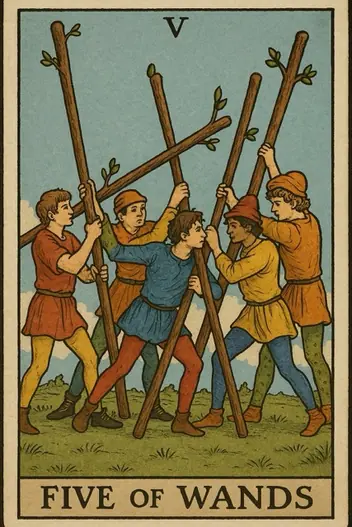
Five of Wands
- Arcana
- Minor Arcana, Suit of Wands
- Element
- Fire
- Decan
- Saturn in Leo
- Numerology
- 5
The Five of Wands represents the Jungian archetype of the Agon—the spirit of competitive struggle that forges identity through friction. This card is not about chaos or destruction; it is about the psychological necessity of conflict as a mechanism for differentiation and growth. In life, this card appears when you must assert your position, defend your boundaries, or engage in a structured contest for resources, recognition, or truth.
The core challenge of this card is learning to fight without losing your mind. It asks you to distinguish between productive tension that sharpens your skills and destructive aggression that wastes your energy. The Five of Wands is a call to engage with reality head-on, using competition as a mirror for your own competence and resilience.
Main Dynamics and Interpretation
The upright Five of Wands signals a period of healthy, structured competition. Psychologically, this activates the ego’s need for differentiation—you must prove your unique value against others who are also striving. This is not a time for passive observation; it is a time for strategic engagement. The card rewards those who can tolerate the anxiety of being challenged without collapsing into defensiveness or avoidance.
In practical terms, this card indicates a situation where multiple competing interests collide. You may face conflicting priorities, rival proposals, or direct opposition from peers. The optimal mindset is competitive pragmatism: view each clash as data. What are you fighting for? Is the prize worth the energy? Bold the key insight: The Five of Wands is not a card of defeat; it is a card of selection. It filters out those who lack the will to persist.
The resource this card provides is clarity through friction. When ideas clash, the weaker ones break first. When wills collide, the stronger emerges refined. Use this period to test your assumptions under pressure. The Five of Wands demands that you stop avoiding necessary confrontations and instead learn to fight cleanly, with purpose and discipline.
Ask your question and flip the cards
or simply focus on it
Five of Wands: Yes or No?
Leaning no.. The Five of Wands embodies discord, competition, and scattered energy—archetypally, it represents the chaotic skirmish of the ego before clarity emerges. In a yes/no reading, this card signals that the current situation lacks the stability or unified direction needed for a definitive affirmative outcome. Reversed, the card suggests internalized conflict or avoidance of necessary confrontation, which further muddles the answer toward a “no” or at best a “not yet.” The critical caveat: the outcome depends on whether you are willing to engage in the friction as a constructive catalyst rather than a destructive fight—if you can channel the chaos into productive debate or competition, the energy may shift toward a qualified “yes.”
Your unique Tarot reading
See how these cards interact with your destiny. Start a free personal reading now.
What Does Five of Wands Mean for Your Day?
Today’s energy is one of friction, competition, and multiple forces pulling in different directions—you may feel like you’re in a tug-of-war with colleagues, partners, or even your own inner drives. The core message is to lean into the clash as a refining fire: use disagreements to sharpen your ideas, not to wound others. Focus on asserting your perspective with clarity and resilience, but avoid the trap of taking every conflict personally or trying to “win” at all costs. Steer clear of reactive anger, petty rivalries, or spreading your energy too thin across too many battles. The day demands you hold your ground without losing sight of the larger goal.
Love and Relationships
If you are not in a relationship:
This card suggests you are attracting or attracted to high-drama, competitive dynamics in dating. You may be drawn to partners who challenge you, but beware of mistaking conflict for passion. Focus on finding a partner who respects your boundaries, not just your ability to fight.
If you are in a relationship:
You are likely experiencing power struggles, disagreements over control, or competing needs. This is not a sign of a failing relationship, but a signal that you must negotiate your differences openly. Avoid silent resentment; instead, use structured communication.
In a relationship, the Five of Wands manifests as recurring friction over roles, resources, or attention. The psychological trap is to personalize the conflict—to see your partner as an enemy rather than a teammate solving a problem. The key is to externalize the conflict: fight the problem, not each other. Bold the main practical relationship advice: Establish clear rules of engagement for disagreements: no name-calling, no stonewalling, and a time limit for heated discussions. This transforms destructive arguments into productive negotiations.
Five of Wands as Feelings: What They Think of You
Through the lens of the Five of Wands, this person perceives you as a catalyst for tension—someone who disrupts their comfort zone and forces them to defend their position. They see you as a rival or a mirror that provokes their competitive instincts, often unconsciously; you evoke a mix of admiration for your assertiveness and irritation at the challenge you represent. Their hidden intention may be to test your limits, to see if you can hold your own in a clash of wills, while their underlying fear is that you will expose their insecurities or overshadow them. There is a strong internal conflict: part of them is drawn to your energy and vitality, but another part feels threatened and wants to push you away to regain equilibrium. Psychologically, they are not at peace with you—you represent unfinished business, a dynamic that feels like a fight for recognition or space.
What Does Five of Wands Mean for Work and Money?
Strategic Opportunities:
Use competition as a benchmark. If you are up for a promotion, a project bid, or a client pitch, the Five of Wands indicates that the contest is fair and winnable if you bring your best strategy. Study your rivals to identify their weaknesses.
Resource Management:
Network with your competitors. In many fields, rivals are also potential collaborators. This card suggests that forming temporary alliances or learning from the opposition can accelerate your growth.
Calculated Risks:
Avoid overcommitting to a fight you cannot win. The Five of Wands warns against ego-driven battles where the only reward is pride. If the competition drains resources without clear payoff, disengage strategically.
In your career, this card signals a high-stakes environment where multiple stakeholders vie for influence. The optimal decision-making framework is cost-benefit analysis of each conflict. Bold financial warnings or strategic advice: Do not confuse activity with productivity. Fighting for the sake of fighting burns capital—both financial and psychological. Instead, choose your battles based on ROI: time, energy, and money. If you are an entrepreneur, this card favors competitive pricing or marketing battles that differentiate your brand.
Reversed Positions: What Changes?
When reversed, the Five of Wands indicates blocked competition or internalized conflict. The external struggle has turned inward, manifesting as self-sabotage, indecision, or passive-aggressive behavior. You may be avoiding necessary confrontations, leading to bottled-up resentment that erodes relationships and productivity. Psychologically, this represents repressed aggression—the shadow of the warrior archetype turning against the self.
This reversal warns of cognitive dissonance: you want to win but refuse to engage. In relationships, this creates stonewalling or emotional withdrawal. In career, it leads to missed opportunities because you feared the fight. Bold the warning: The reversed Five of Wands is a sign of learned helplessness—you must reclaim your agency. The correction is direct, honest confrontation. Identify one conflict you have been avoiding and schedule a resolution conversation. The energy is not gone; it is misdirected. Re-channel it into purposeful action.
The Shadow Side of Five of Wands
The shadow of the Five of Wands is destructive competitiveness—the belief that only one can win, leading to zero-sum thinking. This manifests as paranoia about others' motives, a tendency to undermine rivals, or an inability to collaborate. The cognitive bias here is loss aversion: you fight harder to avoid losing than to gain, which depletes resources.
Another pitfall is conflict addiction—using fights to feel alive or validated. This stems from an unstable ego that needs external opposition to define itself. In relationships, this creates drama cycles that exhaust partners. In career, it leads to burnout from constant turf wars. The shadow also includes perfectionism disguised as competition: you fight to be flawless, punishing yourself for any failure. Bold the core risk: The Five of Wands can become a self-fulfilling prophecy where you create enemies where none exist. The antidote is self-awareness: ask, "Am I fighting for a real outcome, or to feel powerful?"
Synthesis: What It All Adds Up To
The Five of Wands is a card of necessary friction. It teaches that conflict is not a sign of failure but a tool for differentiation. To use this energy constructively, adopt a strategic mindset: treat every clash as a data point about your strengths, your opponents, and the stakes. The goal is not to eliminate conflict but to master it—to fight with precision, not passion.
Psychologically, this card calls you to integrate the warrior archetype without becoming a warmonger. You must be willing to assert your needs, defend your position, and tolerate the discomfort of disagreement. The payoff is clarity, growth, and respect—from yourself and others. In relationships, this means setting boundaries that deepen trust. In career, it means earning recognition through competence, not compliance.
The strategic conclusion is this: do not avoid the fight, but choose it wisely. The Five of Wands rewards those who engage with purpose and disengage with discipline. If you can learn to fight cleanly, you will emerge stronger, more defined, and more capable of handling life’s inevitable tensions.
Your Next Step: Personal Context Matters
This psychological and strategic breakdown provides a deep understanding of archetypes. However, Tarot is never universal for everyone. To understand exactly how this dynamic applies to your specific situation, a reading tailored exclusively to you is necessary.
Download the Fortune Cards app or visit our platform to get a deep AI interpretation of your unique spread. Don't just read about the cards—use Fortune Cards to find out exactly what step you need to take next.
Try Tarot Spreads with Five of Wands
Interpretation by the Fortune Cards editorial team, based on the Rider–Waite tradition and Jungian archetypes. About our methodology · Updated: 2026-08-26
Top Combinations with Five of Wands
Discover how Five of Wands interacts with other major cards in the deck to form powerful messages.
All 77 Combinations with Five of Wands
Discover how this card interacts with every other card in the Tarot deck and reveal hidden meanings.
Table of Contents
- Main Dynamics and Interpretation
- Five of Wands: Yes or No?
- What Does Five of Wands Mean for Your Day?
- Love and Relationships
- Five of Wands as Feelings: What They Think of You
- What Does Five of Wands Mean for Work and Money?
- Reversed Positions: What Changes?
- The Shadow Side of Five of Wands
- Synthesis: What It All Adds Up To
- Your Next Step: Personal Context Matters
Explore Tarot Universe

Ready to find answers to your questions?
Start your first reading now and look at your situation with fresh clarity. The cards are ready to reveal deeper meaning.