Five of Wands and Knight of Pentacles Tarot as Feelings

- Arcana
- Five of Wands — Minor Arcana, Wands; Knight of Pentacles — Minor Arcana, Pentacles
- Elements
- Five of Wands — Fire; Knight of Pentacles — Earth
- Elemental interaction
- Neutral elements — energies coexist without conflict
- Numerology
- 5 + 12 = 17 → 8
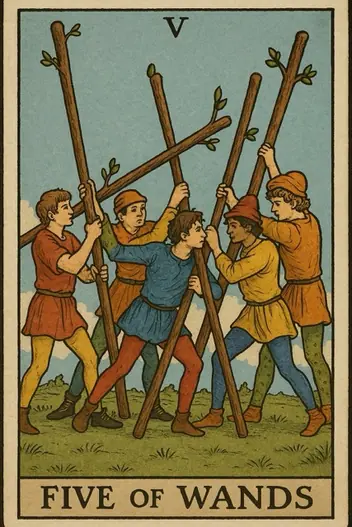
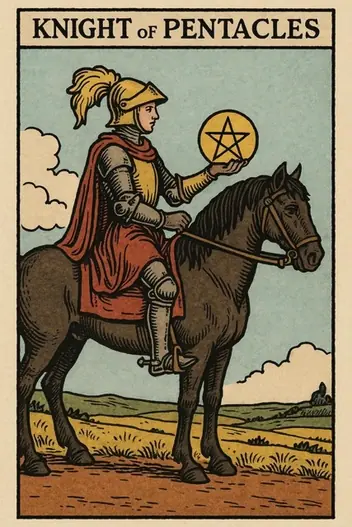
The Five of Wands represents chaos, competition, and scattered energy—a clash of wills where multiple parties vie for dominance or visibility. The Knight of Pentacles, by contrast, embodies patience, diligence, and a slow, steady approach to achieving tangible results. When these two archetypes collide, you face a psychological tension: the urge to fight for your position versus the discipline to methodically build your foundation.
This combination signals a period where external pressures (Five of Wands) test your capacity for sustained effort (Knight of Pentacles). The key insight is not to avoid conflict but to channel it into productive, structured action. Pragmatically, this pairing warns against impulsive reactions and rewards careful risk assessment.
Five of Wands and Knight of Pentacles Combination Meaning
The core dynamic here is a battle between speed and stability. The Five of Wands pushes for immediate resolution through confrontation, while the Knight of Pentacles insists on grinding through obstacles with unwavering focus. Psychologically, this creates a state of cognitive dissonance—you feel the need to act fast, yet every instinct tells you to slow down.
In real-world terms, this often manifests as a project or goal where multiple stakeholders are pulling in different directions (Five of Wands), but the only path to success is through meticulous execution (Knight of Pentacles). The healthiest response is to embrace the friction as a refining force. The Knight’s perseverance can systematically dismantle the chaos of the Five, turning conflict into a series of manageable tasks.
The key psychological takeaway is that this combination demands deliberate emotional regulation. You must resist the temptation to escalate arguments or make hasty decisions. Instead, treat every challenge as a data point for your long-term strategy. The Knight of Pentacles is not a warrior who wins in a single stroke; he is a farmer who wins through consistent, daily labor.
Your pair is already on the table. Ask your question and draw the clarifying card
or simply focus on it
What Do Five of Wands and Knight of Pentacles Indicate for Your Career?
Strategic Opportunities:
Use the competitive energy of the Five of Wands to sharpen your skills. Treat office politics or market rivalry as a training ground for resilience.
Strategic Opportunities:
Leverage the Knight of Pentacles’ patience to build a reputation for reliability. In a chaotic environment, being the steady hand often wins long-term contracts.
Calculated Risks:
Do not invest time or money in projects that require instant results. The Knight of Pentacles moves slowly; trying to speed up will only lead to burnout or costly mistakes.
Professionally, this combination is a strong indicator of a high-stakes, slow-burn project. You may be under intense pressure from competitors or colleagues (Five of Wands), but the data supports a methodical, step-by-step approach. Frame this as a strategic advantage: while others burn out in frantic competition, you are building a durable foundation.
Financially, this is a warning against speculative investments. The Five of Wands can create a fear of missing out (FOMO), while the Knight of Pentacles wants security. Your best move is to stick to a conservative budget. If you are negotiating a raise, do not get drawn into a bidding war. Instead, present a detailed, evidence-based case for your value—the Knight’s strength lies in documentation and persistence.
Critical strategic tip:
Identify the specific "battle" you are fighting. Is it for a promotion, a client, or a new market? Then, break that battle into micro-steps that you can complete daily. This transforms overwhelming conflict into a manageable workflow.
What Do Five of Wands and Knight of Pentacles Say About Love?
If you are single:
This pairing suggests you may be attracted to someone who seems stable but is currently entangled in complicated social dynamics or competing interests. Do not rush into a commitment. Objectively evaluate whether their external chaos is a temporary phase or a permanent character trait.
If you are in a relationship:
You are likely experiencing repetitive arguments over mundane issues (finances, chores, schedules). The Five of Wands energy is creating friction, while the Knight of Pentacles energy wants to fix everything through routine. Beware of letting small irritations erode your emotional connection.
In relationships, this combination often signals a power struggle over control and consistency. One partner may feel the other is too rigid (Knight of Pentacles), while the other sees the first as too reactive (Five of Wands). The psychological trap is confusing efficiency with emotional intimacy. You can solve a logistics problem with a spreadsheet, but you cannot resolve a trust issue with a to-do list.
Key relationship advice:
Establish clear boundaries around how you handle disagreements. The Knight of Pentacles excels at creating structure—use this strength to set rules for fair fighting. For example, agree to a "time-out" rule when emotions run high, then return to the issue with a problem-solving mindset. Avoid the shadow of the Knight: passive-aggressive silence or stubborn refusal to adapt.
Ask your specific question
Don't rely on generic meanings. Get a customized reading tailored specifically to your energies.
What Are the Risks of Five of Wands and Knight of Pentacles?
The shadow side of this combination emerges when the Knight of Pentacles becomes rigid and the Five of Wands becomes purely destructive. You may find yourself stuck in a cycle of passive-aggressive resistance—feigning cooperation while secretly sabotaging progress. This is a cognitive bias known as defensive pessimism, where you prepare for the worst by refusing to fully engage.
Alternatively, the shadow can manifest as obsessive control. The Knight of Pentacles’ need for order can amplify the Five of Wands’ anxiety, leading you to micromanage every detail of a conflict. This breeds resentment in others and exhaustion in yourself. The psychological risk is confusing stubbornness with integrity. Not every battle is worth fighting, and not every plan needs to be perfect before execution.
Self-sabotage warning:
If you are ignoring small conflicts because you are "too busy" with your routine, you are setting yourself up for a larger explosion. The Five of Wands energy must be released in a controlled way—through direct communication or structured problem-solving—or it will erupt destructively.
Reversed Positions: What Changes?
If the Five of Wands is reversed:
Competition shifts into a passive-aggressive phase. Instead of open struggle — hidden manipulations and sabotage. Advice: stop playing "quiet games" and bring the conflict into direct negotiations.
If the Knight of Pentacles is reversed:
Methodicalness turns into rigidity and fear of change. You get stuck in a routine, ignoring new opportunities. Warning: this approach leads to professional degradation. You need to consciously introduce elements of competition into your work.
If BOTH are reversed:
Complete imbalance: you simultaneously fear fighting and don't want to change. This is a state of learned helplessness. A logical way to correct it: start small — set one specific goal (Knight of Pentacles) and take one conscious step toward achieving it (Five of Wands).
What Is the Overall Message of Five of Wands and Knight of Pentacles?
Constructive use of the energy of the Five of Wands to activate the Knight of Pentacles requires shifting the conflict from an external to an internal plane. Instead of fighting others, begin competing with your own limitations. For example, set yourself a goal: "I must master a new skill within a month" (Knight of Pentacles) and use the spirit of rivalry (Five of Wands) to stay on schedule.
The key strategic advice: divide the process into two phases. The first phase is "attack" (Five of Wands): you actively seek opportunities, participate in competitions, and generate ideas. The second phase is "consolidation" (Knight of Pentacles): you solidify what has been achieved, structure the results, and build a foundation for the next leap forward.
Clarity in decision-making arrives when you understand: not every struggle is worth the effort. If you cannot methodically see something through to the end—do not begin it. This union teaches us that true strength lies not in the ability to pick a fight, but in the skill to choose the right battle and win it through discipline.
Where to Go From Here
The Five of Wands and Knight of Pentacles combination ultimately asks you to balance the fire of ambition with the earth of discipline. Your core challenge is to navigate competition without losing your center, and to work steadily without ignoring the need for adaptation. The cards do not predict a winner—they describe a dynamic you can consciously shape.
Ready for a deeper, personalized reading? This article provides the general archetype, but the true power of Tarot lies in its application to your specific situation. The Fortune Cards app allows you to input your exact question—whether about a relationship, career move, or internal conflict—and receive a tailored interpretation of this combination. Use it on the web or download it now to turn these insights into actionable, real-world strategy. Your next step starts with clarity.
Interpretation by the Fortune Cards editorial team, based on the Rider–Waite tradition and Jungian archetypes. About our methodology · Updated: 2026-08-26
Other Combinations with Five of Wands
Other Combinations with Knight of Pentacles
Explore Individual Card Meanings
Table of Contents
- Five of Wands and Knight of Pentacles Combination Meaning
- What Do Five of Wands and Knight of Pentacles Indicate for Your Career?
- What Do Five of Wands and Knight of Pentacles Say About Love?
- What Are the Risks of Five of Wands and Knight of Pentacles?
- Reversed Positions: What Changes?
- What Is the Overall Message of Five of Wands and Knight of Pentacles?
- Where to Go From Here
Ready to find answers to your questions?
Start your first reading now and look at your situation with fresh clarity. The cards are ready to reveal deeper meaning.