Four of Cups and Three of Swords Tarot as Feelings
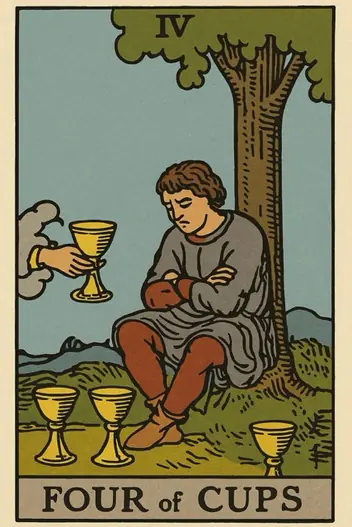
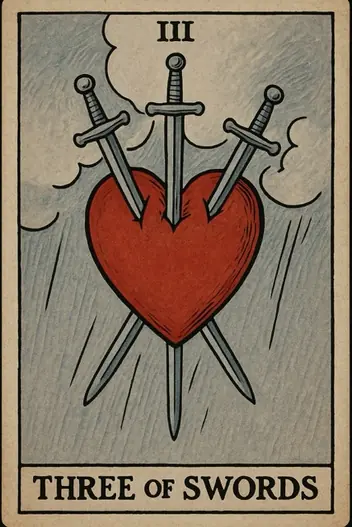
- Arcana
- Four of Cups — Minor Arcana, Cups; Three of Swords — Minor Arcana, Swords
- Elements
- Four of Cups — Water; Three of Swords — Air
- Elemental interaction
- Neutral elements — energies coexist without conflict
- Numerology
- 4 + 3 = 7
This combination represents a critical psychological intersection: emotional withdrawal meets acute pain. The Four Of Cups embodies a state of passive discontent—a refusal to engage with new opportunities because of a pervasive sense of dissatisfaction. The Three Of Swords cuts through this fog with a sharp, undeniable wound: betrayal, grief, or harsh truth. When these archetypes collide, the result is not catharsis, but a dangerous feedback loop. The pain (Three of Swords) reinforces the apathy (Four of Cups), creating a mindset where the seeker feels both too hurt to act and too numb to heal.
This is not a passive reading; it is a strategic warning. The cards suggest that the seeker is actively choosing stagnation as a defense mechanism against further hurt. The psychological state here is one of learned helplessness—a belief that no action will improve the situation, so none is taken. The real-world implication is a self-fulfilling prophecy of missed opportunities and deepened sorrow. The core dynamic asks: Are you refusing to see the cup that is offered because you are still bleeding from the sword that struck you?
What Do Four of Cups and Three of Swords Mean Together?
The psychological state created by the Four Of Cups and Three Of Swords is a paralyzing blend of resentment and rumination. The seeker is stuck in the past, replaying the wound (Three of Swords) while simultaneously rejecting any present-moment solution (Four of Cups). This is not a simple case of sadness; it is a cognitive bias known as "affective forecasting error" —the mistaken belief that because you feel bad now, you will always feel bad. The Four Of Cups' "meh" energy becomes a shield against vulnerability, while the Three of Swords keeps the wound fresh and unexamined.
In real-world terms, this combination often appears when a person has been betrayed or disappointed and now refuses to even look at new possibilities. A job offer is ignored because a previous one ended badly. A potential partner is dismissed because a past relationship caused heartbreak. The key insight here is that the apathy is a symptom, not a solution. The mind has learned to protect itself by shutting down, but this protection is actually a form of self-sabotage. The most important takeaway is that healing requires moving from passive rejection to active discernment—you must learn to say "no" to the wrong thing without saying "no" to everything.
Your pair is already on the table. Ask your question and draw the clarifying card
or simply focus on it
Four of Cups and Three of Swords in Love Tarot
If you are single:
This pair strongly suggests you are projecting past relationship wounds onto new prospects. You are likely dismissing potential partners before giving them a fair chance, using "I'm not ready" as a shield for "I'm scared to be hurt again."
If you are in a relationship:
There is a significant communication breakdown where one partner is withdrawing emotionally (Four of Cups) while the other is expressing pain or criticism (Three of Swords). The dynamic is one of passive-aggressive avoidance versus sharp, hurtful words.
In relationships, this combination demands emotional intelligence over emotional reactivity. The Four Of Cups partner may be withholding affection or presence, while the Three Of Swords partner feels this as a direct attack. The critical advice here is to stop interpreting withdrawal as rejection. The apathetic partner is not intending to hurt; they are simply numbing their own pain. Conversely, the hurt partner must avoid using sharp words as a weapon to force engagement. The only way forward is a structured, calm conversation where both parties agree to set aside blame and instead focus on the underlying fear. Boundaries are essential, but they should be negotiated, not imposed unilaterally. If you are single, actively challenge your own biases—ask yourself if your "lack of interest" is actually a fear of vulnerability dressed up as apathy.
Get a personalized interpretation
Unlock the combined meaning of your cards in the context of your unique question — for free.
Career and Finances
Strategic Opportunities:
Re-evaluate your professional network. The Three of Swords can indicate a betrayal or a failed collaboration. The Four of Cups suggests you are ignoring new connections because of this bad experience. Your next opportunity likely comes through a person you are currently dismissing.
Strategic Opportunities:
Audit your "boredom." The Four of Cups often appears when you are under-challenged or misaligned with your role. The pain of the Three of Swords (e.g., a failed project, a missed promotion) is a signal to pivot, not to stagnate. Use the pain as data to identify what you truly want.
Calculated Risks:
Do not make major financial decisions while in an apathetic state. The combination of emotional numbness (Four of Cups) and acute pain (Three of Swords) impairs judgment. Avoid signing contracts, making large purchases, or quitting your job until you have processed the underlying grief.
In a career context, this combination is a red flag for burnout and disillusionment. The seeker is likely in a job they once cared about but now feel betrayed by—perhaps by a toxic boss, a failed project, or a broken promise. The strategic error is to stay in this state of passive resentment. The Four Of Cups says "nothing here is worth my effort," while the Three of Swords says "this place hurt me." The pragmatic solution is to treat your career like a portfolio, not a relationship. Detach emotionally from the organization and focus on your own skill development and market value. Financially, this is a time for conservation, not expansion. The risk of making an impulsive decision out of pain or apathy is high. Bold financial warning: Do not spend money to "feel better" or to "prove something" to a past employer or colleague. That is a trap.
Reversed Four of Cups and Three of Swords Explained
When cards appear in a reversed position, the dynamic becomes more complex, yet also more manageable.
Four of Cups Reversed:
This signifies a breakthrough of apathy. The person is no longer sitting idly. They begin to act, but impulsively and chaotically. Warning: do not confuse activity with productivity. You risk rushing into new relationships or projects without healing the old wounds of the Three of Swords. Strategy: channel the energy into analysis, not escape.
Three of Swords Reversed:
This indicates suppressed, unexpressed pain. The person denies the trauma or tries to "keep up appearances" (Four of Cups). This is the most dangerous scenario, as internal tension builds. Advice: find an ecological way to express emotions — through psychotherapy, sports, or creativity. Ignoring the pain will lead to psychosomatics or an uncontrollable breakdown.
BOTH reversed:
Complete imbalance. Apathy transitions into chaotic actions, and pain into aggressive denial. This is an identity crisis. The logical way to correct this: consciously slow down. Introduce a rule of "one day without decisions." Focus on basic needs: sleep, food, physical activity. Only by restoring your resources will you be able to adequately assess the situation.
Four of Cups and Three of Swords: Warning Signs
The shadow manifestation of this combination is a dangerous form of self-victimization. The seeker may unconsciously adopt a narrative of "I am the one who was wronged, so I am entitled to withdraw." This is a cognitive bias known as the "just-world hypothesis" gone wrong—the belief that because you suffered unfairly, the universe now owes you something, so you stop trying. The shadow side of the Four Of Cups is entitled apathy: a refusal to engage because you believe you deserve better, but you won't lift a finger to find it. The shadow side of the Three of Swords is chronic rumination: replaying the wound to maintain a sense of moral superiority or to avoid the responsibility of moving on. Together, they create a self-sabotaging loop of bitterness and passivity. The seeker may also engage in "emotional hoarding" —collecting grievances and slights to justify their inaction. The biggest pitfall is mistaking depression for wisdom, believing that your pain makes you more insightful when it actually makes you more biased.
Synthesis: Strategic Conclusion
Constructive use of this pair requires a paradoxical approach: accept the pain to break out of apathy. Do not try to cheer yourself up or find a "magic pill." The energy of the Four of Cups (stasis, disappointment) must be used as fuel for the Three of Swords (decisive action, truth).
Your strategy is "surgery by reality." Sit down and make a list of three things that weigh on you the most in your current situation (work, relationships, habit). Acknowledge that each of them causes you pain (Three of Swords). Then, using the cold mind of the Four of Cups, assess: "What can I cut away right now without catastrophic consequences?" Perhaps this will be a difficult conversation, a resignation, or ending a toxic friendship.
The main strategic advice: use apathy as a defense mechanism for making decisions, not for avoiding them. Tell yourself: "I don't care about the consequences because I'm already in pain. So I can act boldly." The Four of Cups gives you the detachment needed to avoid dramatizing the consequences. The Three of Swords gives you the resolve to strike. Together, they are the perfect tool for emotional detoxification. You are not treating the wound; you are opening it and draining the pus. Only after this is true healing possible, along with the appearance of a new, previously unnoticed cup.
Applying This to Your Situation
The core message of Four Of Cups and Three Of Swords is this: Your pain is real, but your apathy is a lie. You are not truly indifferent; you are protecting a wound that needs to be treated, not ignored. The path forward requires you to separate the signal of the wound from the noise of the withdrawal. Acknowledge the hurt, but do not let it define your ability to see new possibilities.
While this analysis provides the general archetypal framework, the true power of Tarot lies in personal context. Your specific question, your unique history, and your current emotional state will shift the meaning of these cards dramatically. To get a deep, personalized interpretation of exactly how Four Of Cups and Three Of Swords apply to your situation right now, use the Fortune Cards app. You can access it on the web or download it today. Get a reading tailored to your specific question, and turn this painful stasis into a calculated, conscious next step.
Interpretation by the Fortune Cards editorial team, based on the Rider–Waite tradition and Jungian archetypes. About our methodology · Updated: 2026-08-26
Other Combinations with Four of Cups
Other Combinations with Three of Swords
Explore Individual Card Meanings
Table of Contents
Ready to find answers to your questions?
Start your first reading now and look at your situation with fresh clarity. The cards are ready to reveal deeper meaning.