Five of Wands and Eight of Cups Together in Tarot
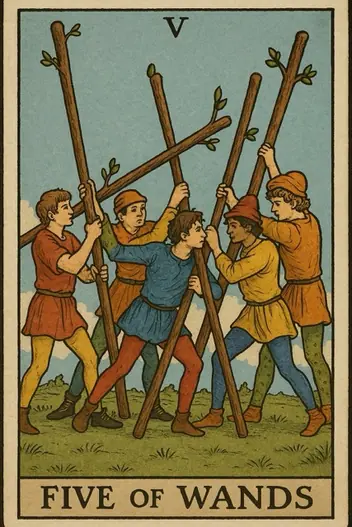

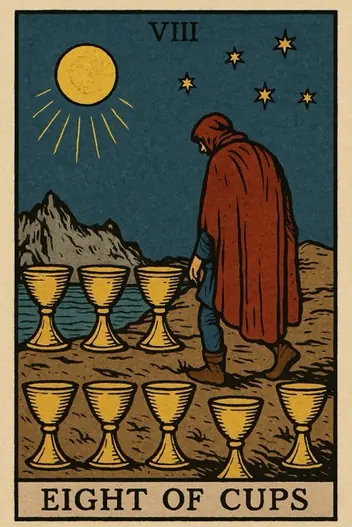
- Arcana
- Five of Wands — Minor Arcana, Wands; Eight of Cups — Minor Arcana, Cups
- Elements
- Five of Wands — Fire; Eight of Cups — Water
- Elemental interaction
- Opposing elements — energies create tension
- Numerology
- 5 + 8 = 13 → 4
When the Five Of Wands collides with the Eight Of Cups, you are facing a psychological crossroads where competitive friction meets a deep, often unconscious, urge to walk away. The Five of Wands represents chaotic struggle, conflicting egos, and the raw energy of competition—a battlefield of opinions and ambitions. The Eight of Cups, by contrast, symbolizes emotional withdrawal, the abandonment of a draining situation, and a quest for higher meaning. Together, they reveal a dynamic where you are fighting for something that your deeper self no longer values.
This combination suggests a critical moment of strategic disillusionment. You may be expending significant energy in a conflict that has become pointless, or you are realizing that the prize at the center of the struggle is not worth the emotional cost. The core psychological insight here is the difference between productive conflict and futile resistance. The cards ask you to assess whether your current battles are building something meaningful or merely exhausting your resources. The pragmatic path forward involves recognizing when to fight and when to turn your back—a decision that requires both courage and emotional intelligence.
Core Dynamics & Interpretation
The core dynamic of the Five Of Wands and Eight Of Cups combination is a psychological tug-of-war between ego-driven competition and soul-level dissatisfaction. The Five of Wands activates the Shadow of the Warrior—where you may feel compelled to prove yourself, defend your position, or engage in petty rivalries. This energy can be constructive when channeled into healthy competition, but it becomes destructive when it masks a deeper need for escape. The Eight of Cups then introduces the archetype of the Seeker, who recognizes that the battlefield is not the true arena for growth.
This pairing often indicates a cognitive dissonance between your conscious goals and your unconscious needs. You might be arguing for a promotion, a relationship, or a project, yet feeling a quiet pull to leave it all behind. The Eight of Cups represents emotional maturity through detachment—not running away, but consciously choosing to invest your energy elsewhere. The key strategic insight is to identify which conflicts are worth your time and which are simply noise. The Eight of Cups does not signal defeat; it signals a reallocation of resources toward higher priorities.
The psychological state here is one of calculated withdrawal. You are not avoiding conflict; you are choosing to disengage from a system that offers no real reward. This requires self-awareness to distinguish between ego-driven fights and values-driven battles. If you are fighting because of pride or fear of losing face, the Eight of Cups advises you to leave. If you are fighting for a core principle, then the Five of Wands energy can be weaponized productively. The combination demands honest assessment of your motivations before taking action.
Your pair is already on the table. Ask your question and draw the clarifying card
or simply focus on it
Career and Finances
Strategic Opportunities:
Identify which professional conflicts are worth your energy. Use the Five of Wands’ competitive drive to excel in negotiations, but only if the outcome aligns with your long-term goals.
Strategic Opportunities:
Consider a strategic career pivot. The Eight of Cups suggests that your current environment may be draining your potential. Look for roles or projects that offer deeper meaning and less interpersonal friction.
Calculated Risks:
Avoid burning bridges during conflict. The combination warns against resigning in a fit of anger or making impulsive financial decisions based on office politics. Always have an exit plan before you act.
In career and finances, this combination is a powerful indicator of a need for strategic repositioning. The Five of Wands energy can be highly productive in competitive fields like sales, law, or entrepreneurship—but only if you are fighting for a clear goal. When paired with the Eight of Cups, it suggests that your current workplace or industry may be creating unnecessary friction that is not serving your growth. Bold financial warning: Do not invest more money or time into a venture that is causing constant conflict without a clear path to profitability or satisfaction.
The Eight of Cups here represents the courage to walk away from a sinking ship or a toxic team. However, this must be a calculated move. Assess your financial runway and have a concrete next step before leaving. The combination also warns against competitive spending—trying to “keep up” with colleagues or rivals. Instead, prioritize financial independence so you have the freedom to leave when the situation no longer serves you. The most pragmatic approach is to use the Five of Wands’ energy to negotiate better terms while quietly preparing your exit strategy.
Your unique Tarot reading
See how these cards interact with your destiny. Start a free personal reading now.
Five of Wands and Eight of Cups in Love Tarot
If you are single:
This combination suggests you are caught between the thrill of dating competition and a growing sense that the current dating pool or dynamic is emotionally draining. You may need to step back from the chase and focus on what you truly seek, rather than proving you can win.
If you are in a relationship:
You are likely experiencing recurring conflicts that feel pointless or repetitive. One or both partners may be considering emotional or physical distance as a solution. The key is to distinguish between a salvageable issue and a fundamental incompatibility.
In relationship readings, the Five Of Wands and Eight Of Cups often point to power struggles that have become emotionally exhausting. The Five of Wands manifests as arguments over control, differing values, or external pressures (like family or work). The Eight of Cups warns that if these conflicts are not addressed with genuine empathy, one partner may emotionally check out. This is not necessarily a sign of impending breakup, but it is a critical warning to change the communication dynamic.
Bold key relationship advice:
The most pragmatic action is to schedule a neutral, structured conversation where both parties can express their frustrations without escalation. Avoid the trap of “winning” the argument—this is the Five of Wands’ shadow. Instead, focus on whether the relationship provides the emotional fulfillment you both need. If the answer is no, the Eight of Cups advises a graceful, conscious exit rather than a bitter fight. The combination rewards emotional honesty over competitive pride.
What Are the Risks of Five of Wands and Eight of Cups?
The shadow side of this combination is the tendency to confuse healthy competition with destructive conflict, and strategic withdrawal with escapism. When the Five Of Wands energy is blocked, you may become passive-aggressive, avoiding direct confrontation while secretly resenting others. This leads to simmering tension that eventually erupts, causing you to flee the situation without resolution. Alternatively, the Eight of Cups shadow manifests as emotional avoidance—leaving a relationship or job without addressing the underlying issues, which then repeat in your next environment.
Cognitive biases to watch for:
The sunk cost fallacy is particularly dangerous here. You may feel compelled to continue fighting because you have already invested so much time, money, or emotion. The Five of Wands says “keep fighting,” while the Eight of Cups says “cut your losses.” The shadow lies in letting ego override logic. Another risk is self-sabotage through premature withdrawal—interpreting every conflict as a sign to leave, when sometimes the friction is necessary for growth. Poor judgment occurs when you act on emotion rather than strategy. The key is to pause and assess whether the conflict is a stepping stone or a dead end.
Reversed Positions: What Changes?
When cards appear in a reversed position, the dynamic becomes distorted, yet more predictable.
Five of Wands Reversed:
Internal conflict finds no outlet. Instead of open struggle — passive aggression, sabotage, and protracted arguments. You neither leave (Eight of Cups) nor fight productively. Advice: stop avoiding conflict — bring it into the open. Only then can you understand whether to stay or go.
Eight of Cups Reversed:
Fear of the unknown paralyzes you. You know you need to leave, but emotional dependency (fear of loneliness, fear of losing status) keeps you in place. Warning: this is a path to depression and stagnation. Your task is to recognize that fear is not a reason to stay, but a signal that change is necessary.
BOTH Reversed:
Complete imbalance. Chaotic struggle without purpose and an inability to take the decisive step. You vacillate between the desire to win at any cost and the desire to abandon everything. Correction: take a pause. For a week, disconnect from all "battlefields" — social media, work chats, conflicts. Only in silence will you hear what you truly want.
Five of Wands and Eight of Cups Combined Message
How to constructively use the energy of the Five of Wands to balance the Eight of Cups? The answer is to transform conflict into fuel for exploration. Do not fight against people or circumstances — fight for clarity. Use the competitive energy of the Five to "drill through" the surface layers of reality and reach the core. Ask hard questions: "Why am I still here? What do I truly want to gain?"
Your strategy is that of a "warrior-explorer". You are not fleeing the battlefield; you are ending the battle on your own terms. You take the spoils (experience, lessons, connections) and leave not into a void, but toward a new challenge. The Eight of Cups in this context is not an escape, but a strategic retreat for regrouping. You are not losing ground — you are changing the map.
A deep strategic counsel: Apply the principle "Stop to speed up." Pause for 48 hours. During this time, make no decisions and enter no conflicts. Simply observe your emotions. When the timer runs out, you will see the situation not as a battlefield, but as a map of possibilities. Your next step will not be a reaction to pain, but an action based on clear vision. Remember: leaving is not weakness. Weakness is staying in a place you have outgrown.
Your Next Step: Personal Context Matters
The Five Of Wands and Eight Of Cups combination ultimately asks you to distinguish between battles that build character and battles that drain your soul. It is a call to strategic emotional intelligence: fight when it matters, walk away when it doesn’t. The core message is that your energy is a finite resource, and how you allocate it defines your growth. Whether in love, career, or personal development, this pair rewards those who can balance competitive drive with the wisdom to know when to leave.
However, the meaning of these cards shifts dramatically based on your specific question and life situation. A general interpretation can guide you, but it cannot replace a personalized reading tailored to your unique context. That is why I recommend using the Fortune Cards app. Whether on the web or through the app, you can input your exact question and receive a deep, personalized interpretation of this combination for your relationship, career, or personal challenge. The app applies Jungian psychology and Tarot archetypes to your specific situation, giving you actionable insights you can use today. Download it now to unlock the full potential of this reading for your life.
Interpretation by the Fortune Cards editorial team, based on the Rider–Waite tradition and Jungian archetypes. About our methodology · Updated: 2026-08-26
Other Combinations with Five of Wands
Other Combinations with Eight of Cups
Explore Individual Card Meanings
Table of Contents
Ready to find answers to your questions?
Start your first reading now and look at your situation with fresh clarity. The cards are ready to reveal deeper meaning.