Eight of Cups and Ace of Swords Tarot as Feelings
- Arcana
- Eight of Cups — Minor Arcana, Cups; Ace of Swords — Minor Arcana, Swords
- Elements
- Eight of Cups — Water; Ace of Swords — Air
- Elemental interaction
- Neutral elements — energies coexist without conflict
- Numerology
- 8 + 1 = 9
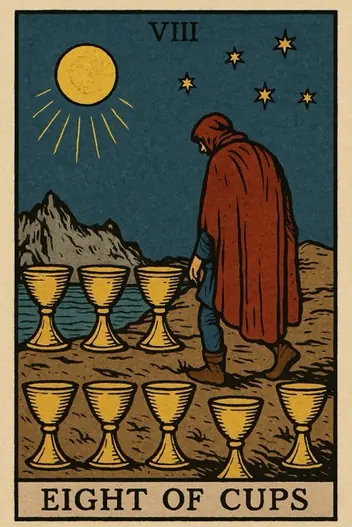
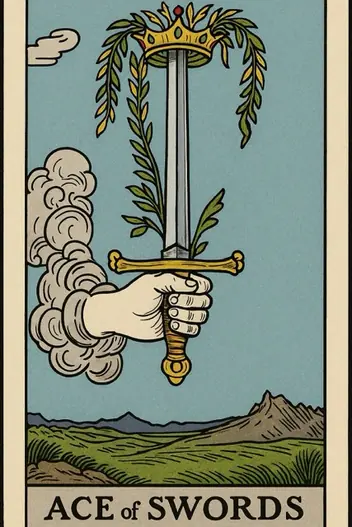
When the Eight of Cups—the card of deliberate withdrawal, emotional closure, and walking away from what no longer serves you—meets the Ace of Swords—the card of mental clarity, piercing truth, and decisive action—the result is a powerful psychological shift. This is not a gentle goodbye; it is a surgical severance. The seeker is not running away in confusion; they are leaving with a clear-eyed understanding of why they must go.
In practical terms, this pairing signals a moment where emotion gives way to reason. The Eight of Cups represents the painful but necessary act of leaving behind a familiar situation—perhaps a relationship, a job, or a belief system. The Ace of Swords provides the mental framework to justify that departure. Together, they create a state of calculated detachment: you know the cost of staying, and you are willing to pay the price of leaving. The key psychological archetype here is the Wounded Healer—someone who must first cut ties with the past to think clearly about the future.
Core Dynamics & Interpretation
The core dynamic of the Eight of Cups and Ace of Swords is a strategic exit rather than an impulsive escape. The Eight of Cups alone can indicate emotional burnout or a vague sense of dissatisfaction. But the Ace of Swords adds intellectual rigor to the decision. This is not a whim; it is a conclusion drawn from careful analysis. The seeker has likely been weighing pros and cons, observing patterns, and finally arriving at a logical verdict.
Psychologically, this combination activates what Jung called "individuation" —the process of separating from collective norms or dysfunctional attachments to become more whole. The Ace of Swords cuts through the fog of guilt, obligation, or nostalgia that might have kept the seeker stuck. The message is clear: staying is a choice, and leaving is a choice—but only one aligns with your long-term integrity. The shadow risk is that this clarity can feel cold or ruthless. The seeker must guard against using intellectual justification to avoid processing grief or loss. The goal is not to feel nothing, but to act with purpose despite the discomfort.
In real-world terms, this means the seeker is likely finalizing a decision they have been contemplating for weeks or months. They have gathered enough evidence—emotional, financial, or relational—to know that the current path is unsustainable. The Eight of Cups provides the courage to walk away, while the Ace of Swords ensures the exit is well-planned and decisive. This is a powerful, albeit difficult, phase of personal growth.
Love and Relationships
If you are single:
This pairing suggests you are ready to mentally close the chapter on a past relationship or pattern. You may have been holding onto hope or nostalgia, but the Ace of Swords gives you the clarity to see why it was not working. Act on this insight by setting clear standards for future partners.
If you are in a relationship:
This combination signals a critical conversation or a major decision point. One partner may feel the need to leave, while the other is forced to confront hard truths. Honesty, even if painful, is the only path forward.
In relationships, the Eight of Cups and Ace of Swords often appear when one partner has emotionally checked out but is now using logic to justify the departure. This is not about impulsivity; it is about recognizing that the relationship has reached a dead end in terms of growth. The Ace of Swords demands that both parties face the truth: perhaps values have diverged, communication has broken down, or fundamental needs are not being met. The advice here is to avoid blame or emotional manipulation. Instead, focus on clear, respectful communication about what is and is not working. If you are the one leaving, do so with integrity—do not ghost or leave ambiguous signals. If you are the one being left, use this as a moment of radical self-honesty about what you contributed to the dynamic.
For couples who choose to stay, this combination can be a catalyst for restructuring the relationship. The Ace of Swords can cut away old patterns of resentment or avoidance. The key is to use this mental clarity to negotiate new terms, not to punish each other. Therapy or structured conversations may be necessary to ensure the emotional cost of staying does not outweigh the benefits.
Your pair is already on the table. Ask your question and draw the clarifying card
or simply focus on it
Career Meaning of Eight of Cups and Ace of Swords
Strategic Opportunities:
Walk away from a role or project that no longer aligns with your core values or professional growth. The Ace of Swords gives you the clarity to identify what is truly holding you back.
Strategic Opportunities:
Use this period of mental sharpness to negotiate a severance, a pivot, or a new role with better conditions. The Eight of Cups energy supports a clean break, while the Ace of Swords helps you draft a clear exit strategy.
Calculated Risks:
Avoid burning bridges out of frustration. The Ace of Swords can cut too deep if you act impulsively. Ensure your departure is strategic, not reactive.
In the career context, the Eight of Cups and Ace of Swords is a powerful signal for professional reinvention. You may have been feeling undervalued, stagnant, or misaligned with your company’s culture. The Eight of Cups says it is time to move on, but the Ace of Swords insists you do so with precision and planning. This is not a resignation letter written in anger; it is a well-reasoned decision supported by data, networking, and financial preparation.
Financially, this combination warns against emotional spending or rash investments as a way to cope with dissatisfaction. Instead, use the Ace of Swords to audit your budget and identify where you are leaking resources into dead-end ventures. The best financial move now is to cut losses on underperforming assets or side projects. If you are considering a career change, focus on upskilling or acquiring certifications that give you a competitive edge. The Eight of Cups energy supports leaving, but the Ace of Swords ensures you have a landing pad before you jump.
Get a personalized interpretation
Unlock the combined meaning of your cards in the context of your unique question — for free.
Reversed Positions: What Changes?
When cards appear reversed, the dynamic is distorted, but not eliminated.
Eight of Cups Reversed:
This is blocked departure. You know you need to leave, but you cannot. Fear, guilt, or false hope keep you in place. Warning: you risk becoming a hostage to your own passivity. Advice: acknowledge that your inaction is also a choice, and it has consequences.
Ace of Swords Reversed:
This is inner resistance to the truth. You have the information, but you refuse to accept it. This is the cognitive distortion of "denial." Advice: find one person you trust, and allow them to speak the truth to your face.
Both Reversed:
Complete imbalance. You are stuck in a situation where you can neither leave nor stay. This is paralysis of the will. Correction: start small—make one simple but honest decision about your day. Reconnect with reality through action, not through rumination.
What Are the Risks of Eight of Cups and Ace of Swords?
The shadow of the Eight of Cups and Ace of Swords is intellectual coldness used to avoid emotional responsibility. The seeker may convince themselves they are being "logical" when they are actually being defensive or dismissive. This can manifest as ghosting a partner, quitting a job without notice, or cutting off a friend without explanation. The cognitive bias at play is rationalization: using reason to justify what is actually an emotional avoidance.
Another pitfall is analysis paralysis disguised as decisiveness. The seeker may overthink the exit, waiting for the "perfect" moment or the "perfect" reason, when in reality, the data is already clear. This combination demands action, not endless deliberation. The warning is to avoid using the Ace of Swords' clarity as a weapon against others or yourself. Do not shame yourself for needing to leave, and do not punish others for your decision.
Finally, the shadow can appear as a refusal to grieve. The Eight of Cups represents loss, and the Ace of Swords can make the seeker feel they should "just move on" without processing the sadness. This suppresses the emotional work needed to truly heal. The healthy path is to acknowledge the loss while using the mind to build a new structure for your life.
Synthesis: Strategic Conclusion
Constructive use of this energy requires the discipline of discernment. The Eight of Cups is about "when to leave." The Ace of Swords is about "how to do it." Your task is not to let one dominate the other. If you feel emotions overwhelming you, use the Ace of Swords not for striking, but for diagnosis. Ask yourself: "What exactly am I losing by staying?" Write down the answers. If the list of losses outweighs the gains—you have the right to leave.
A deep strategic counsel: do not burn bridges until you have built a new one. The Eight of Cups walks into the void, but the Ace of Swords must clear the path to a new goal. Before announcing your decision, ensure you have at least a rough draft of Plan B. Clarity without action is self-deception. Action without clarity is chaos. Your task is to find the point of equilibrium where cold calculation serves your long-term interests, not merely justifies fleeing from discomfort.
Applying This to Your Situation
The Eight of Cups and Ace of Swords together deliver a clear message: leave what no longer serves you, but do so with clarity, strategy, and integrity. This is a time for decisive action backed by honest self-assessment. Whether in love, career, or personal growth, the combination urges you to cut ties with the past and step into a future defined by your own values. The pain of leaving is real, but the cost of staying is greater.
Ready to see how this applies to your exact situation? The Fortune Cards app provides a deep, personalized interpretation of this combination for your specific question—whether it's about a relationship, a career move, or a life transition. Use it on the web or download it now to get the clarity you need to take your next step with confidence.
Interpretation by the Fortune Cards editorial team, based on the Rider–Waite tradition and Jungian archetypes. About our methodology · Updated: 2026-08-26
Other Combinations with Eight of Cups
Other Combinations with Ace of Swords
Explore Individual Card Meanings
Ready to find answers to your questions?
Start your first reading now and look at your situation with fresh clarity. The cards are ready to reveal deeper meaning.