Eight of Cups and Seven of Swords Tarot as Feelings
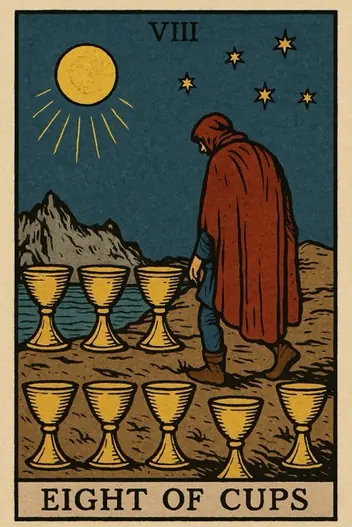

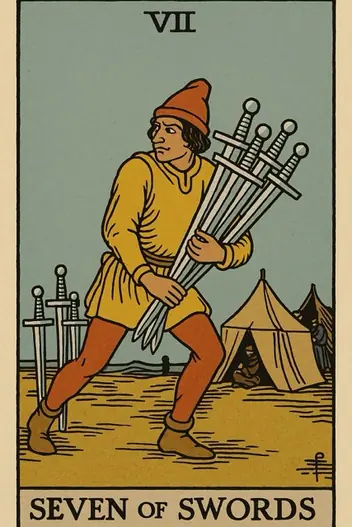
- Arcana
- Eight of Cups — Minor Arcana, Cups; Seven of Swords — Minor Arcana, Swords
- Elements
- Eight of Cups — Water; Seven of Swords — Air
- Elemental interaction
- Neutral elements — energies coexist without conflict
- Numerology
- 8 + 7 = 15 → 6
When the Eight Of Cups—the card of walking away from emotional investment—meets the Seven Of Swords—the card of stealth, strategy, and selective honesty—you are looking at a powerful psychological archetype. This is not a combination of passive resignation; it is a calculated withdrawal from a situation that no longer serves your growth. The core conflict here is between emotional detachment and strategic deception. In real life, this often manifests as someone leaving a relationship, job, or commitment quietly, without full transparency, because they believe the truth would create more chaos than it resolves.
This pairing demands a pragmatic assessment of your motives. Are you leaving to protect yourself, or are you avoiding accountability? The Eight Of Cups provides the motivation to move on, while the Seven Of Swords provides the method. Together, they create a risk-management mindset where you prioritize your own psychological safety over social niceties. The key is to ensure your exit is not just clever, but also ethical in the long run.
Core Dynamics & Interpretation
The psychological state created by the Eight Of Cups and Seven Of Swords is one of controlled disengagement. You have likely reached a point of emotional exhaustion (Eight Of Cups) but are not ready to confront the situation head-on. Instead, you are using strategic avoidance—a form of cognitive dissonance reduction—to navigate the gap between what you feel and what you are willing to express. This is not cowardice; it is a survival mechanism. The Seven Of Swords lends you the ability to read the room, identify weak points, and exit without triggering a defensive reaction from others.
In real-world terms, this combination often appears when you are planning a quiet resignation from a job, a slow fade from a friendship, or a carefully worded breakup that omits certain uncomfortable truths. The risk is that you may become too comfortable with selective transparency, rationalizing deception as a necessary evil. The strength is that you are emotionally honest with yourself—you know this situation is over, and you are acting on that knowledge. The core dynamic is a tension between self-preservation and integrity. To use this energy wisely, you must ask: Am I protecting my peace, or am I avoiding a necessary confrontation?
What Do Eight of Cups and Seven of Swords Say About Love?
If you are single:
This combination suggests you are evaluating a new connection with a skeptical eye. You may sense that the other person is not fully transparent, or you are withholding parts of yourself to test their intentions. Proceed with caution, but do not ghost without reason.
If you are in a relationship:
This pairing often indicates a power imbalance where one partner is emotionally checked out and considering a quiet exit. Communication is likely strained, with unspoken resentments and strategic omissions replacing honest dialogue.
In relationships, the Eight Of Cups and Seven Of Swords point to a critical juncture where emotional withdrawal meets calculated behavior. If you are the one pulling away, you must examine whether your avoidance is protecting you from pain or preventing your partner from understanding your true needs. Bold, honest confrontation is often more healing than a silent retreat. If you suspect your partner is using this energy, look for subtle signs of withholding information—such as vague answers about their feelings or sudden changes in availability without explanation. The healthiest path forward is to acknowledge the emotional distance and decide whether to bridge it with vulnerability or end it with clarity. Do not mistake silence for peace; it is often just deferred conflict.
Your pair is already on the table. Ask your question and draw the clarifying card
or simply focus on it
What Do Eight of Cups and Seven of Swords Indicate for Your Career?
Strategic Opportunities:
Quietly pivoting to a new role or industry without burning bridges is a key strength. Use this energy to network discreetly and gather intelligence before making a move.
Strategic Opportunities:
Reevaluating your professional worth and walking away from undervalued positions. This is an excellent time to renegotiate terms or exit a toxic work environment with a well-planned exit strategy.
Calculated Risks:
Avoid stealing credit or withholding critical information from colleagues. The Seven Of Swords warns that short-term gains through deception can damage your reputation long-term. Do not sabotage others to advance your own exit.
Professionally, this combination is a call to strategic action. The Eight Of Cups indicates that you have emotionally outgrown your current role, project, or company. The Seven Of Swords suggests that direct confrontation is not your best move—instead, gather data, secure your next opportunity, and leave without fanfare. Bold financial warning: If you are considering intellectual property theft or undermining a competitor, this card pair cautions that the karmic cost may outweigh the immediate benefit. Instead, focus on building your own assets—skills, savings, and connections—so that your departure is a strategic leap forward, not a desperate escape. The most profitable move is to invest in your own independence, not in someone else's downfall.
Reversed Positions: What Changes?
When cards appear in a reversed position, the dynamic becomes distorted. The straightforwardness of the strategy is lost, giving way to chaos or stagnation.
If the Eight of Cups is reversed:
This indicates a blocked potential for withdrawal. You want to leave, but cannot bring yourself to do it. You are stuck in a "swamp" of habit, fear, or guilt. The Seven of Swords in an upright position here can work against you — you are expending energy on cunning maneuvers within the situation, instead of gathering the will to actually depart from it. Advice: Acknowledge your fear of change. Your cleverness is currently serving self-deception.
If the Seven of Swords is reversed:
This is a signal of internal resistance and a weak strategy. Your "exit" plan is failing. What was hidden is becoming known, and you find yourself in a vulnerable position. The Eight of Cups (upright) provides the impulse to leave, but you are doing it unprepared, impulsively, leaving chaos in your wake. Warning: Your "tricks" will not work. The only way out is to act openly and honestly, even if it is painful.
If BOTH are reversed:
This is complete imbalance. You cannot leave (Eight of Cups in negative) and you cannot maneuver successfully (Seven of Swords in negative). This is a state of paralysis of will and confusion. You simultaneously want to throw it all away and fear the consequences. Advice: This is a point requiring external help (psychologist, mentor, coach). Getting out of this tangle of contradictions on your own is nearly impossible. An outside perspective is needed to break the cycle.
Deepen your understanding
Find out exactly what this reading means for your current life situation with our oracle.
Shadow Side & Pitfalls
The shadow of this combination emerges when fear of conflict overrides ethical clarity. You may rationalize gaslighting, ghosting, or passive-aggressive behavior as necessary self-protection. The cognitive bias at play is self-serving dishonesty—convincing yourself that others cannot handle the truth, when in reality, you cannot handle the discomfort of delivering it. This can lead to burning bridges you never intended to burn, as your stealthy exit is eventually discovered and interpreted as betrayal. Another pitfall is paralysis by analysis: you become so focused on planning the perfect escape that you never actually leave, remaining stuck in a situation that drains you. The shadow is a lack of courage disguised as strategy. If you find yourself lying by omission or manipulating perceptions to avoid accountability, you are operating from the lower expression of these cards. Honest detachment is growth; deceptive detachment is self-sabotage.
What Is the Overall Message of Eight of Cups and Seven of Swords?
Constructive use of this combination requires integration of emotional honesty and tactical wisdom. The Eight of Cups grants you the right to walk away from what drains you. The Seven of Swords gives you the tools to do so. But the key to success lies in directing cunning not at others, but at managing your own vulnerability.
Your strategy should look like this: first, you make an inner decision (Eight of Cups). You clearly define for yourself the reason for leaving: "This project/relationship has exhausted its potential for my growth." Then, you develop a damage minimization plan (Seven of Swords). You think not about how to deceive the system, but about how to exit it with maximum benefit for yourself and minimal harm to others.
A deep strategic piece of advice: use the Seven of Swords to protect your boundaries, not to attack those of others. Your task is not to "rob" the past, but to secure a safe passage into the future. This means you may not tell the whole truth if it would cause unnecessary pain, but you must not lie. You may leave without grand declarations, but you must not leave behind debts and unfulfilled promises. Clarity comes when you understand that your goal is not to win an argument, but to free up resources for a new life.
Where to Go From Here
The Eight Of Cups and Seven Of Swords together tell a story of strategic emotional departure. You are ready to leave something behind, but you must do so with self-awareness and integrity. The core message is: Know why you are leaving, and be honest about it—at least with yourself. Whether in love or career, this combination rewards calculated clarity over impulsive escape. Your next step is to define your boundaries and execute your exit plan without sacrificing your values.
While this article provides the general archetype, the true magic happens when Tarot is applied to your unique situation. The Fortune Cards app can give you a deep, personalized interpretation of this exact combination for your specific question—whether it’s about a relationship, a job, or a personal dilemma. Use it on the web or download it now to get the clarity you need to move forward with confidence and purpose.
Interpretation by the Fortune Cards editorial team, based on the Rider–Waite tradition and Jungian archetypes. About our methodology · Updated: 2026-08-26
Other Combinations with Eight of Cups
Other Combinations with Seven of Swords
Explore Individual Card Meanings
Table of Contents
- Core Dynamics & Interpretation
- What Do Eight of Cups and Seven of Swords Say About Love?
- What Do Eight of Cups and Seven of Swords Indicate for Your Career?
- Reversed Positions: What Changes?
- Shadow Side & Pitfalls
- What Is the Overall Message of Eight of Cups and Seven of Swords?
- Where to Go From Here
Ready to find answers to your questions?
Start your first reading now and look at your situation with fresh clarity. The cards are ready to reveal deeper meaning.