Seven of Swords and Ten of Pentacles Tarot as Feelings
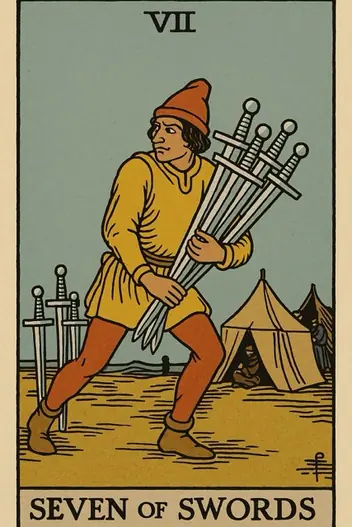
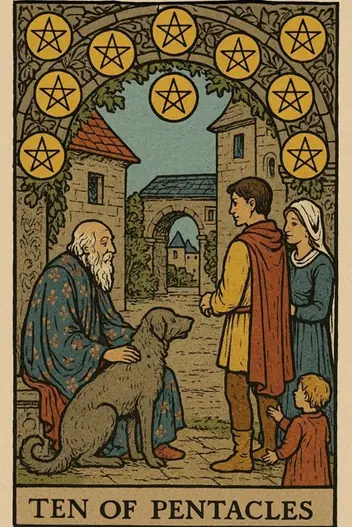
- Arcana
- Seven of Swords — Minor Arcana, Swords; Ten of Pentacles — Minor Arcana, Pentacles
- Elements
- Seven of Swords — Air; Ten of Pentacles — Earth
- Elemental interaction
- Opposing elements — energies create tension
- Numerology
- 7 + 10 = 17 → 8
When the Seven of Swords—the card of cunning, strategic withdrawal, and hidden agendas—intersects with the Ten of Pentacles—the archetype of legacy, family fortune, and long-term stability—a fascinating psychological tension emerges. This pairing often represents a moment where short-term tactical moves collide with long-term structural consequences. The seeker may be tempted to take a shortcut, conceal a truth, or operate outside the established rules of a system they wish to inherit or preserve. The core question becomes: Can you secure lasting prosperity through cleverness, or does deception ultimately unravel the very foundation you seek to build?
This combination demands a pragmatic examination of risk versus reward. It is not inherently "good" or "bad"; rather, it is a powerful signal that the seeker must weigh the immediate payoff of a strategic maneuver against the potential erosion of trust, reputation, or inheritance. In Jungian terms, this is the Shadow of the Trickster confronting the Animus of the Patriarch. The challenge is to integrate the Seven's resourcefulness without sacrificing the Ten's integrity.
Seven of Swords and Ten of Pentacles Combination Meaning
The psychological state created by this pair is one of calculated opportunism mixed with underlying anxiety. You see a clear path to a desired outcome—perhaps financial security, a promotion, or a family inheritance—but the direct route is blocked or carries a high cost. The Seven of Swords energy suggests a mental escape plan or a strategic withdrawal to regroup and act from the periphery. The Ten of Pentacles represents the established order you are trying to navigate: a company hierarchy, a family trust, or a long-term partnership. The key insight here is that the seeker feels they must operate outside the system to secure a place within it.
This dynamic often manifests as information asymmetry. You may know something others do not, or you are considering withholding key facts to gain an advantage. The most critical psychological risk is rationalizing dishonesty as "necessary" for a greater good. The Ten of Pentacles demands accountability across generations; the Seven of Swords seeks immediate tactical gain. When these energies merge, the practical advice is stark: Any short-term gain achieved through deception will likely trigger a long-term audit of your character. The real-world implication is that you must find a way to be both clever and transparent. Can you negotiate a win-win without hiding your true intentions? That is the core challenge.
Your pair is already on the table. Ask your question and draw the clarifying card
or simply focus on it
Seven of Swords and Ten of Pentacles in Love Tarot
If you are single:
This pair suggests you may be attracted to someone who seems established or wealthy, but you are unsure of their true intentions. Be wary of projecting a fantasy of "the perfect partner" onto someone who may be hiding their real circumstances. Prioritize verifiable actions over charming words.
If you are in a relationship:
A hidden agenda or unspoken financial arrangement may be eroding trust. This could involve secret spending, inheritance disputes, or one partner feeling they must "sneak" to get their needs met. Direct, honest conversation about money and boundaries is non-negotiable.
In relationships, the Seven of Swords and Ten of Pentacles combination often signals a power imbalance masked by tradition or money. One partner may feel they must be strategically silent about their desires to maintain the peace or preserve the family image. The Ten of Pentacles can represent the weight of family expectations—perhaps you feel pressured to stay in a relationship for financial security or social standing. The psychological danger is that you begin to operate like a spy in your own home. You might hide purchases, conceal feelings, or avoid discussing a major life decision. Boldly, the advice here is to stop treating your partner as an obstacle to be outsmarted. Instead, recognize that the legacy you are building together—whether of trust or resentment—is shaped by every honest disclosure. If you feel you must "steal" freedom or resources from the relationship, the structure itself needs renegotiation.
Career and Finances
Strategic Opportunities:
Use your analytical skills to identify inefficiencies in a legacy system (e.g., a family business or established company) and propose transparent, value-creating improvements rather than exploiting loopholes.
Strategic Opportunities:
This is an excellent time for restructuring debt or renegotiating contracts—but only if you are fully transparent about your financial position. The Seven's cunning can be a strength in competitive negotiations, but the Ten's stability demands you document everything.
Calculated Risks:
Avoid any action that could be perceived as insider trading, embezzlement, or breaking a fiduciary duty. The "shortcut" that seems too good to be true likely violates a core rule of the system. Do not sacrifice your professional reputation for a quick financial win.
Professionally, this combination points to a high-stakes decision involving inheritance, succession, or a major financial deal. You may be considering a strategic alliance with a partner who has more resources, but you are holding back some crucial information. The pragmatic approach is to treat this as a stress test for your ethics. Ask yourself: If my actions were fully visible to the board, the family, or the public, would I still proceed? If the answer is no, you are in the shadow territory. Financially, the Seven of Swords warns against "creative accounting" or hiding assets. The Ten of Pentacles rewards long-term, compound growth built on trust. The most strategic move is to leverage your intelligence to create a new, transparent structure—perhaps a side venture or a clear succession plan—rather than trying to pilfer from the old one.
Ask your specific question
Don't rely on generic meanings. Get a customized reading tailored specifically to your energies.
Reversed Positions: What Changes?
When the Seven of Swords is reversed, cunning loses its effectiveness. This may mean your plan has failed, a secret has been revealed, or you yourself have become entangled in your own lies. Warning: do not try to "force" the situation — admit the mistake. Or, conversely, you are finally abandoning dishonest tactics and ready to act directly, which opens the path to true stability.
If the Ten of Pentacles is reversed, the very foundations of stability are crumbling. Family bonds weaken, a business empire cracks at the seams, an inheritance loses its value. Advice: do not try to hold onto what is collapsing through new intrigues. This is a signal to reconsider what truly constitutes "home" and "security" for you, and to rebuild them on honest principles.
When BOTH cards are reversed, a complete imbalance sets in: you are simultaneously deceived and have lost your footing. This is a state of total crisis of trust in yourself and the world. The logical way to correct it: stop. Do not make decisions. Acknowledge that old strategies (cunning) and old structures (stability) no longer work. Your next step should be the simplest and most honest — ask yourself: "What can I do right now to regain at least a minimal sense of truth?"
Shadow Side & Pitfalls
When this energy is blocked or acted upon irrationally, the seeker falls into the Trickster Shadow. This manifests as self-sabotage through overconfidence in one's ability to deceive. You may believe you are too clever to get caught, or that the "end justifies the means." The cognitive bias at play is the "illusion of control" —you think you can manage the fallout of a hidden action, but the Ten of Pentacles represents a system far larger and more interconnected than you can control. A single lie can unravel decades of trust, particularly in family or corporate dynasties. Another pitfall is "analysis paralysis": you become so focused on the perfect strategic move that you never act, or you miss the window of opportunity. The Seven of Swords can also indicate scapegoating—blaming the system (the Ten) for your own unethical choices. The most dangerous outcome is being "caught in the act," leading to exile from the very legacy you sought to join.
Seven of Swords and Ten of Pentacles Combined Message
How can the energy of the Seven of Swords be used constructively to balance the Ten of Pentacles? Answer: transform cunning into strategy, and deception into confidentiality. The difference between cunning and tactics is that tactics do not violate ethical norms. You may "not say everything," but you must not lie. You may "circumvent obstacles," but you must not set others up. Your task is to protect the system, not to undermine it.
The Seven of Swords grants you a brilliant analytical mind and the ability to see hidden paths. The Ten of Pentacles is a card of responsibility and legacy. Strategic advice: use your discernment to identify external threats (competitors, fraudsters), not to manipulate those close to you. Become the "secret guardian" of your system, not its "inner thief." Only then can you preserve and multiply what you value.
Deep conclusion: true stability is never built on a foundation of lies. If you want a long-term result, you must be willing to endure temporary losses and discomfort for the sake of transparency. The combination of "Seven of Swords + Ten of Pentacles" teaches us that true strength lies not in the ability to conceal, but in the courage to be honest, even when it is risky.
Your Next Step: Personal Context Matters
The core message of Seven of Swords and Ten of Pentacles is a call for strategic integrity. You possess the intelligence and foresight to navigate complex systems, but the true test is whether you can do so without compromising the foundation you value most. Your next step is not to choose between "clever" and "stable"—it is to find the third path where your cunning serves the legacy, not subverts it.
However, Tarot archetypes are powerful, but they are also general. The true magic happens when this combination is applied to your unique situation—your specific question about a partner, a job offer, or a family conflict. Use the Fortune Cards app to get a deep, personalized interpretation of this exact combination for your question right now. Whether you access it on the web or download it, the app uses your context to reveal the hidden dynamics and actionable steps that a generic article cannot. Stop guessing—get your custom reading today.
Interpretation by the Fortune Cards editorial team, based on the Rider–Waite tradition and Jungian archetypes. About our methodology · Updated: 2026-08-26
Other Combinations with Seven of Swords
Other Combinations with Ten of Pentacles
Explore Individual Card Meanings
Table of Contents
Ready to find answers to your questions?
Start your first reading now and look at your situation with fresh clarity. The cards are ready to reveal deeper meaning.