Love Tarot: The Hanged Man and Ten of Pentacles
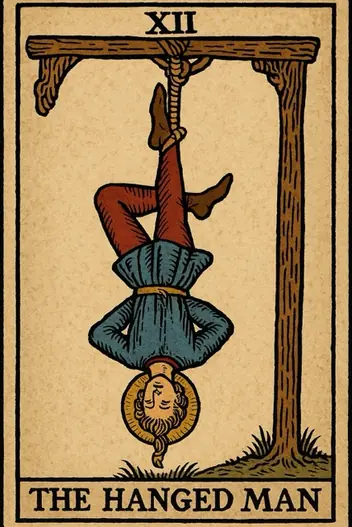
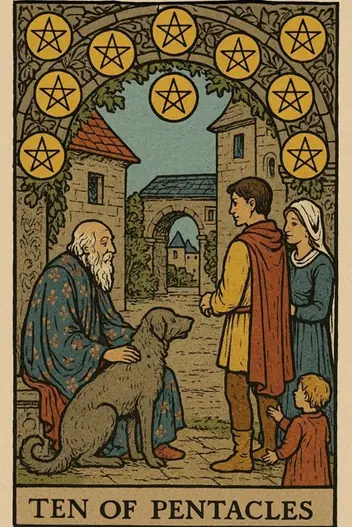
- Arcana
- The Hanged Man — Major Arcana; Ten of Pentacles — Minor Arcana, Pentacles
- Elements
- The Hanged Man — Water; Ten of Pentacles — Earth
- Elemental interaction
- Friendly elements — energies support each other
- Numerology
- 12 + 10 = 22 → 4
When the Hanged Man meets the Ten of Pentacles, we encounter a profound psychological tension: the need to pause and gain perspective collides with the drive to secure long-term stability and legacy. This is not a card of immediate action, but of strategic recalibration. You are being asked to sacrifice a comfortable routine or a familiar definition of success to align with a deeper, more authentic purpose. The Hanged Man represents a voluntary suspension—a period of waiting that is actually a form of active, internal work. The Ten of Pentacles represents the material and emotional inheritance we either build or inherit, including family, career structures, and financial foundations.
In practical terms, this combination suggests you are at a crossroads where the very structures you rely on for security may be the source of your stagnation. You may feel trapped between honoring tradition and breaking free to find your own path. The key insight here is that this "hanging" period is not wasted time; it is a necessary incubation for a more grounded, sustainable future. The Ten of Pentacles promises that the rewards of this pause will be tangible and lasting, but only if you are willing to release old attachments to how things "should" be done.
The Hanged Man and Ten of Pentacles Combination Meaning
The psychological core of this pairing is a conflict between the superego (internalized rules and expectations) and the authentic self. The Hanged Man represents the ego's suspension—a moment where you stop trying to control outcomes and instead observe your own patterns. Meanwhile, the Ten of Pentacles activates the archetype of the "Pater Familias" or the "Matriarch"—the drive to build something that outlasts you. When these collide, you may feel a deep sense of guilt or obligation about deviating from family or societal expectations, even as you sense that the old path is no longer viable.
This is a highly strategic moment for long-term planning. The Hanged Man's perspective allows you to see the hidden dynamics in your family, career, or financial structures that you previously overlooked. You might notice, for example, that you are repeating a parent's career mistake or inheriting a limiting belief about money. The Ten of Pentacles asks you to consciously choose which legacy you want to build—not just inherit. The actionable takeaway is this: Stop trying to force outcomes. Instead, spend the next 2-4 weeks observing your patterns without judgment. Journal about the stories you tell yourself about security, success, and duty. This data will be invaluable for the next phase.
What Do The Hanged Man and Ten of Pentacles Indicate for Your Career?
Strategic Opportunities:
Reevaluate your career path from a bird's-eye view. This is an ideal time to step back from day-to-day tasks and assess whether your current role aligns with your long-term vision of legacy and impact.
Strategic Opportunities:
Focus on skill-building and research. Use this pause to learn a new competency that will future-proof your career or to study market trends before making a major investment.
Calculated Risks:
Avoid making major financial commitments during this period. The Hanged Man warns that you may lack critical information. Do not sign contracts, change jobs, or make large purchases without a 30-day review period.
Professionally, this combination is a powerful signal to stop chasing short-term gains at the expense of long-term stability. You may feel pressure to "keep up" with peers or family members, but the Ten of Pentacles rewards patience and legacy-building. Strategic tip: If you are considering a career shift, treat this as a "sabbatical of the mind." Spend a few weeks networking with people in fields that interest you, but do not commit to anything. Financially, be wary of "golden handcuffs"—situations where high pay keeps you in a role that drains your spirit. The Hanged Man asks you to calculate the true cost of your current security. Bold financial warning: Avoid leveraging debt to maintain a lifestyle that no longer fits your values.
Your pair is already on the table. Ask your question and draw the clarifying card
or simply focus on it
Love and Relationships
If you are single:
This combination suggests you may be attracted to someone who represents stability or tradition, but you feel a strange hesitation. The pause is a sign to examine whether you are seeking a partner for genuine connection or to fulfill a family or social expectation. Do not commit until you have clarity.
If you are in a relationship:
You or your partner may feel stuck in a routine that provides security but lacks emotional vitality. The Hanged Man here calls for a "time-out" to discuss the unspoken contracts in your relationship—like who pays for what, or whose career takes priority.
In relationships, this pairing often reveals power dynamics rooted in historical obligation. One partner may feel they are sacrificing their own dreams to maintain a family legacy or financial stability. The Hanged Man's energy is not passive resignation; it is active, conscious waiting. For couples, this means scheduling intentional conversations about the future without pressure to decide immediately. Bold advice: Use this time to explore each other's fears about inheritance, family expectations, and long-term goals. The Ten of Pentacles ultimately rewards those who build a partnership based on shared values, not just shared history. If you are single, avoid rushing into a relationship that looks "perfect on paper" but feels hollow. The Hanged Man warns that your intuition is more reliable than your checklist.
Get a personalized interpretation
Unlock the combined meaning of your cards in the context of your unique question — for free.
What Are the Risks of The Hanged Man and Ten of Pentacles?
The shadow of this combination emerges when the seeker mistakes paralysis for enlightenment. The Hanged Man's pause can become a trap of endless analysis, where you use "waiting for clarity" as an excuse to avoid making hard decisions. The Ten of Pentacles' shadow is rigid adherence to tradition or materialism—clinging to a job, relationship, or financial plan that is clearly failing because it "looks good" or "is what's expected." Cognitive biases to watch for include sunk cost fallacy (staying because you've already invested time or money) and status quo bias (fearing change more than the pain of stagnation). Self-sabotage here might look like: overworking to prove your worth, ignoring red flags in a partner because they come from a "good family," or refusing to ask for help because it feels like a weakness. The antidote is radical honesty about what you truly value versus what you've been taught to value.
Reversed Positions: What Changes?
If The Hanged Man is Reversed:
Blocked Potential or Recklessness. You are stuck in a sacrificial position but are not learning the lessons. You continue to lose time and money without changing your strategy. Advice: Stop immediately. The reversed Hanged Man indicates the pause has become prolonged and destructive. You need not to wait, but to act, even if it means losing part of the inheritance.
If the Ten of Pentacles is Reversed:
Internal Resistance or a Weak Foundation. The family or financial foundations have already cracked. You are sacrificing something to save what can no longer be saved. Warning: Do not try to fix what is broken by pouring resources into the past. You may need to acknowledge that the old structure has outlived its usefulness and sacrifice it in order to build a new one.
If BOTH are Reversed:
Complete Dynamic Imbalance. This is a state of acute crisis, where the sacrifice is meaningless and stability is an illusion. You are spending your last reserves of strength holding onto something that is collapsing. The logical way to correct this: a radical change of course. You need to abandon the idea of "salvation" and focus on preserving what is most valuable—your mental and physical health. Rebuild your basic foundations before you think about the legacy.
Synthesis: Strategic Conclusion
How can the energy of The Hanged Man be used constructively to balance the Ten of Pentacles? The answer lies in setting a clear goal. The Hanged Man is a tool, not a way of life. You must know precisely why you are pausing. If the Ten of Pentacles symbolizes "legacy," then your sacrifice must be aimed at preserving it, not at escaping reality.
Strategic advice: use the "Hanged Man" period for an audit of your resources. Take inventory of all assets: finances, connections, knowledge. What among these can be surrendered painlessly, and what must be protected at all costs? Your task is to sacrifice the small to save the essential. Do not try to hold on to everything.
The second step is a change of perspective. The Hanged Man sees the world upside down. This is a metaphor for seeking unconventional solutions. Perhaps the problem is not that you have little money, but that your business model is outdated. Or not that your partner doesn't value you, but that you yourself failed to set boundaries. Accept the uncomfortable truth you have been avoiding.
Finally, remember: this combination is not eternal. Once you pass the point of reassessment and accept the sacrifice, the energy of The Hanged Man will exhaust itself, and you will be able to activate a healthy Ten of Pentacles — stability founded on wisdom, not inertia. Your next step is not endless suffering, but a concrete action based on new understanding.
Your Next Step: Personal Context Matters
This combination ultimately asks you to sacrifice the illusion of control for the reality of growth. The Hanged Man is not a punishment; it is a gift of perspective. The Ten of Pentacles is not a prison; it is a promise that your patience will yield a legacy you can be proud of. Your next step is to identify one area of your life where you are holding onto a "should" that no longer serves you and consciously choose to release it for 30 days.
Want to apply this insight to your exact situation? The Fortune Cards app can give you a personalized, AI-driven interpretation of The Hanged Man and Ten of Pentacles based on your specific question—whether it's about a relationship, career choice, or financial decision. Stop guessing how these archetypes play out in your life. Use the app on the web or download it now to get a deep, context-aware reading that cuts through the general advice and speaks directly to your unique circumstances.
Interpretation by the Fortune Cards editorial team, based on the Rider–Waite tradition and Jungian archetypes. About our methodology · Updated: 2026-08-26
Other Combinations with The Hanged Man
Other Combinations with Ten of Pentacles
Explore Individual Card Meanings
Table of Contents
- The Hanged Man and Ten of Pentacles Combination Meaning
- What Do The Hanged Man and Ten of Pentacles Indicate for Your Career?
- Love and Relationships
- What Are the Risks of The Hanged Man and Ten of Pentacles?
- Reversed Positions: What Changes?
- Synthesis: Strategic Conclusion
- Your Next Step: Personal Context Matters
Ready to find answers to your questions?
Start your first reading now and look at your situation with fresh clarity. The cards are ready to reveal deeper meaning.