The Hanged Man
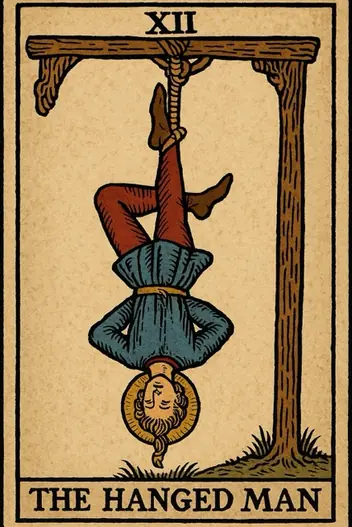
- Arcana
- Major Arcana · XII
- Element
- Water
- Planet / Sign
- Neptune
- Numerology
- 12 → 3
The Hanged Man represents a profound psychological archetype: voluntary surrender as a strategic act. In Jungian terms, this card embodies the Sacrifice of the Ego—a temporary suspension of control to gain a new perspective. It is not a card of passivity or victimhood, but of calculated stillness where action would be counterproductive.
The core challenge of this card is the tension between doing and waiting. It forces you to confront the discomfort of inaction when every instinct screams for movement. The Hanged Man asks: What if the most powerful move right now is to stop moving entirely? This is a high-stakes test of patience, trust in process, and the ability to see reality from an inverted angle.
What Does The Hanged Man Mean in Tarot?
The Hanged Man’s primary resource is perspective. By suspending your usual point of view, you gain access to insights that are invisible from a conventional stance. This card signals a period where reflection outweighs execution. In business, it might mean pausing a project to reassess its foundation; in personal growth, it means sitting with a problem rather than rushing to fix it.
Psychologically, this state mirrors the Jungian concept of enantiodromia—the tendency for things to turn into their opposite. By embracing suspension, you paradoxically accelerate resolution. The key insight here is that waiting is not wasting. The Hanged Man rewards those who can tolerate ambiguity long enough for clarity to emerge naturally. Practically, this means you must resist the urge to force outcomes in the next 30–60 days. Instead, gather data, observe patterns, and let the situation mature.
Ask your question and flip the cards
or simply focus on it
Yes/No Answer
No.. The Hanged Man signifies suspension, sacrifice, and a necessary pause—none of which align with a decisive, forward-moving outcome. Psychologically, it represents a state of liminality where the conscious mind must surrender control to the unconscious, meaning the answer is not yet available or requires you to shift perspective entirely. In reverse, the card leans Leaning No, as the person may be resisting this necessary pause, leading to stagnation or martyrdom rather than insight. The critical condition: the outcome depends on whether you can tolerate ambiguity and voluntarily release your attachment to a specific result—if you force a decision now, you will likely act from confusion rather than clarity.
Your unique Tarot reading
See how these cards interact with your destiny. Start a free personal reading now.
The Hanged Man as the Card of the Day
Today’s energy is one of voluntary surrender—you are being asked to stop pushing, stop solving, and instead observe from an inverted angle. The message is that your usual strategies are exhausted, and the only way forward is to hang upside down metaphorically, seeing the situation from a radically different viewpoint. Focus on doing nothing productive in the conventional sense: meditate, daydream, or let a problem rest while you attend to mundane tasks. Avoid the trap of self-pity or feeling victimized by circumstances, as this card’s shadow is passive resentment rather than active acceptance.
What Does The Hanged Man Mean in a Love Reading?
If you are not in a relationship:
This card suggests you are attracted to unavailable or complex partners because they mirror your own suspension. Your task is to stop waiting for a "perfect" moment and instead examine why you tolerate emotional limbo. The strategic move is to shift from seeking to attracting—stop chasing and let someone prove their interest through consistent action.
If you are in a relationship:
The Hanged Man indicates a power imbalance or unspoken sacrifice. One partner may be giving more than receiving, or both are stuck in a loop of avoidance. The practical advice is to schedule a structured conversation where each person states one thing they are sacrificing silently. This breaks the suspension without drama.
The core relationship insight here is that sacrifice must be reciprocal. If you are the one constantly waiting, compromising, or putting your needs on hold, you are not in a partnership—you are in a hostage situation. The Hanged Man warns against self-abandonment disguised as patience. Use this period to define your non-negotiables. If your partner cannot meet them, the suspension is not growth—it is stagnation.
What does he/she think of me?
Through the lens of The Hanged Man, this person perceives you as someone who represents a necessary suspension in their life—they see you as a catalyst for a pause they both need and resist. They feel a mix of fascination and discomfort, as you evoke the archetype of the wise fool or the sacrificial figure who challenges their habitual patterns. Their hidden intention is to use your presence as a mirror to examine their own stuckness, but they may also unconsciously hope you will “save” them from their inertia. At the same time, they fear that engaging with you will demand a painful sacrifice of their own comfort or identity. The internal conflict is clear: they are drawn to the stillness you represent, yet they are terrified of the vulnerability required to truly meet you there.
The Hanged Man in Career and Finance
Strategic Opportunities:
Reevaluate your current role or business model. This is a prime time to audit processes, cut inefficiencies, and pivot from a position of reflection rather than panic.
Resource Management:
Build a financial cushion. The Hanged Man favors liquidity over leverage. Save cash, reduce debt, and delay major investments until the fog clears.
Calculated Risks:
Avoid making decisions based on pressure or urgency. If a deal requires immediate commitment, walk away. The Hanged Man exposes "opportunities" that are actually traps disguised as speed.
In professional settings, this card signals a strategic pause. You might feel stuck in a dead-end job or stalled project, but the Hanged Man reveals that this limbo is a test of your ability to re-frame the problem. Instead of asking "How do I get out?" ask "What am I meant to learn here?" Financially, the bold warning is to avoid speculation. The market or your business may look volatile, but the Hanged Man counsels defensive positioning: preserve capital, gather intelligence, and wait for a moment of structural clarity before acting.
What Does The Hanged Man Reversed Mean?
When reversed, the Hanged Man signals blocked potential—you are suspended but not voluntarily. This manifests as internal resistance to necessary sacrifice. You may be clinging to a relationship, job, or belief system that has already expired, refusing to let go because of fear or pride. The warning here is clear: stubbornness is not strength. The reversed card indicates that your refusal to pause is causing greater damage than any loss you fear.
To correct this imbalance, you must identify what you are avoiding. Is it a difficult conversation? A career change? Admitting a mistake? The solution is active surrender—consciously choose to release the thing you are gripping too tightly. This might mean resigning, ending a relationship, or accepting a short-term loss. The paradox is that by letting go, you regain momentum. The reversed Hanged Man is a call to stop pretending you are in control and instead align with reality.
Shadow Side and Pitfalls
The shadow of the Hanged Man is martyrdom without purpose. You may rationalize inaction as "wisdom" when it is actually procrastination dressed as philosophy. Cognitive biases like loss aversion and sunk cost fallacy thrive here—you stay in a bad situation because you've already invested time, energy, or money. This is self-sabotage: you are waiting for a rescue that will never come.
Another pitfall is perfectionism disguised as patience. You tell yourself you are "waiting for the right moment," but the right moment is a myth. The Hanged Man’s shadow demands that you distinguish between necessary suspension and cowardice. Ask yourself: Am I pausing to gain clarity, or am I hiding from a decision I need to make? If your answer is the latter, the card’s energy has turned toxic. The only cure is to take one concrete action—even a small one—to break the freeze.
The Hanged Man: The Combined Message
The Hanged Man is a card of high-level strategy, not passivity. To use its energy constructively, you must adopt a meta-cognitive stance: observe your own thoughts, emotions, and reactions as if from outside. This detachment is not coldness—it is clarity. The practical application is to create a "suspension protocol" for your life. For the next week, do not make any major decisions. Instead, keep a journal of what you notice: patterns in your relationships, recurring thoughts in your career, financial triggers. This data will reveal the next move.
The deepest strategic advice of the Hanged Man is this: the most powerful action is often no action at all. In a world that rewards speed and hustle, this card reminds you that timing is a form of intelligence. By pausing, you allow the system to reveal its weaknesses. By waiting, you let others expose their hand. By sacrificing the need to be right now, you position yourself to win later.
The key is to make your suspension intentional. If you are stuck, ask: What am I refusing to see because I am looking from the wrong angle? The Hanged Man’s gift is not suffering—it is the freedom that comes from letting go of the need to control. Embrace that freedom, and you will emerge from this period with a strategy that no amount of frantic action could have produced.
Where to Go From Here
This psychological and strategic breakdown provides a deep understanding of archetypes. However, Tarot is never universal for everyone. To understand exactly how this dynamic applies to your specific situation, a reading tailored exclusively to you is necessary.
Download the Fortune Cards app or visit our platform to get a deep AI interpretation of your unique spread. Don't just read about the cards—use Fortune Cards to find out exactly what step you need to take next.
Try Tarot Spreads with The Hanged Man
Interpretation by the Fortune Cards editorial team, based on the Rider–Waite tradition and Jungian archetypes. About our methodology · Updated: 2026-08-26
Top Combinations with The Hanged Man
Discover how The Hanged Man interacts with other major cards in the deck to form powerful messages.
All 77 Combinations with The Hanged Man
Discover how this card interacts with every other card in the Tarot deck and reveal hidden meanings.
Table of Contents
- What Does The Hanged Man Mean in Tarot?
- Yes/No Answer
- The Hanged Man as the Card of the Day
- What Does The Hanged Man Mean in a Love Reading?
- What does he/she think of me?
- The Hanged Man in Career and Finance
- What Does The Hanged Man Reversed Mean?
- Shadow Side and Pitfalls
- The Hanged Man: The Combined Message
- Where to Go From Here
Explore Tarot Universe

Ready to find answers to your questions?
Start your first reading now and look at your situation with fresh clarity. The cards are ready to reveal deeper meaning.