The Emperor and The Hanged Man Meaning in Tarot

- Arcana
- The Emperor — Major Arcana; The Hanged Man — Major Arcana
- Elements
- The Emperor — Fire; The Hanged Man — Water
- Elemental interaction
- Opposing elements — energies create tension
- Numerology
- 4 + 12 = 16 → 7
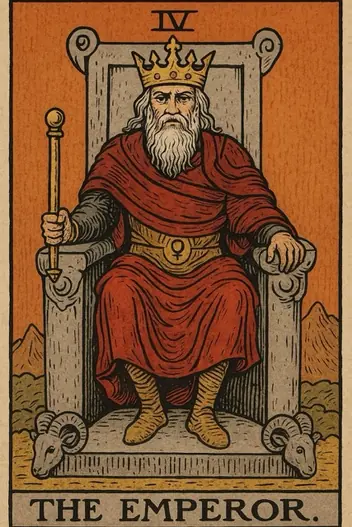
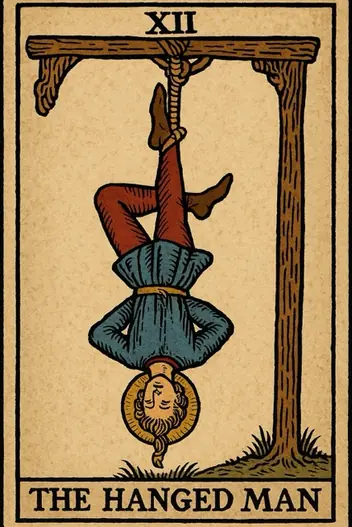
When the Emperor’s rigid structure meets the Hanged Man’s suspended perspective, you are confronting a fundamental tension in your psyche: the need to maintain order versus the necessity of letting go. The Emperor represents authority, discipline, and the establishment of boundaries, while the Hanged Man embodies surrender, sacrifice, and seeing the world from a new angle. In practical terms, this combination often appears when you are forced to pause a long-held plan, or when a crisis of control demands you rethink your entire approach to power.
This is not a passive or weak pairing. It is a strategic paradox—you must hold your ground while simultaneously releasing your attachment to the outcome. The psychological task here is to integrate the Emperor’s executive function with the Hanged Man’s perspective-shifting capacity. You are being asked to lead from a place of stillness, not from a place of force.
The Emperor and The Hanged Man Together: Meaning
The core dynamic of the Emperor and the Hanged Man is a collision between structure and suspension. The Emperor insists on rules, boundaries, and decisive action. The Hanged man demands you stop, reflect, and accept a temporary loss of control. This creates a unique psychological state: disciplined waiting. You are not giving up; you are strategically pausing to gather intelligence that your usual top-down approach has missed.
In practice, this often manifests as a leadership crisis or a relationship power struggle where your usual methods are failing. The Emperor’s shadow is rigidity—insisting on a plan that no longer fits. The Hanged Man’s shadow is passivity—indefinitely postponing necessary decisions. The balanced integration means you maintain your core principles (Emperor) while remaining open to a radical shift in perspective (Hanged Man). The key insight: your authority is not weakened by patience; it is refined by it.
From a Jungian lens, this is an encounter with the Self. The Emperor is the ego’s will and structure; the Hanged Man is the unconscious, which demands sacrifice of the old identity. The result is often a meaningful reorientation of your life’s direction—but only if you consciously choose to learn from the pause rather than resent it.
Your pair is already on the table. Ask your question and draw the clarifying card
or simply focus on it
The Emperor and The Hanged Man as Feelings
If you are single:
This pairing suggests you may be attracting or evaluating partners who present a strong, authoritative exterior but are emotionally unavailable or stuck. The key is to assess whether the person’s stability comes from genuine confidence or from a fear of vulnerability. Do not rush into commitment; observe how they handle uncertainty.
If you are in a relationship:
You are likely in a phase where one partner is asserting control (Emperor) while the other feels stuck or sacrificed (Hanged Man) . This can lead to a power imbalance or a stalemate. The solution is to create a structured space for honest, vulnerable dialogue—not to win, but to see the issue from each other’s viewpoint.
The relationship dynamic here is a test of emotional intelligence and boundary negotiation. The Emperor partner needs to learn that true strength includes the willingness to be vulnerable and to pause. The Hanged Man partner must resist the temptation to become a martyr—surrender is not the same as self-abandonment. The most productive path forward is to schedule a 'pause' in the conflict where both parties agree to listen without defending. This temporary suspension of the usual power struggle can reveal hidden solutions. Bold action here is not about pushing harder; it is about creating the conditions for a breakthrough through mutual respect and a shared commitment to understanding.
The Emperor and The Hanged Man in Career Readings
Strategic Opportunities:
Pause before launching a major initiative. Use this time for market research, scenario planning, or seeking mentorship. The delay is not a setback; it is a quality-control checkpoint.
Strategic Opportunities:
Re-evaluate your leadership style. If you are a manager, consider a more collaborative or coaching-based approach rather than top-down commands. This can unlock loyalty and innovation from your team.
Calculated Risks:
Avoid making decisions based solely on past success. The Hanged Man warns that the old formula may no longer work. Do not double down on a failing strategy out of pride. Instead, sacrifice the need to be right in favor of being effective.
Professionally, this combination often appears when you are at a crossroads between a structured career path and a radical pivot. The Emperor represents your current stability, while the Hanged Man suggests you may need to sacrifice a promotion, a title, or a familiar role to pursue something more aligned with your deeper purpose. Financially, this is not a time for high-risk investments. Instead, focus on consolidating assets and reducing debt. The strategic move is to pause all non-essential spending until the fog clears. The most profitable action you can take right now is a thorough audit of your current resources and commitments.
Deepen your understanding
Find out exactly what this reading means for your current life situation with our oracle.
The Emperor and The Hanged Man Reversed: What Changes?
When cards appear in a reversed position, the dynamic becomes distorted, yet more apparent.
Reversed Emperor + Upright Hanged Man:
This is recklessness and chaos masked as victimhood. The person loses authority but continues to insist on their own way, behaving like a capricious tyrant. Instead of a constructive pause, they throw a tantrum. Advice: Take a time-out to avoid completely destroying your reputation. You need to acknowledge your powerlessness before the situation.
Upright Emperor + Reversed Hanged Man:
This is resistance to change and "tunnel vision". The person is so fixated on their power that they refuse to see the obvious signals for change. They are not ready to "hang" and look at the situation differently. Warning: This is a direct path to stagnation and lost opportunities. Your rigidity is becoming your own worst enemy.
Both Reversed:
Complete imbalance. Anarchy and apathy. There is neither structure (The Emperor) nor a wise pause (The Hanged Man). The person either flails about chaotically or falls into a stupor. Method for correction: Start small. Create at least one simple routine (The Emperor) and set aside 15 minutes a day for reflection without your phone (The Hanged Man). The system must be rebuilt from the foundation.
Negative Meaning of The Emperor and The Hanged Man
The shadow of this pairing is a toxic loop of control and victimhood. The Emperor’s shadow manifests as authoritarianism, micromanagement, or a refusal to delegate—believing that only you can fix the problem. The Hanged Man’s shadow becomes learned helplessness, passive-aggression, or a martyr complex—waiting for someone else to rescue you. The most common cognitive bias here is the sunk cost fallacy: you keep pouring energy into a failing project or relationship because you’ve already invested so much. The Hanged Man’s wisdom is that sometimes the most powerful act of leadership is knowing when to let go. Another pitfall is false surrender—pretending to be open to change while secretly clinging to the old plan. This creates internal conflict and external confusion. If you feel stuck, ask yourself honestly: Are you truly pausing to learn, or are you just avoiding a difficult decision?
The Emperor and The Hanged Man: Tarot Advice
How to use the Emperor's energy to activate the wisdom of the Hanged Man, rather than his suffering? The answer is strategic humility. The Emperor must acknowledge that there are things he cannot control (the market, other people's feelings, timing). His task is to build a structure that is resilient to these uncontrollable factors, not to try and suppress them.
A practical algorithm for action: 1. Diagnosis (The Hanged Man). Stop for 24-48 hours. Completely disconnect from decision-making. Simply observe the situation from the outside, like a spectator in a theater. 2. Restructuring (The Emperor). After the pause, with a clear head, draw up a new plan. Remove everything from it that requires heroic efforts and sacrifices. Your new structure must be energy-efficient. 3. Delegation (Synthesis). Transfer some control to others. This is the act of trust that the Hanged Man symbolizes. You are not "hanging" alone; you are allowing the system to function without your total involvement.
The key insight: True power (The Emperor) is manifested not in the ability to keep everything under control, but in the ability to stop in time and reconsider your strategy (The Hanged Man). This is not weakness, but a higher form of leadership. The one who can voluntarily "hang" to see the whole picture ultimately wins the game.
Where to Go From Here
The Emperor and The Hanged Man together deliver a powerful message: True authority comes from the ability to pause, reflect, and realign your actions with a deeper truth. You are being asked to hold your structure loosely, to lead with patience, and to trust that the pause is not a punishment but a preparation. The answer is not in forcing your will, but in surrendering to a larger perspective—and then acting from that clarity.
This article provides the archetypal blueprint, but your specific situation is unique. The Fortune Cards app can give you a personalized, real-time interpretation of this exact combination for your specific question—whether it’s about love, career, or a personal dilemma. You can use it on the web or download it now to get the deep, actionable guidance you need, tailored to your life. Stop guessing. Start understanding.
Interpretation by the Fortune Cards editorial team, based on the Rider–Waite tradition and Jungian archetypes. About our methodology · Updated: 2026-09-17
Other Combinations with The Emperor
Other Combinations with The Hanged Man
Explore Individual Card Meanings
Table of Contents
- The Emperor and The Hanged Man Together: Meaning
- The Emperor and The Hanged Man as Feelings
- The Emperor and The Hanged Man in Career Readings
- The Emperor and The Hanged Man Reversed: What Changes?
- Negative Meaning of The Emperor and The Hanged Man
- The Emperor and The Hanged Man: Tarot Advice
- Where to Go From Here
Ready to find answers to your questions?
Start your first reading now and look at your situation with fresh clarity. The cards are ready to reveal deeper meaning.