Love Tarot: Eight of Cups and Six of Pentacles
- Arcana
- Eight of Cups — Minor Arcana, Cups; Six of Pentacles — Minor Arcana, Pentacles
- Elements
- Eight of Cups — Water; Six of Pentacles — Earth
- Elemental interaction
- Friendly elements — energies support each other
- Numerology
- 8 + 6 = 14 → 5
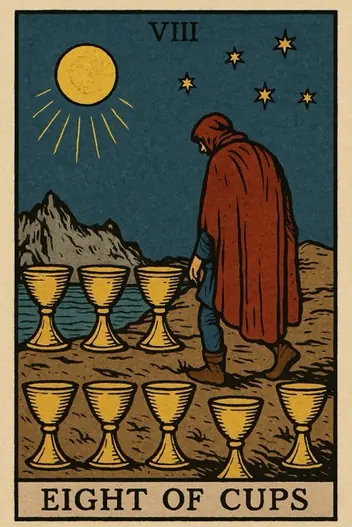
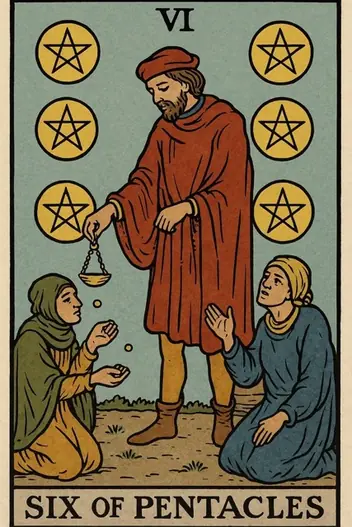
The Eight of Cups represents a deliberate withdrawal—a conscious decision to leave behind an emotional or situational investment that no longer serves your growth. The Six of Pentacles, in contrast, embodies resource exchange, power dynamics, and visible generosity. When these two cards collide, you are facing a moment where you must evaluate whether the "giving and receiving" in your life is actually costing you more than it returns.
This combination forces a pragmatic question: Are you staying in a relationship, job, or obligation purely because of sunk costs or a sense of duty? The Eight of Cups says "walk away," while the Six of Pentacles asks you to audit what you've been trading for stability. The psychological tension here is between the fear of losing support and the courage to reclaim your autonomy.
What Do Eight of Cups and Six of Pentacles Mean Together?
The core dynamic of this pairing is a psychological audit of reciprocity. The Six of Pentacles often signals a patron-client dynamic—someone holds the resources, and you are the recipient. The Eight of Cups suggests you are becoming aware that this exchange is emotionally or spiritually bankrupt. You may have been over-giving (your time, your labor, your loyalty) while under-receiving genuine value. The mind state here is one of calculated disillusionment: you see the ledger clearly and realize the balance is unfair.
This is not a rash departure. The Eight of Cups is a strategic retreat, not an impulsive escape. Combined with the Six of Pentacles, it implies you have already done the math. You’ve noticed that the "generosity" you receive comes with strings—covert control, guilt, or obligation. The psychological breakthrough is recognizing that your growth is not a transaction. You are willing to walk away from a stable resource (job, relationship, financial support) because the cost to your psyche is too high.
The key insight is that this combination rarely signals a complete loss. Instead, it points to a redirection of resources. You may need to stop being the "helper" or the "helped" in an unhealthy dynamic. The shadow of the Six of Pentacles is unequal power disguised as charity. The Eight of Cups says: "Your soul is not a dependent. Leave the arrangement."
Career and Finances
Strategic Opportunities:
Reclaim your autonomy by leaving a job or project where you are undervalued. The resources you need will come from a new source once you stop accepting less than you're worth.
Strategic Opportunities:
Redistribute your attention—stop over-investing in one client, boss, or financial stream that drains you. Diversify your energy.
Calculated Risks:
Avoid burning bridges without a plan. The Eight of Cups is a withdrawal, not a collapse. Ensure you have a transition strategy before cutting ties.
In the professional realm, this is a pragmatic warning about your value. The Six of Pentacles can represent a salary, a contract, or a patron—someone who controls the flow of money or opportunity. The Eight of Cups tells you that your potential is being capped by staying in this arrangement. You may have outgrown the role, and the "generosity" of your employer (or client) is actually a ceiling on your growth.
Financial warning:
Don't mistake stability for safety. If your current income comes with emotional strings or requires you to compromise your ethics, it's a debt you're paying with your integrity. The Eight of Cups says walk away before the cost becomes irreversible. However, the Six of Pentacles also reminds you to plan your exit—leave with grace, not spite, and ensure you have a resource buffer for the transition.
Your pair is already on the table. Ask your question and draw the clarifying card
or simply focus on it
What Do Eight of Cups and Six of Pentacles Say About Love?
If you are single:
This pairing suggests you may be attracted to someone who appears generous or stable, but you sense an underlying imbalance. You might be evaluating whether their "giving" is genuine or a form of control. The advice is to walk away from any connection that feels like a transaction.
If you are in a relationship:
You are likely facing a power disparity—one partner gives more financially, emotionally, or in terms of effort, while the other receives. The Eight of Cups warns that the "giver" may be on the verge of emotional withdrawal if the balance isn't addressed.
In relationships, this combination reveals a crucial moment of emotional honesty. The Six of Pentacles can represent a partner who uses resources (money, time, favors) to maintain the upper hand. The Eight of Cups is the realization that love cannot be bought or owed. If you are the one giving, you may feel resentment building as you realize your generosity isn't reciprocated on a soul level. If you are the one receiving, you may feel guilty or trapped by what you owe.
Key relationship advice:
Audit the power dynamics. Ask yourself: "Is my partner's generosity conditional? Am I staying out of obligation or genuine connection?" The healthiest outcome here is a renegotiation of terms—but if that's not possible, the Eight of Cups suggests a dignified exit is the most self-respecting choice.
Eight of Cups and Six of Pentacles: Warning Signs
The shadow of this combination is self-sabotage disguised as liberation. The Eight of Cups can become escapism—walking away not from a bad situation, but from the hard work of rebalancing. The seeker may convince themselves they are "moving on" when they are actually avoiding confrontation or accountability. The Six of Pentacles' shadow is martyrdom—you may be staying in an unhealthy dynamic because you believe your suffering is noble, or you fear being seen as "ungrateful."
Another pitfall is misreading generosity. You might interpret genuine support (from a partner, mentor, or employer) as controlling, when in fact you are simply uncomfortable with dependency. This leads to premature withdrawal and lost opportunities. Conversely, you might ignore red flags because the resources feel too good to leave. The cognitive bias here is loss aversion—you overvalue what you have and undervalue what you could gain by walking away.
The real danger is confusing the cards' messages. The Eight of Cups says "leave what drains you," but the Six of Pentacles asks "are you sure you aren't just running from responsibility?" The shadow emerges when you act without the audit—leaving without understanding why, or staying without addressing the imbalance.
Uncover hidden insights
Let our advanced Tarot system interpret these archetypes specifically for your personal path.
Reversed Eight of Cups and Six of Pentacles Explained
When cards are reversed, the imbalance intensifies, and hidden motives become apparent.
Eight of Cups Reversed:
Fear of leaving blocks resources. You understand that the relationship or job is going nowhere (as in the upright Eight), but you cannot bring yourself to leave. The Six of Pentacles (upright) in this context becomes an anchor: you accept help to justify your inaction. Warning: you are paying for comfort with your freedom.
Six of Pentacles Reversed:
Resources are used as weapons. If you are leaving (upright Eight), but the reversed Six suggests you are taking everything or, conversely, blackmailing with money. This is harsh manipulation or an attempt to buy your way out. Emotional withdrawal turns into a financial war.
Both Reversed:
Total imbalance and chaos. You cannot leave (fear), but you also cannot receive or give support (resources are blocked). This is a state of "frozen dependency": you hate the situation but refuse help or cannot accept it. Advice: acknowledge that you are stuck. The only way out is to take the first step toward a break (Eight) or honestly ask for help (Six), but not both at once.
Synthesis: Strategic Conclusion
Constructive use of this combination requires iron discipline in separating the spheres of life. The energy of the Eight of Cups is about the courage to say "no" to what has exhausted itself. The energy of the Six of Pentacles is about the wisdom to accept "yes" from what can become a support. Your task is not to let these currents mix.
How to apply this in practice? If you feel the need to leave (a relationship, project, city) but are held back by resources (money, status, obligations), use the Eight of Cups as a strategy and the Six of Pentacles as a tactic. The strategy is your decision to move toward authenticity. The tactic is how you do it: with gratitude, leaving support for those who remain, or accepting help for a fresh start. The key insight: leaving should not be an act of aggression, nor should resources be an act of mercy.
The synthesis of these cards teaches an ecological exit. You can leave a person or a system while maintaining respectful, pragmatic relations with them. This is not about "burning bridges," but about building new, healthier boundaries. Ask yourself: "How can I leave without destroying what was valuable and without creating debt traps?" This combination will provide the answer. Your strength lies in honesty with yourself: do not accept help if it binds you, and do not give it to silence guilt.
Applying This to Your Situation
The Eight of Cups and Six of Pentacles together deliver a sobering message about the price of your connections. You are being asked to evaluate the hidden costs of every relationship, job, and obligation. The core truth is that your growth cannot be outsourced or funded by another's generosity. Whether you need to renegotiate the terms or walk away entirely, the decision must come from a place of clear-eyed self-respect, not fear or resentment.
Ready to apply this to your unique situation? General interpretations can only take you so far. The real insight comes when these archetypes are mapped onto your specific question—your relationship, your career, your financial decision. Use the Fortune Cards app to get a deep, personalized reading of this exact combination. Whether on the web or via download, the app analyzes your context and delivers actionable psychological guidance tailored to your life. Stop guessing—get the clarity you need to make your next move.
Interpretation by the Fortune Cards editorial team, based on the Rider–Waite tradition and Jungian archetypes. About our methodology · Updated: 2026-08-26
Other Combinations with Eight of Cups
Other Combinations with Six of Pentacles
Explore Individual Card Meanings
Table of Contents
- What Do Eight of Cups and Six of Pentacles Mean Together?
- Career and Finances
- What Do Eight of Cups and Six of Pentacles Say About Love?
- Eight of Cups and Six of Pentacles: Warning Signs
- Reversed Eight of Cups and Six of Pentacles Explained
- Synthesis: Strategic Conclusion
- Applying This to Your Situation
Ready to find answers to your questions?
Start your first reading now and look at your situation with fresh clarity. The cards are ready to reveal deeper meaning.