Ace of Swords and Eight of Swords Tarot Combination
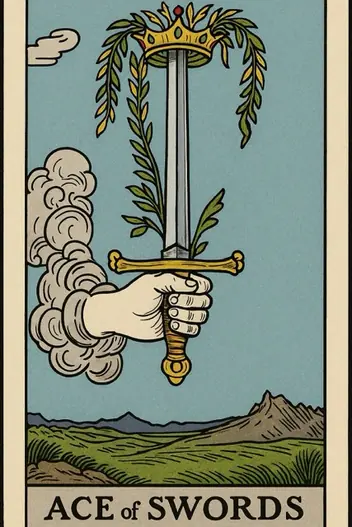

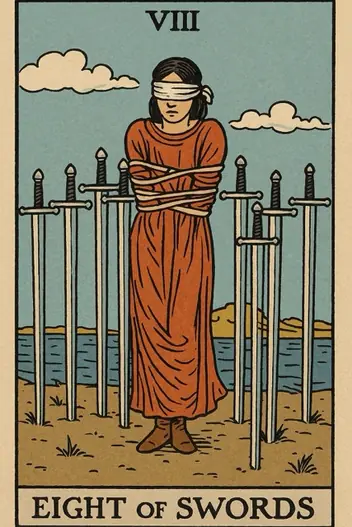
- Arcana
- Ace of Swords — Minor Arcana, Swords; Eight of Swords — Minor Arcana, Swords
- Elements
- Ace of Swords — Air; Eight of Swords — Air
- Elemental interaction
- Same element — energies intensify each other
- Numerology
- 1 + 8 = 9
When the Ace of Swords—the archetype of clarity, truth, and decisive action—collides with the Eight of Swords—the archetype of self-imposed restriction, victim mentality, and cognitive distortion—a powerful psychological tension emerges. The Ace represents a sharp, objective insight that can cut through confusion, while the Eight symbolizes the mental prison we build with our own fears and limiting beliefs. Together, they depict a critical moment: you possess the blade of truth, but you are still bound by invisible ropes of your own making.
This combination is a call to recognize that the primary obstacle is not external circumstance, but your own perception of it. The Eight of Swords reveals a tendency toward catastrophic thinking, where you feel trapped by situations that are, in reality, more fluid than they appear. The Ace of Swords arrives as the tool to sever these mental bindings. In a reading, this pairing signals a juncture where intellectual honesty and a willingness to reframe your narrative are the only paths forward. The real question is not "What is blocking me?" but "What belief am I holding that keeps me stuck?"
Ace of Swords and Eight of Swords Together: Meaning
The core dynamic of the Ace of Swords and Eight of Swords is a clash between objective truth and subjective illusion. The Eight of Swords represents a state of learned helplessness, where past disappointments or social conditioning have led you to believe that your options are limited. You may feel powerless, isolated, or unable to act. The Ace of Swords, however, is a lightning bolt of rational awareness. It offers a clear, unclouded perspective that reveals the cognitive biases—such as confirmation bias (only seeing evidence that supports your fear) or catastrophizing (assuming the worst-case scenario)—that are keeping you in a state of paralysis.
Psychologically, this combination highlights the ego's resistance to change. The Eight of Swords is comfortable in its victim narrative; it knows the rules of the prison. The Ace of Swords demands a painful but liberating confrontation: you must admit that you are the jailer. The strategic action here is to stop looking for external rescue and instead pick up the sword of your own critical thinking. Ask yourself: "What evidence do I have that I am truly trapped?" and "What would happen if I acted as if I had full agency?" The answer will often reveal that the chains were made of self-doubt, not steel. This is not a time for emotional processing; it is a time for cold, pragmatic analysis and a single, decisive move.
Ace of Swords and Eight of Swords as Feelings
If you are single:
This pairing suggests you are idealizing a potential partner while simultaneously convincing yourself you are not good enough for them. The Ace of Swords urges you to objectively assess both their flaws and your own value. Your perceived "unavailability" is likely a story you are telling yourself to avoid the risk of rejection.
If you are in a relationship:
You or your partner may be trapped in a pattern of silent resentment or unspoken rules that stifle authentic communication. The core issue is a fear of confrontation. The Ace of Swords demands a direct, honest conversation, even if it feels uncomfortable.
In relationships, this combination often signals a power imbalance rooted in communication avoidance. One partner may feel bound by the other's expectations or by their own fear of rocking the boat. The Eight of Swords manifests as a refusal to speak your truth, creating a psychological cage of "what-ifs." The Ace of Swords provides the emotional intelligence to recognize that silence does not preserve peace—it builds walls. Key relationship advice: use the Ace to initiate a "truth-telling" conversation. Define the issue with surgical precision. Avoid blame ("You always do X") and instead state your experience ("I feel trapped when we don't discuss Y"). This combination does not promise a smooth resolution, but it promises that staying silent is the only guaranteed failure. The risk of speaking is far lower than the cost of remaining bound.
Your pair is already on the table. Ask your question and draw the clarifying card
or simply focus on it
Ace of Swords and Eight of Swords in Career Readings
Strategic Opportunities:
Re-evaluate your current role or project scope. The Eight of Swords suggests you feel overburdened or micromanaged. The Ace of Swords indicates that a clear, written proposal or a direct conversation with a supervisor can redefine your boundaries and responsibilities.
Strategic Opportunities:
Use analytical tools to break down a complex problem. If you are feeling stuck on a project, the Ace of Swords is your data, your logic, and your critical thinking. Create a decision matrix or a simple pro-con list to cut through the fog.
Calculated Risks:
Avoid making a financial decision based on fear of missing out (FOMO) or fear of loss. The Eight of Swords can create a scarcity mindset where you hold onto a bad investment or avoid a necessary pivot because you feel you have "no other choice." The Ace warns: do not let a perceived lack of options drive you into a poor deal.
Professionally, this combination is a wake-up call to stop playing small. The Eight of Swords often appears when a person is overqualified for their role but feels trapped by golden handcuffs or imposter syndrome. The Ace of Swords provides the clarity to see that your skills are more portable than you think. Frame your career strategy around leverage, not loyalty. Objectively assess your market value. If you feel stuck in a negotiation, the Ace of Swords advises you to present your case with irrefutable logic and evidence. Remove emotional pleas and focus on data. Financially, this is a time for rigorous auditing. Look at your expenses, debts, and investments with cold, hard eyes. The Eight of Swords' illusion of scarcity is often shattered when you realize you have more control over your cash flow than you thought.
When Ace of Swords and Eight of Swords Signal Trouble
The shadow of this combination is a dangerous form of intellectual arrogance or self-deception. When the sharp logic of the Ace of Swords is hijacked by the fear of the Eight of Swords, the seeker may use "analysis paralysis" as a sophisticated excuse for inaction. You might generate endless pros and cons, gather more data, or seek a fifth opinion—all to avoid the discomfort of making a decision. This is cognitive distortion at its finest: using rational thinking to reinforce irrational fear. Another pitfall is using the "truth" of the Ace as a weapon. Instead of cutting through your own mental bindings, you may use your clarity to blame others, pointing out their flaws to deflect from your own feelings of entrapment. This is a defense mechanism that preserves your ego but deepens your isolation. The shadow also manifests as harsh self-criticism. The Eight of Swords' victim mentality can turn the Ace's clarity inward, leading to a cruel inner monologue: "I'm stuck because I'm stupid/weak/not good enough." This is not truth; it is judgment disguised as insight. True clarity from the Ace is neutral, compassionate, and focused on solutions, not self-flagellation.
Your unique Tarot reading
See how these cards interact with your destiny. Start a free personal reading now.
Ace of Swords and Eight of Swords Reversed Meaning
If the Ace of Swords is reversed:
Enlightenment does not arrive. Instead of clarity, there is confusion and misinformation. You are either misinterpreting the facts or clinging to theories that no longer work. Advice: stop searching for "truth" and focus on gathering basic data. Postpone analysis for 24 hours.
If the Eight of Swords is reversed:
A paradoxical state. You know the trap is illusory, but internal resistance prevents you from standing up and walking away. This is not fear, but laziness or learned helplessness. Warning: you risk remaining in a toxic environment due to passivity.
If BOTH are reversed:
Complete imbalance. You have neither clarity (Ace) nor even an excuse for fear (Eight). This is pure chaos and irrational behavior. Corrective measure: change of scenery. Physically leave the place where you are making decisions. Changing the context is the only way to "reset" the cognitive map.
Ace of Swords and Eight of Swords: The Combined Message
Constructive use of this combination begins with acknowledging a simple fact: truth does not have to be comfortable. The energy of the Ace of Swords is not comfort, but a tool. Your task is not to find a "good" solution, but to find one that works. The Eight of Swords shows that your main problem is not external circumstances, but yourself.
Strategic advice: use the "5-second rule." As soon as you have recognized the truth (Ace), you have 5 seconds to begin acting before fear (Eight) takes control. This is not about spontaneity, but about breaking the pattern. You must physically interrupt the cycle of rumination. Stand up, write a letter, make a phone call.
To balance the Eight, use the Ace not for analyzing the past, but for planning the future. Ask yourself: "What single action, taken today, will shatter my illusion of helplessness?" The answer to this question is your point of leverage. Do not try to solve everything at once—solve the one problem that blocks all the others.
Your Next Step: Personal Context Matters
The core message of the Ace of Swords and Eight of Swords is that your mind is both the prison and the key. You possess the clarity to see the truth, but you must choose to use it. The path forward is not about waiting for the situation to change; it is about changing the lens through which you view it. By applying rational analysis to your fears, you can identify the one limiting belief that holds the entire structure of your paralysis together. Cut that one thread, and the rest will fall away.
This analysis provides the general archetype, but the true power of Tarot lies in applying it to your specific situation. The Fortune Cards app allows you to input your exact question—about a relationship, a career move, or a personal dilemma—and receive a deep, personalized interpretation of this exact card combination. Stop guessing and start acting with clarity. Use the app on the web or download it now to cut through your own mental fog and discover the precise, actionable truth for your life.
Interpretation by the Fortune Cards editorial team, based on the Rider–Waite tradition and Jungian archetypes. About our methodology · Updated: 2026-08-26
Other Combinations with Ace of Swords
Other Combinations with Eight of Swords
Explore Individual Card Meanings
Table of Contents
- Ace of Swords and Eight of Swords Together: Meaning
- Ace of Swords and Eight of Swords as Feelings
- Ace of Swords and Eight of Swords in Career Readings
- When Ace of Swords and Eight of Swords Signal Trouble
- Ace of Swords and Eight of Swords Reversed Meaning
- Ace of Swords and Eight of Swords: The Combined Message
- Your Next Step: Personal Context Matters
Ready to find answers to your questions?
Start your first reading now and look at your situation with fresh clarity. The cards are ready to reveal deeper meaning.