Eight of Swords and Page of Pentacles Together in Tarot
- Arcana
- Eight of Swords — Minor Arcana, Swords; Page of Pentacles — Minor Arcana, Pentacles
- Elements
- Eight of Swords — Air; Page of Pentacles — Earth
- Elemental interaction
- Opposing elements — energies create tension
- Numerology
- 8 + 11 = 19 → 1
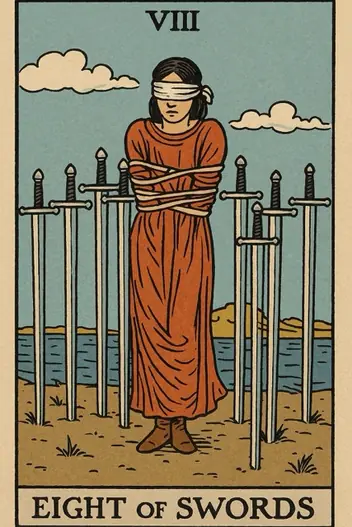
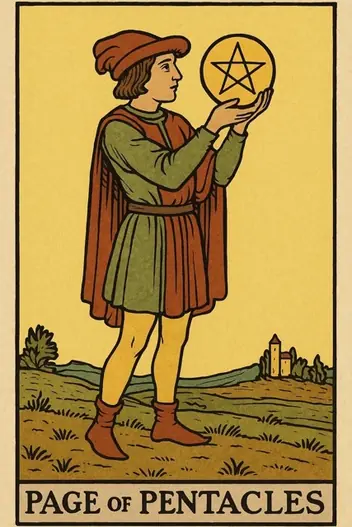
When the Eight of Swords and Page of Pentacles appear together, a powerful psychological conflict emerges. The Eight of Swords represents a state of mental paralysis, self-imposed restriction, and the feeling of being trapped by one’s own thoughts. In stark contrast, the Page of Pentacles embodies curiosity, diligence, and a grounded approach to learning and building something real.
This combination signals a critical turning point: the moment when intellectual over-analysis must give way to tangible, small steps. You are not truly trapped—you are simply overthinking a problem that requires a practical, methodical solution. The Page of Pentacles offers a path out of the mental prison by focusing on what can be measured, touched, and improved.
Eight of Swords and Page of Pentacles Combination Meaning
The core dynamic here is the tension between cognitive distortion and empirical reality. The Eight of Swords often indicates a mindset where you perceive obstacles that are largely self-created—fear of failure, perfectionism, or social anxiety that blinds you to available options. The Page of Pentacles counters this by demanding evidence-based action. Instead of asking “What if I fail?” the Page asks “What is the next single step I can take right now?”
The psychological shift required is from rumination to experimentation. The Page’s energy is that of a student: humble, curious, and willing to start at the very beginning. This is not the time for grand gestures or dramatic breakthroughs. Instead, focus on micro-commitments—small, low-risk actions that build momentum and provide real-world data to challenge your limiting beliefs.
In practice, this means documenting your assumptions and then testing them. For example, if you believe you are “stuck” in a job, the Page suggests updating your resume or taking one online course. The Eight of Swords’ perceived binds often dissolve when you shift from abstract worry to concrete planning. The key insight: you are not powerless; you are simply under-informed about your own capabilities.
Career Meaning of Eight of Swords and Page of Pentacles
Strategic Opportunities:
Start a small side project or learn a new skill that directly addresses a bottleneck in your current role. The Page rewards incremental progress.
Strategic Opportunities:
Document your accomplishments and concerns in a work journal. This creates objective data to challenge feelings of inadequacy.
Calculated Risks:
Avoid impulsive career changes driven by frustration. The Eight of Swords can make a bad situation seem permanent, leading to rash decisions. Bold warning: Do not quit without a concrete plan—the Page requires a roadmap of at least three small steps.
In a professional context, this combination often appears when you feel undervalued or stuck in a dead-end role. The Eight of Swords amplifies the belief that “no one sees my potential” or “I have no options.” The Page of Pentacles counters with a pragmatic audit: What skills are you building? What is your market value? Bold strategic tip: Schedule an informational interview with someone in a role you aspire to. This single action can shatter the illusion of isolation and provide concrete data for your next move.
Financially, the Page warns against all-or-nothing thinking. If you feel trapped by debt or low savings, the solution is not a risky gamble but a disciplined budget. Create a spreadsheet, track one week of spending, and identify one small area to cut. The Page’s energy is about consistency, not intensity. Over time, these small actions compound into real freedom.
Your pair is already on the table. Ask your question and draw the clarifying card
or simply focus on it
Love and Relationships
If you are single:
This pair suggests you may be overthinking a new connection or disqualifying yourself before giving the other person a chance. Focus on one small, low-pressure interaction—like a coffee date—rather than imagining a full future.
If you are in a relationship:
You or your partner may be silently resentful due to unexpressed needs. The Page of Pentacles encourages practical communication: schedule a calm conversation and write down specific requests.
In relationships, the Eight of Swords often manifests as emotional withdrawal—you feel trapped by past patterns or fear of vulnerability. The Page of Pentacles offers a remedy: treat your relationship like a skill to be learned. Instead of waiting for the “perfect moment” to address issues, use gentle, structured dialogue. Bold advice: Create a “weekly check-in” ritual where both partners share one concrete thing they appreciated and one small request for change. This transforms abstract anxiety into manageable, actionable steps.
The key is to recognize that feeling stuck does not mean the relationship is doomed. It often means you need to renegotiate boundaries or responsibilities. The Page’s energy encourages you to approach this with the same curiosity you’d bring to a new hobby—without judgment, just a desire to understand.
Reversed Eight of Swords and Page of Pentacles Explained
When cards appear in a reversed position, the dynamic becomes distorted, but it does not disappear.
If the Eight of Swords is reversed:
This can mean that you have broken free from mental captivity, but too abruptly. Instead of taking cautious steps, you throw yourself headfirst into the fray, ignoring real risks. Advice: slow down. Your impulsiveness is a reaction to past fear, not a strategy. Make sure your actions are considered, not merely an escape from discomfort.
If the Page of Pentacles is reversed:
This points to an internal resistance to learning and growth. You reject any advice, even the simplest. Perhaps you consider yourself "above" basic steps or fear looking foolish by starting from scratch. Warning: your perfectionism is now your greatest enemy. Allow yourself to be a beginner.
If BOTH are reversed:
This is a complete imbalance. The Eight of Swords (reversed) gives a false sense of freedom, while the Page of Pentacles (reversed) signifies a refusal of discipline. You risk falling into a cycle of chaotic actions without a plan, which will lead to burnout. Correction: return to the basics. Write down one specific goal for the month on paper, along with three small steps to achieve it. Structure is your salvation.
Get a personalized interpretation
Unlock the combined meaning of your cards in the context of your unique question — for free.
Shadow Side & Pitfalls
The shadow of this combination emerges when the Page’s diligence becomes obsessive detail-orientation that reinforces the Eight of Swords’ paralysis. You may find yourself endlessly researching, planning, or “preparing” without ever taking action. This is a sophisticated form of procrastination disguised as prudence.
Another pitfall is intellectualizing emotions. You might analyze your situation so thoroughly that you disconnect from the visceral experience of being stuck. The Eight of Swords is a card of suppressed feelings—anxiety, shame, or grief—that the Page’s logic cannot solve alone. If you find yourself creating elaborate spreadsheets but still feeling trapped, you may need to acknowledge the emotional root first.
Cognitive biases to watch for:
Confirmation bias (seeking data that proves you’re stuck) and the sunk cost fallacy (staying in a bad situation because you’ve invested time). The Page of Pentacles demands honest data collection, not data that confirms your fears. If you catch yourself saying “I’ve tried everything,” ask: “Have I tried this specific small thing for 30 days?”
Synthesis: Strategic Conclusion
Constructive use of the Eight of Swords' energy to activate the Page of Pentacles requires a conscious shift in focus from "why" to "how." Instead of asking yourself, "Why am I trapped?" ask, "What is the smallest step I can take right now?" The Eight of Swords represents analytical paralysis, while the Page of Pentacles is an invitation to action.
Your strategy is breaking down a big problem into micro-tasks. Feeling fear about a new project? Don't think about the project as a whole. Open the document and write one sentence. Feeling lonely? Don't search for the "perfect partner." Sign up for one event or write to one friend. Each such micro-action shatters the illusion of powerlessness.
Deep strategic advice:
Keep a "Journal of Small Victories." Every evening, write down three concrete actions you took despite fear. This could be a call you had been putting off or a chapter of a book you read. In a week, you will see that your "cage" (the Eight) was merely a shadow, and your capacity for growth (the Page) is real. Do not wait for fear to disappear. Act while it is still here.
Applying This to Your Situation
The Eight of Swords and Page of Pentacles together deliver a clear message: your mind is the only cage, and the key is action. The path out of confusion and stagnation is not a dramatic leap but a series of deliberate, small steps. Focus on what you can control today—one conversation, one document, one hour of focused effort. The feeling of being trapped is real, but it is not permanent. It is a signal that you need to shift from thinking to doing.
Ready to apply this to your exact situation? While this article reveals the general archetype of this card pair, the true power of Tarot lies in its personal relevance. The Fortune Cards app offers a deeply personalized interpretation of this combination based on your specific question and life context. Use it on the web or download it now to receive a custom reading that addresses your unique love, career, or personal growth challenges. Your next step is just one tap away.
Interpretation by the Fortune Cards editorial team, based on the Rider–Waite tradition and Jungian archetypes. About our methodology · Updated: 2026-09-24
Other Combinations with Eight of Swords
Other Combinations with Page of Pentacles
Explore Individual Card Meanings
Table of Contents
Ready to find answers to your questions?
Start your first reading now and look at your situation with fresh clarity. The cards are ready to reveal deeper meaning.