The Hierophant and Eight of Swords Tarot Combination
- Arcana
- The Hierophant — Major Arcana; Eight of Swords — Minor Arcana, Swords
- Elements
- The Hierophant — Earth; Eight of Swords — Air
- Elemental interaction
- Opposing elements — energies create tension
- Numerology
- 5 + 8 = 13 → 4
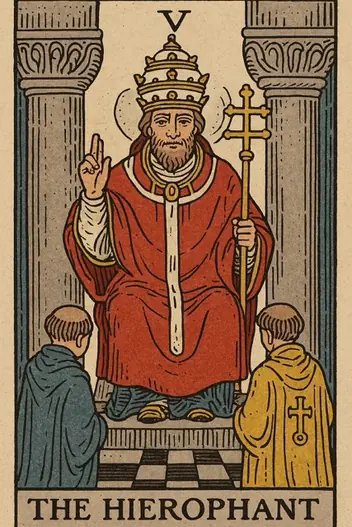
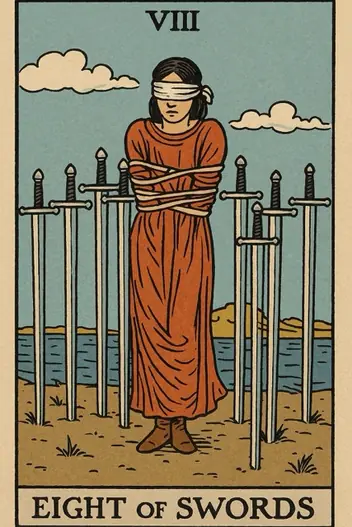
When The Hierophant meets the Eight of Swords, we witness a collision between the security of established systems and the paralysis of a self-imposed mental prison. The Hierophant represents the institutional, the conventional, and the trusted path—whether that’s religion, academia, corporate culture, or family tradition. The Eight of Swords, conversely, depicts a figure blindfolded and bound, surrounded by blades, suggesting restriction born from irrational beliefs and fear. Psychologically, this combination signals a crisis where one’s loyalty to external authority has become a cage for the mind. The seeker may feel trapped not by reality, but by the rigid rules they’ve internalized, mistaking conformity for safety. The pragmatic question emerges: Are you following a path because it’s right for you, or because you’re afraid to question the script you were given?
The Hierophant and Eight of Swords: How These Energies Interact
This pairing creates a powerful tension between seeking external validation and feeling internally constrained. The Hierophant’s archetype encourages adherence to a moral or social code, but when fused with the Eight of Swords, that adherence becomes a source of anxiety rather than stability. You may find yourself over-relying on doctrine—whether from a partner, boss, or spiritual teacher—to make decisions, only to feel paralyzed by the fear of making a wrong move. The key insight here is that the prison is largely symbolic: the blindfold is your own refusal to see alternative perspectives, and the swords are the critical thoughts you’ve weaponized against yourself.
In practical terms, this combination often appears when a seeker is stuck in a conflict between duty and personal truth. The Hierophant says, “Follow the rules,” while the Eight of Swords whispers, “But what if the rules are wrong?” This mental tug-of-war leads to stagnation, not because of external obstacles, but because of an internalized belief system that limits your options. The solution lies in questioning the source of your authority: Is the tradition serving your growth, or are you serving it out of fear? Recognize that true wisdom involves knowing when to adapt the rules, not just obey them.
The Hierophant and Eight of Swords for Career and Money
Strategic Opportunities:
Challenge the status quo by identifying one outdated process or policy at work that you’ve been afraid to question. Present a data-backed alternative to a trusted mentor.
Strategic Opportunities:
Leverage institutional knowledge to your advantage. Your familiarity with the system (Hierophant) can be used to navigate bureaucratic obstacles that others find paralyzing.
Calculated Risks:
Avoid over-compliance. If you’re in a job or industry that feels like a dead end, the real trap is staying out of fear of the unknown. The Eight of Swords warns that your perception of limited options is the biggest risk.
In your professional life, this combination points to a crisis of confidence within a structured environment. You may feel stuck in a role that demands conformity, yet your inner critic tells you that leaving is impossible. The Hierophant can represent a mentor, boss, or company culture that values tradition over innovation. The strategic move is to reframe your position: Instead of seeing yourself as a victim of the system, view yourself as a potential reformer from within. Financially, the Eight of Swords warns against making decisions based on scarcity mindset—for example, staying in a draining job because “it’s safe.” The truth is, your skills and experience (Hierophant) are transferable. Bold advice: Create a “freedom fund” by saving three months’ expenses to break the psychological chains of financial fear.
Your pair is already on the table. Ask your question and draw the clarifying card
or simply focus on it
The Hierophant and Eight of Swords as Feelings
If you are single:
This combination warns against seeking a partner through rigid, conventional channels (e.g., family matchmaking, strict dating checklists) that may not align with your authentic desires. The real barrier is your own belief that love must follow a prescribed script.
If you are in a relationship:
You may be stuck in a dynamic where tradition or external expectations (e.g., “we have to stay together for the kids,” “this is how a good partner should act”) create a stifling communication loop. The fear of breaking the mold keeps both of you silent.
In relationships, The Hierophant and Eight of Swords often reveal a power imbalance masked by tradition. One partner may hold the role of the “authority” (the Hierophant), while the other feels bound by self-doubt and unspoken rules (the Eight of Swords). This can manifest as a dynamic where you avoid difficult conversations because of a perceived obligation to maintain harmony, even when that harmony is built on resentment. Boldly acknowledge that the “rules” of your relationship may need renegotiation. The Eight of Swords suggests that the biggest obstacle is not your partner, but your own internalized belief that you cannot speak up. Practical advice: Schedule a non-negotiable check-in conversation where both parties can openly question any unspoken agreements without judgment.
Ask your specific question
Don't rely on generic meanings. Get a customized reading tailored specifically to your energies.
The Shadow Side of The Hierophant and Eight of Swords
The shadow of this combination is a toxic marriage of dogmatism and victimhood. The Hierophant’s shadow manifests as rigid authoritarianism—using tradition as a weapon to control others or justify inaction. The Eight of Swords’ shadow is catastrophizing and learned helplessness. Together, they create a feedback loop: you cling to a flawed system because you believe you have no other choice, while simultaneously blaming the system for your unhappiness. Cognitive biases at play include the “sunk cost fallacy” (staying because you’ve invested too much time) and “confirmation bias” (only noticing evidence that supports your feeling of being trapped). Watch for passive-aggressive behavior or martyrdom—you may be playing the role of the “good soldier” while secretly resenting everyone around you. The true pitfall is mistaking discomfort for danger: growth requires leaving the familiar, but this pair can trick you into thinking that discomfort equals risk.
The Hierophant and Eight of Swords Reversed Meaning
When cards appear reversed, the dynamic becomes distorted, but does not disappear.
If The Hierophant is reversed:
External authority is either absent or discredited. You lose structure and feel disoriented. The Eight of Swords in an upright position here indicates self-isolation without a clear reason. Advice: do not seek a new guru, but create your own system of rules — start with a daily schedule.If the Eight of Swords is reversed:
You are beginning to realize that your limitations are illusory. However, The Hierophant in an upright position can mean resistance to change out of fear of losing the group's approval. Warning: do not succumb to the illusion that "everything will sort itself out." You need a plan of action.If BOTH are reversed:
This is a complete imbalance. You simultaneously reject all authorities and cannot escape your own inner chaos. This is a state of dangerous recklessness or deep apathy. Correction: find one person you trust (not a system) and ask them to be your external timer for making decisions.
The Hierophant and Eight of Swords: Tarot Advice
How to constructively use the Hierophant's energy to balance the Eight of Swords? The key lies in reframing: stop perceiving the Hierophant as a jailer, and begin seeing it as a navigation tool. Any structure (be it a corporate code, a family tradition, or a curriculum) is merely a map, not the territory. The Eight of Swords shows you are stuck at one point on this map.
Your strategic move is to accept the rules of the game, but play your own game. Study the system (the Hierophant) thoroughly to find the hidden opportunities within it. Instead of fighting against limitations, use them as a filter. For example, if a boss demands a strict report, make it perfect, but add one sentence that shifts the project's course. This transforms your "cage" into a "frame for a picture." Remember: you are not forced to choose between total submission and rebellion. The third path is the conscious use of structure to achieve your own goals, not to serve those of others.
Applying This to Your Situation
The core message of The Hierophant and Eight of Swords is this: Your greatest limitation is not the system, but your unquestioning loyalty to it. Freedom begins when you examine the beliefs you’ve inherited and decide which ones truly serve your growth. While this analysis provides a roadmap for the general archetype, your unique situation—your specific relationship, career crossroads, or personal history—will determine how these energies play out.
Ready to break free from your own mental prison? Use the Fortune Cards app to get a deeply personalized interpretation of this exact combination for your specific question. Whether you’re navigating a career dilemma, a relationship crossroads, or a moment of self-doubt, the app’s AI-driven insights will help you see the blind spots and find the exit. Available on the web and for download—unlock your clarity now.
Interpretation by the Fortune Cards editorial team, based on the Rider–Waite tradition and Jungian archetypes. About our methodology · Updated: 2026-08-26
Other Combinations with The Hierophant
Other Combinations with Eight of Swords
Explore Individual Card Meanings
Table of Contents
- The Hierophant and Eight of Swords: How These Energies Interact
- The Hierophant and Eight of Swords for Career and Money
- The Hierophant and Eight of Swords as Feelings
- The Shadow Side of The Hierophant and Eight of Swords
- The Hierophant and Eight of Swords Reversed Meaning
- The Hierophant and Eight of Swords: Tarot Advice
- Applying This to Your Situation
Ready to find answers to your questions?
Start your first reading now and look at your situation with fresh clarity. The cards are ready to reveal deeper meaning.