The Hierophant and Ten of Wands Together in Tarot
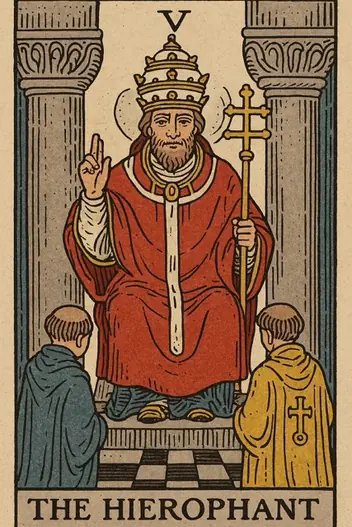
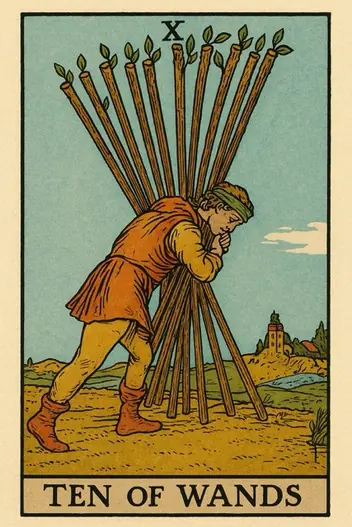
- Arcana
- The Hierophant — Major Arcana; Ten of Wands — Minor Arcana, Wands
- Elements
- The Hierophant — Earth; Ten of Wands — Fire
- Elemental interaction
- Neutral elements — energies coexist without conflict
- Numerology
- 5 + 10 = 15 → 6
When the Hierophant—the archetype of tradition, structure, and institutional wisdom—collides with the Ten of Wands—the card of overwhelming responsibility, fatigue, and carrying too much—the result is a powerful psychological tension. You are likely trying to uphold a system, a role, or a belief that is becoming unsustainable. This is not a time for rebellion, but for strategic evaluation of what you are carrying and why.
This combination speaks to the cognitive dissonance between your duty to a group, family, or career path, and your personal capacity for endurance. The Hierophant asks you to respect the rules and the chain of command; the Ten of Wands asks if those rules are worth your burnout. The key insight here is that loyalty to a system does not require self-sacrifice. You must distinguish between a necessary burden and a self-imposed martyrdom.
The Hierophant and Ten of Wands Combination Meaning
The core dynamic of the Hierophant and Ten of Wands is a conflict between obligation and overload. You may be the person everyone relies on—the expert, the mentor, the responsible one—but the weight of that role is crushing you. The Hierophant's energy encourages adherence to protocol, but the Ten of Wands reveals that the protocol itself may be flawed or excessive. Your mindset is likely one of rigid duty, where you believe you must "see it through" regardless of the personal cost.
Psychologically, this pair often indicates a superego-driven crisis. Your internal critic (the Hierophant's shadow) is telling you that you must not fail, you must not delegate, and you must not rest. The Ten of Wands is the physical and emotional consequence of that internal pressure. The solution is not to abandon your commitments, but to renegotiate the terms. Ask yourself: Which of these responsibilities are truly mine? Which are inherited from others' expectations? The pragmatic action here is to audit your obligations and identify the 20% of tasks that create 80% of the value—then let the rest go with permission from the system.
Love and Relationships
If you are single:
This combination suggests you may be attracted to someone who represents stability and tradition, but you must ensure you are not taking on their emotional baggage or life problems prematurely. Evaluate if the relationship feels like a partnership or a rescue mission.
If you are in a relationship:
You are likely the one carrying the majority of the emotional labor, household duties, or financial planning. A power imbalance is present, and it is eroding your energy. This is a call to have a direct, structured conversation about division of responsibilities.
In relationships, the Hierophant and Ten of Wands points to a dynamic where one partner is over-functioning while the other may be under-functioning, often within a traditional or codified role (e.g., the "responsible spouse" or the "always-available parent"). The psychological trap is that you may feel it is your moral duty to carry the load, believing that asking for help would be a sign of weakness or failure. Boundary-setting is not betrayal; it is survival. The practical advice is to schedule a weekly "state of the union" talk where you both review who is doing what, using a neutral, fact-based approach. This is not about blame, but about recalibrating the system so that it works for both of you.
Your pair is already on the table. Ask your question and draw the clarifying card
or simply focus on it
Career Meaning of The Hierophant and Ten of Wands
Strategic Opportunities:
Delegate or automate tasks that are not core to your unique value. Identify one process you can hand off to a colleague, assistant, or software within the next week.
Strategic Opportunities:
Leverage institutional support. If you are in a corporate or bureaucratic setting, use the Hierophant's energy to request resources, training, or a reduced workload through official channels.
Calculated Risks:
Avoid taking on another project or promotion until you have cleared at least one existing burden. The risk of saying "yes" now is a high probability of burnout and diminished quality in all areas.
In your professional life, this card pair is a red flag for overcommitment within a rigid structure. You may be the "go-to" person, the expert who is expected to handle every crisis, or the manager who is covering for an understaffed team. The Hierophant warns you to respect the chain of command—do not bypass your boss or the rules—but the Ten of Wands demands that you use that same chain to escalate the problem. Document your workload and present it to your supervisor as a systemic issue, not a personal complaint. Financially, this is not a time for risky investments. Focus on paying down debt and building a cash reserve, as the stress of this combination can lead to impulsive spending to relieve emotional pressure. The strategic move is to trade short-term discomfort for long-term structural change.
Ask your specific question
Don't rely on generic meanings. Get a customized reading tailored specifically to your energies.
Reversed Positions: What Changes?
Reversed cards amplify shadow aspects and indicate broken mechanisms.
If The Hierophant is reversed:
This is rebellion against the system without a strategy. You are rejecting traditions and authorities, but doing so impulsively, leading to chaos. Instead of modernizing the rules, you are simply destroying them. Advice: do not confuse freedom with anarchy. Before casting off the "burden of rules," create a new, more flexible coordinate system; otherwise, you will simply replace one form of suffering with another.
If The Ten of Wands is reversed:
This is internal resistance and passive aggression. You are physically unable or unwilling to bear responsibility, yet you do not openly refuse it either. You sabotage processes, show up late, "forget" about tasks. Warning: this is a path to losing trust and reputation. You need to honestly admit to yourself (and others) that you are overloaded, rather than pretending you are coping.
If BOTH are reversed:
Complete imbalance. The person simultaneously despises the rules (reversed Hierophant) and suffers from the consequences of breaking them (reversed Ten of Wands). This is a state of chronic neurosis and self-sabotage. The remedy: a radical simplification of life is necessary. Temporarily renounce any obligations that do not concern your basic survival. You need a "digital detox" from social roles and expectations in order to hear your inner voice anew, rather than the voice of "should."
Shadow Side & Pitfalls
The shadow of the Hierophant and Ten of Wands is dogmatic self-sacrifice. You may fall into the cognitive bias of the martyr complex, where you derive a sense of identity and moral superiority from suffering for a cause or a group. This is dangerous because it prevents you from seeing that your suffering is not noble—it is inefficient. You may also exhibit confirmation bias, seeking out evidence that your burden is unavoidable while ignoring options for relief. Another pitfall is passive-aggressive resentment: you continue to carry the load but grow bitter toward those who are not helping, yet you never clearly communicate your limits. The shadow also manifests as perfectionism driven by fear of authority—you are so afraid of disappointing a mentor, parent, or boss that you over-function until you collapse. Recognize that the Hierophant's true wisdom is not about blind obedience, but about knowing when the form no longer serves the function.
Synthesis: Strategic Conclusion
How can the energy of the Hierophant be used constructively to balance the Ten of Wands? The answer is paradoxical: use the authority of the system to reform the system itself. The Hierophant is not only about "must" but also about "wisdom." Wisdom in this context lies in the ability to see the difference between "important" and "urgent," between "obligatory" and "formal."
Your strategy is to become an "architect of processes, not their porter." Stop carrying everything on your own shoulders. Instead, use your authority (Hierophant) to teach others, delegate responsibilities, and optimize work/personal flows. Ask yourself: "Which rules do I follow out of habit, and which truly serve my goals?" A deep strategic insight: apply the principle of "controlled chaos." Allow yourself not to finish something "perfectly." See if the world collapses. Most likely, it won't. You will discover that your value to the system lies not in carrying everything, but in knowing how to do it correctly. Redirect your energy from "execution" to "management"—this is the only way to lift the burden without losing face.
Applying This to Your Situation
The core message of the Hierophant and Ten of Wands is this: Honor your commitments, but do not let them bury you. You are being called to use structure and tradition as tools for efficiency, not as chains for self-punishment. The path forward requires you to renegotiate your role within the systems you belong to—whether that is a relationship, a family, or a career. You are not failing by asking for help; you are leading by modeling sustainable responsibility.
While this article provides the general archetype of this card pair, the real power of Tarot lies in how it applies to your specific situation. The Fortune Cards app allows you to get a deep, personalized interpretation of the Hierophant and Ten of Wands for your exact question—whether it's about a specific relationship conflict, a career decision, or a personal boundary you need to set. Use the app on the web or download it to receive a reading that speaks directly to your unique context, right now.
Interpretation by the Fortune Cards editorial team, based on the Rider–Waite tradition and Jungian archetypes. About our methodology · Updated: 2026-08-26
Other Combinations with The Hierophant
Other Combinations with Ten of Wands
Explore Individual Card Meanings
Ready to find answers to your questions?
Start your first reading now and look at your situation with fresh clarity. The cards are ready to reveal deeper meaning.