Ten of Wands
- Arcana
- Minor Arcana, Suit of Wands
- Element
- Fire
- Decan
- Saturn in Sagittarius
- Numerology
- 10 → 1
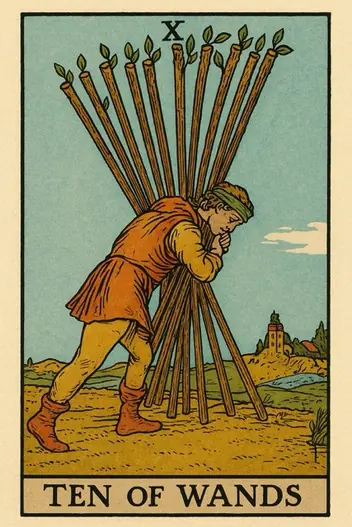
The Ten of Wands represents the archetype of the Atlas figure—the individual who carries the weight of the world on their shoulders. In Jungian terms, this is the Hero in the exhaustion phase, where the quest for achievement has shifted into a struggle for mere survival under accumulated responsibilities. This card does not depict failure, but rather the critical tipping point where ambition meets its physical and psychological limits.
The core challenge of the Ten of Wands is resource allocation under duress. The figure carries ten wands, obscuring their vision of the path ahead. This symbolizes the cognitive load of over-commitment—when you have taken on so many projects, obligations, or expectations that you can no longer see where you are going. The central question is: are you building a legacy, or are you just piling burdens?
Ten of Wands: Core Meaning and Interpretation
Psychologically, the Ten of Wands manifests as decision fatigue and diminishing returns. The individual is likely operating in a state of chronic stress, where each additional task reduces overall efficiency. The card warns that persistence without strategic pruning leads to burnout, not success. The key insight here is that the burden is not the problem—the failure to delegate or prioritize is the root cause.
From a strategic mindset, this card demands a cost-benefit analysis of your current commitments. You are likely overvaluing the necessity of each wand while undervaluing the cost of carrying them all. The pragmatic action is to identify which wands can be set down, shared, or completed first. The Ten of Wands rewards those who have the courage to stop doing and start choosing. It is a card of mature leadership, where the leader recognizes that carrying everything alone is not strength—it is a failure of systems thinking.
Ask your question and flip the cards
or simply focus on it
Is Ten of Wands a Yes or a No?
No. But with a critical caveat. The Ten of Wands depicts a figure burdened by an overwhelming load, struggling forward under crushing responsibility. This card answers in the negative because the energy is one of exhaustion, obligation, and depletion, not of alignment or mutual benefit. The weight suggests that whatever you are asking about will require disproportionate sacrifice or will arrive at a cost that undermines the original desire. In reversed position, the answer shifts to Leaning Yes, as the burden may be released, delegated, or finally set down — but only if you are willing to face the root cause of why you took on so much in the first place. The practical condition for any positive outcome is this: you must clearly distinguish between duty you chose and duty imposed by guilt or fear, and act only from the former.
Ask your specific question
Don't rely on generic meanings. Get a customized reading tailored specifically to your energies.
Card of the Day
The Ten of Wands warns that today is a day of accumulated pressure — the energy is heavy, demanding, and likely a result of past overcommitments. You may feel as though you are carrying the weight of others’ expectations or unfinished tasks from previous days. The key action is to ruthlessly prioritize: identify the single most essential task and complete it, then stop. Avoid the trap of martyrdom — do not take on additional burdens out of a sense of obligation or to prove your worth. Today is not for heroics; it is for survival and boundary-setting.
Ten of Wands in Love and Relationships
If you are not in a relationship:
This card suggests you are attracting partners who project their own burdens onto you, or you are approaching dating as another task on your to-do list. You may be so focused on your own responsibilities that you lack the emotional availability for genuine connection.
If you are in a relationship:
You are likely in a dynamic of unequal load-bearing, where one partner carries the emotional, logistical, or financial weight for both. This creates resentment and a power imbalance that erodes intimacy.
In relationships, the Ten of Wands indicates that love is being suffocated by obligation. The behavioral pattern is one of martyrdom—sacrificing your own needs to meet your partner's expectations, or vice versa. The practical relationship advice is to explicitly renegotiate the division of labor and emotional support. Set a boundary: "I cannot carry this alone anymore, and I will not." This is not a failure of love, but a necessary recalibration of partnership. Healthy relationships under this card require clear communication about capacity and a commitment to shared responsibility.
What Does Ten of Wands Say About Their Feelings?
This person perceives you through the archetype of the Ten of Wands: they see you as someone who carries a significant emotional or practical burden, and they may associate you with a sense of strain or responsibility. You evoke in them a mixture of respect for your endurance and a subtle guilt about the weight you bear — they may feel they have contributed to your load, even unintentionally. Their hidden intention is often to keep you in a role where you manage the difficult work, while they remain more free; deep down, they fear that if you set down your burdens, you might also set down your connection to them. There is a clear internal conflict: they admire your strength but are uneasy with the debt they feel toward you. They may unconsciously hope you will keep carrying without complaint, yet that very hope reveals their own reluctance to share the load.
Career and Finance
Strategic Opportunities:
The breakthrough lies in delegation. Identify one task or project you can hand off this week. This frees up mental bandwidth for higher-value strategic work.
Resource Management:
Completion is your asset. Focus on finishing your top three existing projects before starting anything new. This creates a powerful sense of momentum and closure.
Calculated Risks:
Avoid taking on new leadership roles or additional responsibilities until you have cleared your current backlog. The risk of overextension is that you will drop all wands, not just one.
Professionally, the Ten of Wands is a red flag for burnout and inefficiency. The card indicates you are in a high-output, low-satisfaction phase where effort does not translate into proportional reward. The financial warning is clear: do not take on debt or new loans to fund more work. Instead, strategize to reduce your operational costs—whether that means cutting non-essential projects, renegotiating deadlines, or automating routine tasks. The best strategic advice is to shift from "doing more" to "doing what matters most." This card rewards ruthless prioritization and penalizes the belief that volume equals value.
Ten of Wands Reversed: What Changes
When reversed, the Ten of Wands indicates the release of a burden, but not necessarily through wise decision-making. This can manifest as sudden collapse, quitting under pressure, or a forced surrender of responsibilities. The psychological state is one of exhaustion so deep that you are no longer able to carry the load, and the wands are dropped involuntarily. This is a warning against waiting until the breaking point to act. The reversed position shows blocked potential—you had the resources to manage the burden, but you ignored the early signs of overload.
To correct this imbalance, you must reclaim agency in your unloading. Instead of waiting for crisis, proactively shed commitments that no longer serve your core goals. The reversed card asks you to distinguish between healthy release and self-sabotaging avoidance. If you quit a job or a relationship under the reversed Ten of Wands, ensure it is a strategic decision, not a panicked escape. The logical correction is to create a "stop doing" list—a conscious plan for what you will no longer tolerate or carry.
What Are the Pitfalls of Ten of Wands?
The shadow of the Ten of Wands is the martyr complex—the unconscious need to suffer for others' approval or to prove your worth through exhaustion. This manifests as cognitive biases like the sunk cost fallacy, where you continue to carry burdens because you have already invested so much time or effort. You may also engage in perfectionism, refusing to delegate because "no one else can do it right," which is a form of control-based anxiety.
Another pitfall is avoidance of responsibility in the name of "rest." Some individuals, under this card's influence, may use the burden as an excuse to neglect self-care or emotional processing, claiming they are "too busy." This is self-deception—the burden becomes a shield against confronting deeper issues. The most dangerous error is believing that the weight is permanent. The Ten of Wands is a snapshot of a moment, not a life sentence. The shadow lies in refusing to see that you have the power to set wands down.
Synthesis: Strategic Conclusion
The Ten of Wands is not a card of failure, but a diagnostic tool for the over-committed achiever. Its constructive energy lies in forcing a moment of clarity: you cannot move forward while blinded by your own burdens. The strategic path is to stop, reassess, and shed what is unnecessary. This is not weakness; it is the highest form of strategic intelligence. The card teaches that true power is the ability to choose your load, not the capacity to endure any load.
To use this card's energy productively, apply the "80/20 Rule" (Pareto Principle) to your life. Identify the 20% of your commitments that produce 80% of your results, and ruthlessly eliminate or defer the rest. This requires emotional discipline—you must accept that you will disappoint some people, and that is acceptable. The Ten of Wands rewards those who prioritize their own long-term capacity over short-term approval.
Finally, remember that this card is a call to mature leadership. Whether in career, love, or personal growth, the solution is not to carry more, but to build better systems of support, delegation, and boundaries. The Ten of Wands is the card of the conscious leader who learns to distribute weight wisely, ensuring that the path ahead is clear, and the load is sustainable.
Applying This to Your Situation
This psychological and strategic breakdown provides a deep understanding of archetypes. However, Tarot is never universal for everyone. To understand exactly how this dynamic applies to your specific situation, a reading tailored exclusively to you is necessary.
Download the Fortune Cards app or visit our platform to get a deep AI interpretation of your unique spread. Don't just read about the cards—use Fortune Cards to find out exactly what step you need to take next.
Try Tarot Spreads with Ten of Wands
Interpretation by the Fortune Cards editorial team, based on the Rider–Waite tradition and Jungian archetypes. About our methodology · Updated: 2026-08-26
Top Combinations with Ten of Wands
Discover how Ten of Wands interacts with other major cards in the deck to form powerful messages.
All 77 Combinations with Ten of Wands
Discover how this card interacts with every other card in the Tarot deck and reveal hidden meanings.
Table of Contents
- Ten of Wands: Core Meaning and Interpretation
- Is Ten of Wands a Yes or a No?
- Card of the Day
- Ten of Wands in Love and Relationships
- What Does Ten of Wands Say About Their Feelings?
- Career and Finance
- Ten of Wands Reversed: What Changes
- What Are the Pitfalls of Ten of Wands?
- Synthesis: Strategic Conclusion
- Applying This to Your Situation
Explore Tarot Universe
Ready to find answers to your questions?
Start your first reading now and look at your situation with fresh clarity. The cards are ready to reveal deeper meaning.