Love Tarot: The Hanged Man and Ten of Wands
- Arcana
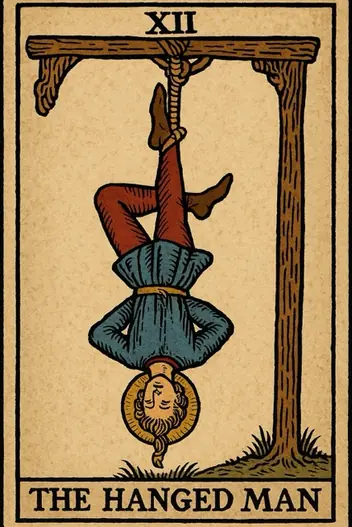
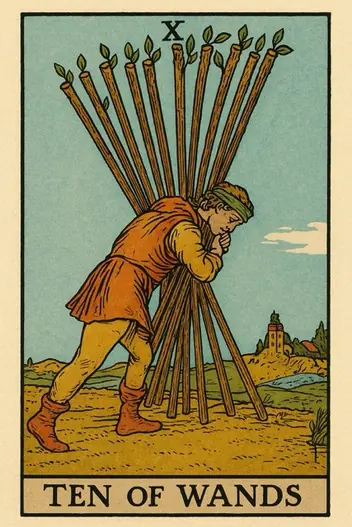
- The Hanged Man — Major Arcana; Ten of Wands — Minor Arcana, Wands
- Elements
- The Hanged Man — Water; Ten of Wands — Fire
- Elemental interaction
- Opposing elements — energies create tension
- Numerology
- 12 + 10 = 22 → 4
When the suspended perspective of The Hanged Man collides with the crushing weight of the Ten of Wands, you face a profound psychological dilemma: you are being asked to release control over a situation that feels impossibly heavy. This combination suggests that your current burdens are not merely external pressures—they are symptoms of a deeper cognitive trap. You may be gripping too tightly to a path, a responsibility, or a self-imposed obligation, precisely when clarity requires you to step back.
The core tension here is between action and stillness. The Ten of Wands screams "push harder, carry more," while The Hanged Man whispers "stop, observe, and let go." In practice, this creates a state of paralyzed endurance—you feel you cannot drop the load, yet you cannot move forward with it either. The pragmatic path forward lies not in brute force, but in reframing your relationship to the burden itself.
The Hanged Man and Ten of Wands Combination Meaning
The psychological state triggered by The Hanged Man and Ten of Wands is one of cognitive dissonance and strategic paralysis. You are likely experiencing a situation where the harder you work, the less progress you make. This is not a sign of incompetence; it is a signal that your current framework for solving the problem is flawed. The Hanged Man represents the need to shift your perspective—literally to see the problem from a new angle—while the Ten of Wands represents the accumulated cost of persisting with the old approach.
The key insight here is that the burden is not the problem; your attachment to it is. The Ten of Wands often appears when you have taken on more than your share, either out of guilt, obligation, or a mistaken belief that you are the only one who can handle it. The Hanged Man forces you to confront the ego-driven narrative that says "I must carry this alone." In Jungian terms, this is the shadow of the martyr archetype—a pattern where suffering becomes a substitute for genuine change.
Real-world implications are stark: this combination is a warning against burnout disguised as virtue. If you are in a leadership role, you may be micromanaging. If you are in a relationship, you may be sacrificing your own needs to keep the peace. The strategic action is to pause, audit your commitments, and ask yourself what would happen if you simply stopped carrying one of these burdens for 48 hours. The answer will reveal which tasks are truly essential and which are psychological baggage.
Your pair is already on the table. Ask your question and draw the clarifying card
or simply focus on it
What Do The Hanged Man and Ten of Wands Say About Love?
If you are single:
This pair suggests you are carrying emotional baggage from a past relationship or unrealistic expectations about what a partner should "fix" for you. Take a break from active dating to reassess what you truly need versus what you think you should want.
If you are in a relationship:
You may be sacrificing your own emotional well-being to maintain the status quo. This is not sustainable. A conversation about boundaries and shared responsibility is overdue.
In relationships, The Hanged Man and Ten of Wands often point to a power imbalance masked by devotion. One partner feels they are doing all the emotional labor, while the other remains passive or oblivious. The psychological trap here is codependency—the belief that your value is tied to how much you sacrifice for the other person. The healthiest move is to temporarily withdraw your emotional labor and observe how the dynamic shifts. This is not punishment; it is a diagnostic tool.
Key advice: Stop solving your partner's problems for them. The Hanged Man's wisdom is that sometimes the most loving act is to let another person experience the natural consequences of their choices. If you are constantly rescuing them from stress, you are robbing them of the opportunity to grow—and yourself of the opportunity to rest.
Ask your specific question
Don't rely on generic meanings. Get a customized reading tailored specifically to your energies.
Career and Finances
Strategic Opportunities:
Audit your workload for low-value tasks that you can delegate, automate, or eliminate. This is a prime moment to renegotiate deadlines or responsibilities.
Strategic Opportunities:
Use the Hanged Man's perspective to identify a bottleneck in your workflow that you have been ignoring. A fresh look at a stale process can yield surprising efficiency gains.
Calculated Risks:
Avoid taking on new projects until you have cleared existing obligations. The temptation to "power through" will backfire; quality will suffer, and your reputation may be damaged.
Professionally, this combination is a red flag for overcommitment and poor resource allocation. You may be the "go-to person" who never says no, or you may be working on a project that has become a sunk-cost fallacy—you continue investing time because you have already invested so much, rather than because it is still viable. The strategic move is to step back and evaluate the ROI of your current efforts. Ask yourself: "If I were advising a colleague in my exact position, what would I tell them to stop doing?"
Financially, this is not a time for aggressive investment or expansion. The Hanged Man suggests a holding pattern—preserve capital, reduce debt, and simplify your financial structure. The Ten of Wands warns against leveraging yourself too thin. If you are considering a major purchase or business loan, delay the decision by at least one month to gain clarity.
Reversed Positions: What Changes?
If The Hanged Man is reversed:
This points to blocked potential or reckless resistance. The person refuses to take a necessary pause, stubbornly continuing to carry the burden even though it's obvious they need to stop. Warning: you risk physical burnout, as you are ignoring the signals from your body and psyche. Advice: forcibly take a day off, even if it feels like a catastrophe.
If the Ten of Wands is reversed:
This is about internal resistance and weakness. The person drops the load, but not consciously — rather through procrastination, illness, or conflicts. Advice: do not be afraid to ask for help openly, rather than through displaying suffering. This is not weakness, but mature resource management.
If BOTH are reversed:
Complete imbalance — the system of relationships or work is in chaos. The reversed Hanged Man offers no wisdom, and the reversed Ten of Wands provides no strength. The only logical way to fix the situation is a complete reorganization. Quit your job, end the relationship, or radically change the conditions. Continuing in the same vein means destroying yourself.
What Are the Risks of The Hanged Man and Ten of Wands?
The shadow manifestation of this combination is learned helplessness disguised as spiritual growth. A seeker might rationalize staying in a toxic job or relationship by claiming they are "learning patience" or "surrendering to the universe." This is a cognitive bias: confusing endurance with wisdom. The Hanged Man is about voluntary suspension, not victimhood. If you feel trapped rather than enlightened, you are likely misinterpreting the energy.
Another pitfall is reactive martyrdom—using your burdens as a badge of honor to manipulate others' guilt or admiration. This is a defense mechanism against the fear of being ordinary or unneeded. The ego loves the Ten of Wands because it makes you feel important. The shadow here is that you may secretly enjoy your suffering because it gives you a sense of purpose. Honest self-reflection is required to distinguish between genuine service and self-aggrandizing sacrifice.
Synthesis: Strategic Conclusion
How to constructively use the energy of The Hanged Man to balance the Ten of Wands? The key lies in conscious choice. The Hanged Man teaches us that true strength is not the ability to endure, but the ability to stop and see the situation from another perspective. The Ten of Wands demands action, but The Hanged Man grants permission for a pause. The synthesis of these archetypes is a strategy of "conscious burden": you take on only what you are ready to carry without harming yourself, and you do so with a full understanding of the cost.
Deep strategic advice:
Imagine your life as a project with a limited budget of resources. The Ten of Wands is the deadline and the volume of work. The Hanged Man is the stage of reflection before launch. Do not begin to act until you have answered three questions: 1) What exactly must I do? 2) Why is this important specifically for me? 3) What am I willing to give up to achieve it? If the answers are vague or cause anxiety — you are not yet ready to bear this load. Postpone the decision, reassess, and only then act. Clarity, not sacrifice, is what leads to results.
Your Next Step: Personal Context Matters
The Hanged Man and Ten of Wands together deliver a clear message: stop trying to solve this problem with the same mindset that created it. Your next step is to create intentional space—a day off, a silent morning, or a walk without your phone—to observe your situation from a detached perspective. The solution will not come from more effort; it will come from a shift in how you define the problem.
For a truly personalized reading, this general interpretation is only a starting point. The cards speak differently depending on your specific question, your life stage, and the surrounding cards in a spread. Use the Fortune Cards app to get a deep, AI-powered interpretation of The Hanged Man and Ten of Wands tailored to your exact situation. Whether you are navigating a career crossroads, a relationship decision, or a personal crisis, the app provides the psychological insight and strategic clarity you need—right now, on the web or on your phone.
Interpretation by the Fortune Cards editorial team, based on the Rider–Waite tradition and Jungian archetypes. About our methodology · Updated: 2026-08-26
Other Combinations with The Hanged Man
Other Combinations with Ten of Wands
Explore Individual Card Meanings
Table of Contents
Ready to find answers to your questions?
Start your first reading now and look at your situation with fresh clarity. The cards are ready to reveal deeper meaning.