Love Tarot: The Emperor and Ten of Wands
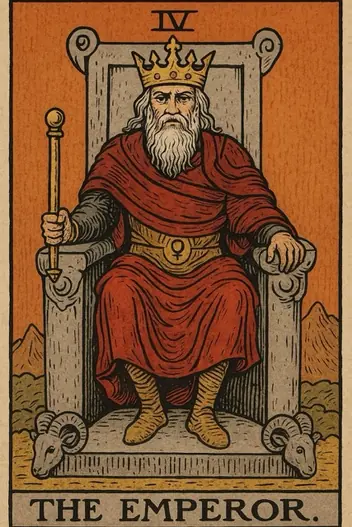
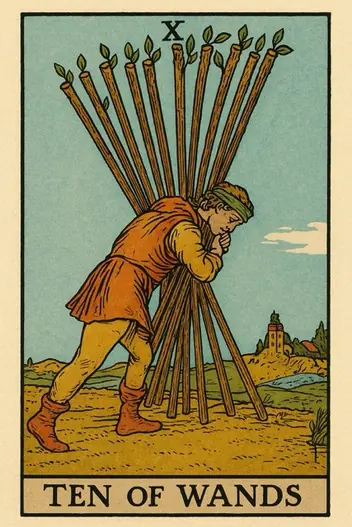
- Arcana
- The Emperor — Major Arcana; Ten of Wands — Minor Arcana, Wands
- Elements
- The Emperor — Fire; Ten of Wands — Fire
- Elemental interaction
- Same element — energies intensify each other
- Numerology
- 4 + 10 = 14 → 5
The Emperor represents structure, authority, and the disciplined use of power to create order from chaos. The Ten of Wands, however, signals a burden that has grown too heavy—a load of responsibilities that threatens to crush the very system it was meant to sustain. When these two cards appear together, they create a powerful psychological tension: the drive to control and lead colliding with the reality of overcommitment and diminishing returns.
This combination is not a warning against ambition or leadership. Instead, it is a pragmatic call to audit your resources and recalibrate your boundaries. The Emperor’s strength is in strategic delegation and systematic risk management, not in carrying every burden alone. The Ten of Wands asks whether your current structure is sustainable or if you are mistaking endurance for effectiveness.
The Emperor and Ten of Wands Combination Meaning
The psychological core of this pairing is a leadership paradox: the more you try to control everything, the more you become controlled by your own responsibilities. The Emperor archetype thrives on clear hierarchies and efficient processes, but the Ten of Wands signals that the load has exceeded the capacity of the current system. This is not a failure of will—it is a failure of resource allocation.
In practical terms, this combination suggests you have taken on too much, perhaps out of a sense of duty or a desire to prove your competence. The Emperor’s shadow is rigid perfectionism and fear of delegating, which directly feeds the Ten of Wands’ exhaustion. The key insight here is that true authority is measured by the ability to let go of what is unnecessary, not by how much you can endure. You must ask: Is this burden mine to carry, or have I claimed it out of habit or ego?
The remedy is not to abandon your goals but to restructure your approach. Break large tasks into smaller, delegated units. Set hard boundaries on your time and energy. Recognize that sustainable power requires periodic pruning—removing what no longer serves the mission, even if it feels like a loss of control.
The Emperor and Ten of Wands in Love Tarot
If you are single:
This combination suggests you may be attracted to partners who seem powerful or successful but who are actually overwhelmed and unavailable. Focus on emotional availability over status or competence.
If you are in a relationship:
The dynamic may be one where one partner carries the bulk of practical or emotional responsibilities, leading to resentment. This is a call to renegotiate roles and share the load more evenly.
In relationships, The Emperor and Ten Of Wands often point to a power imbalance disguised as duty. One partner may feel they must be the “responsible one”—managing finances, household logistics, or emotional support—while the other remains passive or dependent. This creates a toxic cycle of resentment and burnout. The Emperor’s healthy expression here is setting clear expectations and mutual accountability, not unilateral control.
Key relationship advice in bold:
If you feel burdened, communicate your limits directly rather than silently enduring. If your partner is the one overwhelmed, offer specific, actionable help rather than vague support. The goal is to transform the relationship into a cooperative system where both partners share authority and responsibility, not a hierarchy where one person carries the weight of both.
Your pair is already on the table. Ask your question and draw the clarifying card
or simply focus on it
Career and Finances
Strategic Opportunities:
Restructure your workflow by delegating low-priority tasks to focus on high-impact decisions. This is a prime time to hire an assistant or automate routine processes.
Strategic Opportunities:
Negotiate for more resources—budget, staff, or time—before taking on new projects. Use your authority to set realistic deadlines and push back against unreasonable expectations.
Calculated Risks:
Avoid micromanaging, which will only deepen your exhaustion. Do not take on new commitments until you have cleared existing ones. Beware of “hero syndrome” —the belief that only you can do it right.
This combination is a red flag for burnout in high-pressure careers, especially in management, entrepreneurship, or caregiving roles. The Emperor’s authority can become a trap if you believe that asking for help signals weakness. In reality, strategic delegation is a sign of mature leadership. Financially, this pair warns against overleveraging yourself—taking on debt or investments that require more work than you can sustainably provide.
Important financial warning:
If you are running a business, this is a warning that operational inefficiencies are eating into profits. Audit your processes and cut what is not essential. Do not confuse activity with productivity.
What If The Emperor or Ten of Wands Appears Reversed?
When cards appear in a reversed position, the dynamic becomes distorted, but does not disappear.
If The Emperor is reversed:
Structure collapses. This is recklessness and chaos masked as strength. The person either abuses power (tyranny) or, conversely, abdicates responsibility, leaving the team without guidance. Warning: do not try to compensate for a lack of order with even more control — this will lead to anarchy.
If the Ten of Wands is reversed:
This is internal resistance and weakness. The person does not take on even the burden they are capable of carrying. They either sabotage tasks or offload them onto others without seeing them through. Advice: you need not to lighten the load, but to learn to take on commitments and see them through to completion.
If BOTH are reversed:
Complete imbalance. Authority is undermined, and responsibility is diffused. This is a situation where no one is responsible for anything, but everyone complains of exhaustion. The logical way to correct it: start small. Restore one clear boundary (The Emperor) and take on one specific commitment (Ten of Wands). Do not try to establish order everywhere at once.
Deepen your understanding
Find out exactly what this reading means for your current life situation with our oracle.
The Emperor and Ten of Wands: Warning Signs
The shadow of The Emperor combined with the Ten Of Wands manifests as authoritarian burnout. You may become rigid, irritable, and controlling under pressure, alienating colleagues, partners, or friends. The cognitive bias here is overconfidence in your own capacity—you underestimate the true cost of your commitments and overestimate your ability to handle them.
Another common pitfall is martyrdom: you take on burdens to prove your worth, then resent others for not helping. This is a form of passive-aggressive control that undermines trust. You may also fall into all-or-nothing thinking, believing that if you cannot do everything perfectly, you have failed entirely. This binary mindset prevents the pragmatic compromise that The Emperor’s wisdom actually requires.
Synthesis: Strategic Conclusion
To constructively harness the Emperor's energy to balance the Ten of Wands, one must understand the central paradox: true strength is not the ability to bear any burden, but the ability to create a structure that renders that burden unnecessary. Your task is not to become a "superhero" who can handle everything, but to become the architect of a system that operates efficiently without your constant intervention.
The first step is an audit. Take a list of all your current projects and responsibilities. Next to each item, honestly write: "Does this truly require my involvement?" or "Can this be delegated, taught, or automated?" The Emperor grants you the authority to set the rules, so use this right to establish the rule: "I do not do the work for others."
The second step is delegation with control. Create clear protocols and deadlines (the Emperor), but transfer authority and resources to the executors. By lifting the burden of operations (the Ten of Wands) off your shoulders, you free up energy for strategic planning. Remember: you are responsible for the outcome, but you are not obligated to personally perform every action. This shift in thinking transforms a "heavy burden" into a "manageable load."
A deep strategic counsel:
Stop measuring your worth by the quantity of work. Measure it by the quality of your decisions and the resilience of the systems you have built. The Emperor in a healthy form is not one who holds everything in his hands, but one who has built a temple that will not collapse, even if he steps aside.
Your Next Step: Personal Context Matters
The core message of The Emperor and Ten Of Wands is that sustainable leadership requires strategic surrender. You must release the illusion that control equals carrying everything alone. True authority comes from building systems that work without your constant input—and from knowing when to say “no” to protect your energy. This is not a time for heroic endurance; it is a time for pragmatic restructuring.
To get the most accurate guidance for your unique situation, use the Fortune Cards app. While this article explains the general archetype, the real power of Tarot lies in how it applies to your specific question, relationship, or career challenge. The app provides a deep, personalized interpretation of this exact combination based on your context. You can use it on the web or download it now to receive the clarity you need to move forward with confidence.
Interpretation by the Fortune Cards editorial team, based on the Rider–Waite tradition and Jungian archetypes. About our methodology · Updated: 2026-08-26
Other Combinations with The Emperor
Other Combinations with Ten of Wands
Explore Individual Card Meanings
Table of Contents
Ready to find answers to your questions?
Start your first reading now and look at your situation with fresh clarity. The cards are ready to reveal deeper meaning.