Ten of Wands and Six of Swords Reversed in Tarot
- Arcana
- Ten of Wands — Minor Arcana, Wands; Six of Swords — Minor Arcana, Swords
- Elements
- Ten of Wands — Fire; Six of Swords — Air
- Elemental interaction
- Friendly elements — energies support each other
- Numerology
- 10 + 6 = 16 → 7
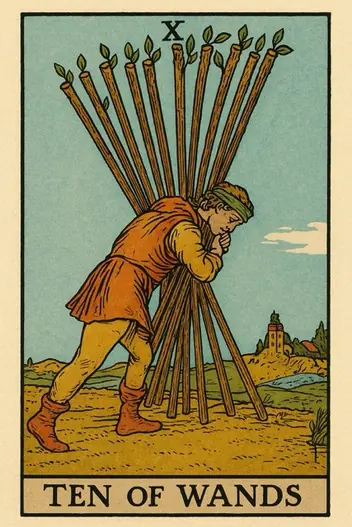
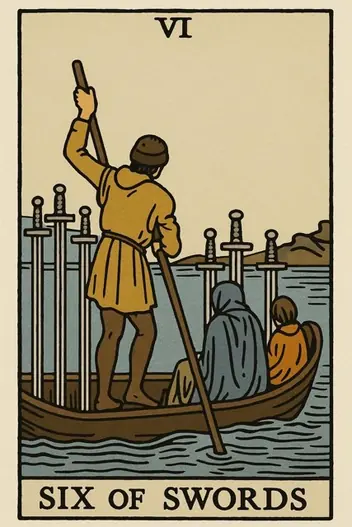
The intersection of the Ten of Wands and the Six of Swords presents a powerful psychological narrative: the moment when overwhelming responsibility meets the need for a difficult, but necessary, transition. The Ten of Wands represents the weight of accumulated burdens—often self-imposed—while the Six of Swords symbolizes a journey toward calmer waters, but one that requires leaving something behind. Together, they create a dynamic where perseverance is no longer about endurance alone, but about strategic release.
This combination asks you to examine the boundary between duty and self-destruction. The Ten of Wands warns of burnout from carrying too many projects, obligations, or emotional loads. The Six of Swords offers a path forward, but only if you are willing to confront the cognitive dissonance that comes with letting go. The key insight here is that not all burdens are yours to carry; some are simply the price of an outdated identity you have outgrown.
Ten of Wands and Six of Swords: How These Energies Interact
When the Ten of Wands and Six of Swords appear together, the core psychological state is one of exhaustion mixed with reluctant hope. You are likely in a phase where you have been pushing hard—perhaps too hard—to maintain control over a situation that is no longer sustainable. The Ten of Wands highlights the physical and mental fatigue of overcommitment, while the Six of Swords introduces the archetype of the "necessary departure." This is not a time for more effort; it is a time for strategic withdrawal.
The real-world implication is that you must distinguish between productive struggle and futile resistance. The Six of Swords suggests a journey, but it is often a slow, contemplative one—moving through grief, loss, or change with your eyes fixed on a better horizon. The challenge is that the Ten of Wands energy makes you want to hold on tighter, fearing that letting go will cause collapse. In reality, the collapse has already begun; the cards are asking you to manage its aftermath with clarity.
Psychologically, this pairing activates the shadow of martyrdom. You may believe that suffering proves your worth, but the Six of Swords counters this by showing that true strength lies in choosing which battles to abandon. The pragmatic approach is to audit your responsibilities: rank them by necessity, delegate what you can, and accept that some outcomes are beyond your control. This is not an admission of failure, but a recalibration of your resources.
Your pair is already on the table. Ask your question and draw the clarifying card
or simply focus on it
Ten of Wands and Six of Swords for Career and Money
Strategic Opportunities:
Identify tasks or projects that can be delegated or automated to reduce your workload. The Six of Swords favors efficiency over heroism.
Strategic Opportunities:
Consider a career pivot or relocation that aligns with your core strengths rather than your current obligations. This is a time for calculated reinvention.
Calculated Risks:
Avoid taking on new debt or financial commitments to ease short-term pressure. The Ten of Wands warns that more weight will only sink the boat.
In the professional realm, this combination is a red flag for burnout and poor resource management. You may be holding onto a role, a client, or a business strategy that is draining you without yielding proportional returns. The Six of Swords suggests that the most profitable move is often the one that feels like a retreat. Bold financial tip: Cut losses on underperforming assets or relationships before they drag you further down. This applies to contracts, partnerships, and even job positions that no longer serve your long-term goals.
The strategic advice here is to conduct a ruthless audit of your time and energy. Use the Six of Swords' energy to plan a phased exit from unsustainable commitments. This might mean renegotiating deadlines, hiring help, or even changing industries. Your career trajectory will not improve by working harder; it improves by working smarter and with less resistance.
Ten of Wands and Six of Swords Love Outcome
If you are single:
This combination suggests you may be carrying emotional baggage from a past relationship into new connections. Focus on healing before seeking a partner, as the weight of unresolved issues will distort your judgment.
If you are in a relationship:
You and your partner may be stuck in a cycle of over-functioning and under-communicating. One person may be carrying the emotional load for both, leading to resentment and distance.
In relationships, the Ten of Wands and Six of Swords point to a power imbalance masked by duty. One partner may feel they are doing all the work—financially, emotionally, or logistically—while the other remains passive or detached. The Six of Swords here is a call to initiate a difficult conversation about boundaries and shared responsibility. Bold advice: Do not confuse sacrifice with love. Healthy relationships require mutual investment, not one person sacrificing their well-being for the other's comfort.
If you are single, the cards warn against attracting partners who mirror your own over-functioning tendencies. You may be drawn to people who need "saving," or who present themselves as projects. The Six of Swords urges you to cross the river into a new emotional landscape where you are valued for who you are, not for what you can carry. This may require a period of solitude to recalibrate your standards.
Your unique Tarot reading
See how these cards interact with your destiny. Start a free personal reading now.
When Ten of Wands and Six of Swords Signal Trouble
The shadow of this combination manifests as chronic martyrdom and refusal to change. You may be so attached to the identity of the "hard worker" or the "responsible one" that you actively resist solutions. The cognitive bias here is loss aversion—you overvalue what you have (even if it's painful) and undervalue the relief of letting go. This can lead to self-sabotage through overcommitment, where you take on more tasks to prove your worth, only to collapse under the weight.
Another pitfall is emotional avoidance. The Six of Swords represents a journey, but it can also represent denial if you use "moving on" as a way to avoid processing grief. You might change jobs, end relationships, or relocate, but if you don't address the underlying patterns, you will simply recreate the same burdens in a new context. Bold warning: Do not mistake geographical or situational change for psychological growth. The real work is in understanding why you took on the burden in the first place.
Finally, beware of resentment. The Ten of Wands often carries feelings of being unappreciated, and the Six of Swords can amplify this if you feel forced to leave without closure. The shadow here is bitterness disguised as wisdom. Recognize that holding onto anger only adds weight to your journey. The goal is not to be right; it is to be free.
Ten of Wands and Six of Swords Reversed: What Changes?
If the Ten of Wands is reversed:
You have shed the burden, but did so impulsively, without thinking through the consequences. Risk of sabotaging your career or relationships due to a sudden departure. You need not just to leave, but to create an "evacuation plan."
If the Six of Swords is reversed:
You are stuck in a swamp of stability, afraid of change. Internal resistance to movement is stronger than external pressure. Advice: start small — change one ritual, stop doing one thing that drains you.
If BOTH are reversed:
Complete imbalance. You are simultaneously carrying an unbearable burden and refusing to row toward the shore. This is a state of chronic crisis and self-sabotage. The logical way to correct it: acknowledge your powerlessness before the situation and seek professional help (coach, psychologist, financial advisor). Your strategy of "endure and hope" has failed.
Ten of Wands and Six of Swords: The Combined Message
The energy of the Ten of Wands in this pair is not an enemy, but a catalyst. It creates enough pressure for you to finally break free from stagnation. Your task is to use this pressure not to break down, but to launch forward like a catapult. The Six of Swords is not a passive river current, but the active steering of a boat. You need to clearly define what you take with you into the new life and what you leave behind on the shore.
Strategic advice: apply the "one thing" rule. Choose just one area of life (work, relationships, health) on which to concentrate your efforts for change. Everything else should be frozen or outsourced. Attempting to change everything at once is a surefire way to return to the starting point of overload. Your main resource right now is not money or time, but mental energy. Spend it only on what leads you to a safe harbor. Remember: liberation is not a single act, but a process of letting go of the illusion of your own omnipotence.
Applying This to Your Situation
The core message of the Ten of Wands and Six of Swords is that you are carrying too much, and the only way forward is to release what no longer serves you. This is not a failure of will, but a strategic choice to preserve your energy for what matters most. The journey ahead is not about speed; it is about direction and lightness. Letting go is an act of courage, not weakness.
Ready to apply this insight to your unique situation? While this analysis provides the general archetype, the true power of Tarot lies in its personal relevance. Use the Fortune Cards app on the web or download it now to get a deep, personalized interpretation of this exact combination for your specific question. Whether you're navigating a career crossroads, relationship tension, or personal growth, the app will help you see how these archetypes play out in your life—and what your next step should be.
Interpretation by the Fortune Cards editorial team, based on the Rider–Waite tradition and Jungian archetypes. About our methodology · Updated: 2026-08-26
Other Combinations with Ten of Wands
Other Combinations with Six of Swords
Explore Individual Card Meanings
Table of Contents
- Ten of Wands and Six of Swords: How These Energies Interact
- Ten of Wands and Six of Swords for Career and Money
- Ten of Wands and Six of Swords Love Outcome
- When Ten of Wands and Six of Swords Signal Trouble
- Ten of Wands and Six of Swords Reversed: What Changes?
- Ten of Wands and Six of Swords: The Combined Message
- Applying This to Your Situation
Ready to find answers to your questions?
Start your first reading now and look at your situation with fresh clarity. The cards are ready to reveal deeper meaning.