Six of Swords
- Arcana
- Minor Arcana, Suit of Swords
- Element
- Air
- Decan
- Mercury in Aquarius
- Numerology
- 6
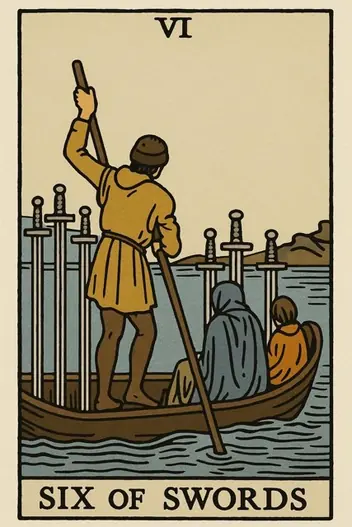
The Six of Swords represents the Jungian archetype of the Transitional Voyager—the psyche’s mechanism for moving from a state of cognitive dissonance toward a more coherent, stable reality. This card does not depict victory or defeat; it depicts calculated withdrawal from a situation that has become psychologically or materially untenable. The core challenge here is the tension between the ego’s desire to fight and the unconscious wisdom that knows when to cut losses.
Fundamentally, this card asks you to confront the cognitive bias of sunk cost fallacy. You are not fleeing; you are executing a strategic relocation of resources—emotional, financial, or mental. The boat in the imagery is not a vessel of escape but a vehicle of deliberate transition. The water is calm because the decision has been made; the turbulence is in the mind that is still resisting the necessity of the journey.
Main Dynamics and Interpretation
The Six of Swords embodies the psychological state of controlled disengagement. In practical terms, this means you are consciously choosing to leave behind a situation—a job, a relationship, a belief system—that no longer serves your long-term goals. The mindset required here is emotional compartmentalization: you must separate your attachment to the past from your assessment of the present reality. This is not about ignoring pain but about prioritizing functional outcomes over emotional comfort.
The resource this card provides is clarity under pressure. Unlike the Five of Swords, which signals conflict and loss, the Six offers a path to reduce future damage. The key insight is that waiting for closure before moving is a trap. You do not need to resolve every loose end; you need to transport what is essential—your core values, your skills, your health—to a new context. The most strategic action here is to stop investing in a losing proposition and redirect your energy toward rebuilding elsewhere.
Ask your question and flip the cards
or simply focus on it
Six of Swords: Yes or No?
Leaning yes.. The Six of Swords represents a transition away from turmoil, not a definitive resolution. Its archetype is the ferryman crossing the Styx—movement is occurring, but the outcome depends on your willingness to leave the past behind. In a yes/no context, the card suggests the answer is "yes, but only if you accept a necessary loss or change." Reversed, the answer shifts to no—the crossing is blocked, often by denial, resistance, or unresolved grief. The critical caveat: the outcome depends on whether you can release control over what you cannot change, rather than forcing a static result.
Uncover hidden insights
Let our advanced Tarot system interpret these archetypes specifically for your personal path.
What Does Six of Swords Mean for Your Day?
The main vector of the Six of Swords today is emotional passage—you are in the middle of a transition, not at its start or end. Focus on practical logistics: pack what matters, leave the rest, and trust the silent forward movement. Avoid the trap of ruminating on what you left behind or seeking closure where none is available; this card warns against intellectualizing pain instead of feeling it. Energy today calls for quiet endurance, not dramatic action—let the boat drift. If you feel numb or detached, that is the psyche’s protective mechanism, not a sign of failure.
Love and Relationships
If you are not in a relationship:
This card suggests you are carrying emotional baggage from a past dynamic. You are unconsciously drawn to partners who mirror the unresolved conflicts you are trying to leave behind. The strategic move is to actively choose solitude over familiarity—do not settle for a relationship that repeats the same structural problems.
If you are in a relationship:
You are in a phase of renegotiating boundaries or considering separation. The Six of Swords does not guarantee a breakup, but it does indicate that the current emotional environment is no longer sustainable. The practical advice is to initiate a calm, factual conversation about the gap between your needs and the current reality.
In relationships, this card warns against the overfunctioning rescuer dynamic. You may feel compelled to "fix" your partner or carry the emotional weight of the pair. Healthy conflict resolution under this card requires you to stop absorbing responsibility for the other person’s growth. Instead, focus on defining what you need to move forward—whether that means couples therapy, a trial separation, or simply a new communication protocol. The archetype demands that you honor your own need for psychological safety above the fear of being alone.
Six of Swords as Feelings: What They Think of You
Through the lens of the Six of Swords, this person sees you as a passage—someone who represents a necessary but painful transition in their life. They associate you with emotional rescue or relief, yet also with the grief of what had to be left behind. Their hidden intention is to move forward without fully processing the departure; they may unconsciously use you as a symbol of hope to avoid their own sadness. There is a deep internal conflict: they are grateful for your presence but fearful of becoming dependent on you as a crutch. They perceive you as calm on the surface, but sense your concealed depths—which both attracts and unsettles them. Ultimately, they view you less as a destination and more as the boat that carries them away from their past.
What Does Six of Swords Mean for Work and Money?
Strategic Opportunities:
Exit a failing project or toxic work environment. This card signals that the most profitable move is to cut your losses and pivot to a new industry, role, or client base.
Resource Management:
Consolidate your assets and downsize. If you are in debt or overextended, the Six of Swords advises a minimalist approach: sell non-essential assets, reduce overhead, and focus on liquidity.
Calculated Risks:
Avoid jumping into a new venture immediately. The transition must be deliberate, not impulsive. Do not confuse movement with progress—ensure you have a clear destination before you row the boat.
Professionally, this card is about strategic repositioning. You may be leaving a job that is secure but stagnant. The financial warning here is do not burn bridges with hostility, as the Six of Swords favors quiet exits and diplomatic severance. The decision-making framework is simple: evaluate the opportunity cost of staying versus leaving. If the emotional and cognitive drain of your current role exceeds the financial gain, the rational choice is to transition. Bold financial advice: prioritize a runway of 3-6 months of savings before making the move.
Reversed Positions: What Changes?
When reversed, the Six of Swords indicates blocked transition—you are stuck in the middle of the river, unable to move forward or return. Psychologically, this manifests as analysis paralysis or a refusal to accept the necessity of the journey. You may be clinging to a situation because you fear the unknown, or you are trying to negotiate a compromise that allows you to stay in the familiar pain rather than face the uncertainty of change.
The primary warning here is self-sabotage through procrastination. You know you need to leave, but you keep finding reasons to stay—a new project, a promise of change, a fear of disappointing others. The logical correction is to impose a hard deadline on your decision. Use the Parkinson’s Law principle: work expands to fill the time available. If you give yourself infinite time to decide, you will never decide. Set a 30-day timeline to execute the transition, and accept that discomfort is part of the process, not a signal to stop.
The Shadow Side of Six of Swords
The shadow of the Six of Swords is emotional avoidance disguised as pragmatism. The danger is that you use the narrative of "strategic retreat" to justify running away from legitimate confrontation or emotional processing. You may leave a relationship without having the difficult conversation, or quit a job without addressing the underlying pattern of burnout. This creates a cognitive bias where you mistake geographical movement for psychological growth.
Another pitfall is overprotection of the self. You may become so focused on minimizing risk that you refuse to take any emotional or professional chances. This manifests as perfectionism in the transition—waiting for the perfect job, the perfect partner, the perfect moment to move. The irrational behavior here is treating life as a chess game where you never lose a piece, when in reality, growth requires calculated losses. The fear of making a wrong move can keep you paralyzed in a situation that is slowly eroding your resources. The shadow also includes a tendency toward martyrdom—carrying the emotional burden of others while silently resenting them, rather than setting clear boundaries.
Synthesis: What It All Adds Up To
The Six of Swords is not a card of hope or despair; it is a card of operational logic. To use its energy constructively, you must adopt the mindset of a portfolio manager for your own life. You are not abandoning your past; you are reallocating your assets—time, energy, emotional capacity—to a more viable future. The strategic advice is to perform a ruthless audit of your current commitments: what is costing you more than it yields? What can you transport to a new context, and what must you leave behind?
The core psychological operation here is cognitive reframing. Instead of viewing the transition as a loss, frame it as a capital preservation strategy. You are not giving up; you are repositioning to avoid further damage. This requires emotional discipline: you must resist the urge to seek validation from others about your decision. The boat moves silently across the water for a reason—public explanations often invite resistance and doubt. Trust your analysis, execute the plan, and let the results speak for themselves.
Finally, remember that the Six of Swords is a temporary state. The journey has a destination. Once you arrive at the new shore, the card transitions into the Six of Cups (emotional stability) or the Ten of Cups (fulfillment), depending on your choices. The strategic goal is not to stay in the boat forever, but to land safely and rebuild. Use the calm of this transition to gather your strength, not to wallow in what you are leaving behind. The most profound insight is this: the ability to leave is a strength, not a weakness—provided you leave with intention, not fear.
Your Next Step: Personal Context Matters
This psychological and strategic breakdown provides a deep understanding of archetypes. However, Tarot is never universal for everyone. To understand exactly how this dynamic applies to your specific situation, a reading tailored exclusively to you is necessary.
Download the Fortune Cards app or visit our platform to get a deep AI interpretation of your unique spread. Don't just read about the cards—use Fortune Cards to find out exactly what step you need to take next.
Try Tarot Spreads with Six of Swords
Interpretation by the Fortune Cards editorial team, based on the Rider–Waite tradition and Jungian archetypes. About our methodology · Updated: 2026-08-26
Top Combinations with Six of Swords
Discover how Six of Swords interacts with other major cards in the deck to form powerful messages.
All 77 Combinations with Six of Swords
Discover how this card interacts with every other card in the Tarot deck and reveal hidden meanings.
Table of Contents
- Main Dynamics and Interpretation
- Six of Swords: Yes or No?
- What Does Six of Swords Mean for Your Day?
- Love and Relationships
- Six of Swords as Feelings: What They Think of You
- What Does Six of Swords Mean for Work and Money?
- Reversed Positions: What Changes?
- The Shadow Side of Six of Swords
- Synthesis: What It All Adds Up To
- Your Next Step: Personal Context Matters
Explore Tarot Universe
Ready to find answers to your questions?
Start your first reading now and look at your situation with fresh clarity. The cards are ready to reveal deeper meaning.