Love Tarot: Four of Wands and Six of Swords

- Arcana
- Four of Wands — Minor Arcana, Wands; Six of Swords — Minor Arcana, Swords
- Elements
- Four of Wands — Fire; Six of Swords — Air
- Elemental interaction
- Friendly elements — energies support each other
- Numerology
- 4 + 6 = 10 → 1
This combination presents a fascinating psychological tension: the desire for rooted celebration (Four of Wands) colliding with the necessity of emotional or physical departure (Six of Swords). In practical terms, you are standing at a threshold where a safe, stable situation—perhaps a home, a relationship, or a job—is now calling for a deliberate, reasoned exit. The core conflict isn't about chaos or loss, but about choosing to leave a good thing for a better one, or accepting that the "home" you built no longer supports your growth. This is not a crisis; it is a strategic pivot driven by psychological maturity.
Core Dynamics & Interpretation
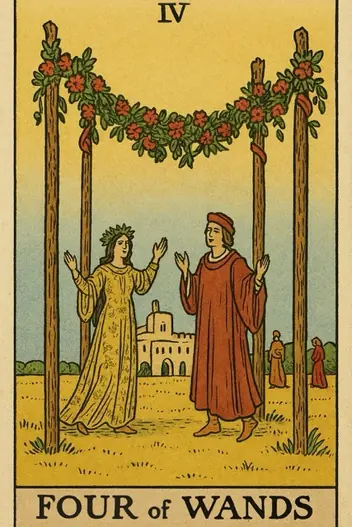
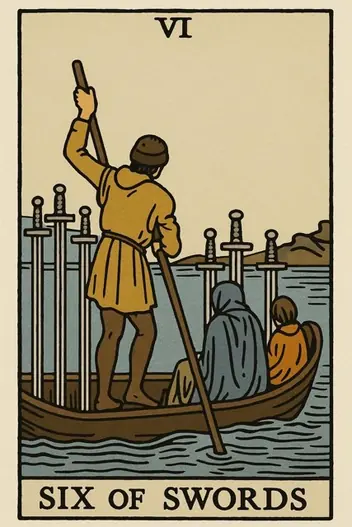
The psychological state here is one of bittersweet clarity. The Four of Wands represents the archetype of the Home—a safe base, a celebration of achievements, and emotional security. It is the part of you that craves stability, belonging, and the reward of past efforts. The Six of Swords, however, is the archetype of the Ferryman—the conscious decision to cross troubled waters toward an unknown shore. When these two meet, you are not fleeing a disaster; you are intentionally leaving a sanctuary because staying has become a form of stagnation.
The key insight is that this departure is not reactive but proactive. You are not being pushed out; you are choosing to move. This requires a high degree of emotional intelligence to separate nostalgia from genuine need. The Four of Wands may tempt you to stay because "it's not that bad," but the Six of Swords insists that comfort is not the same as fulfillment. The practical implication is clear: you must acknowledge the value of what you are leaving behind while simultaneously committing to the journey ahead. Gratitude for the past must coexist with courage for the future.
This dynamic is particularly potent in decision-making. The combination warns against analysis paralysis—the trap of over-valuing a stable situation that no longer serves your long-term trajectory. The psychological work is to audit your attachments: Are you staying out of genuine love, or out of fear of the unknown? The Six of Swords demands a logical, almost clinical assessment of your next steps, while the Four of Wands reminds you to honor the foundation you are leaving intact.
Four of Wands and Six of Swords in Love Tarot
If you are single:
This pair suggests you are evaluating a new connection through the lens of past stability. You may be attracted to someone who feels "safe," but you sense a need to move on from old patterns. The advice is to date with intention—do not settle for comfort if growth is what you truly need.
If you are in a relationship:
You are likely contemplating a significant transition—moving in together, breaking up, or redefining the relationship's structure. The key is to separate the emotional attachment from the practical decision.
In relationships, this combination often signals a conscious uncoupling or a planned evolution. The Four of Wands represents the shared home, the rituals, and the emotional safety you have built together. The Six of Swords indicates that one or both partners are mentally preparing for a departure—not necessarily a breakup, but a shift in the relationship's geography. This could mean a long-distance move, a career change that affects the partnership, or a decision to live apart for personal growth.
The critical relationship advice is to communicate the "why" behind the departure. The Six of Swords is not about secrecy; it is about strategic navigation. If you are the one leaving, you must articulate your reasons with clarity and empathy to avoid resentment. If your partner is the one leaving, you must trust their judgment while establishing new boundaries for connection. Boldly acknowledge that the relationship's form is changing, but its value is not diminished. The shadow here is passive-aggressive withdrawal—using the "need for space" as a cover for unresolved conflict. Instead, use this energy to negotiate a new contract for the relationship, one that honors both partners' need for growth.
Your pair is already on the table. Ask your question and draw the clarifying card
or simply focus on it
Career and Finances
Strategic Opportunities:
Leverage your current reputation and network (Four of Wands) to negotiate a graceful exit from a role or project that no longer challenges you.
Strategic Opportunities:
Identify a new industry or role that offers long-term intellectual growth (Six of Swords) while preserving the stability you have built (Four of Wands).
Calculated Risks:
Avoid burning bridges. The Four of Wands warns that your past success is an asset; do not sabotage it by leaving abruptly or with hostility.
In a professional context, this combination is a powerful signal for a planned career transition. You are not being fired or laid off; you are choosing to leave a stable position for a more strategic opportunity. The Four of Wands represents your current role's security, recognition, and positive relationships. The Six of Swords urges you to move toward a role that offers greater intellectual challenge, autonomy, or alignment with your long-term vision.
The bold financial warning is this: do not underestimate the cost of staying. The comfort of a steady paycheck (Four of Wands) can blind you to the opportunity cost of stagnation. The Six of Swords requires you to calculate the risk of departure—but also the risk of inaction. A practical strategy is to create a transition timeline: set a date to leave, build a financial buffer, and negotiate a phased exit if possible. For entrepreneurs, this combination suggests pivoting your business model—moving from a "safe" niche to a more scalable one. The strategic tip is to treat your career like a portfolio: diversify your skills and networks before making the leap.
Shadow Side & Pitfalls
The shadow of this combination manifests as nostalgia-induced paralysis or premature escapism. A common cognitive bias here is the sunk cost fallacy—overvaluing what you have built (Four of Wands) because of the time, effort, or emotion already invested. This can lead to staying in a relationship, job, or living situation long after it has stopped serving you, simply because it feels "safe" or "familiar." Conversely, the Six of Wands can tip into avoidance behavior—using the idea of "moving on" as a way to escape from unresolved issues rather than addressing them directly.
Another pitfall is romanticizing the departure—believing the "new shore" (Six of Swords) will solve all problems without acknowledging the work required to rebuild. The Four of Wands warns that stability is not automatic; it must be intentionally recreated. Self-sabotage can occur if you leave without a clear plan, mistaking motion for progress. The psychological antidote is radical honesty about your motivations: Are you leaving toward something, or just away from discomfort? If the latter, the Six of Swords becomes a flight response rather than a strategic relocation.
Get a personalized interpretation
Unlock the combined meaning of your cards in the context of your unique question — for free.
What If Four of Wands or Six of Swords Appears Reversed?
If the Four of Wands is reversed, it indicates blocked potential or recklessness. The celebration is canceled not due to a lack of success, but due to an inability to acknowledge it. Warning: you may be devaluing your achievements, leading to burnout and loss of motivation. Advice: find a way to symbolically mark the completion of a stage, even if you feel tired.
If the Six of Swords is reversed, it signals internal resistance to change. You know you need to move forward, but you sabotage this process out of fear or nostalgia. Weakness: you cling to the past, even if it is toxic or unpromising. Advice: make a list of the specific benefits of the transition and hang it in a visible place.
If BOTH cards are reversed, a complete imbalance of dynamics arises. You are simultaneously unable to enjoy the present and afraid of the future. This is a state of cognitive dissonance and paralysis of will. Logical way to correct it: start small. Focus on one task — either finish the old project (even in a reduced form) or take one small step in a new direction. Break the cycle of inaction with action.
What Is the Overall Message of Four of Wands and Six of Swords?
How can the energy of the Four of Wands be used constructively to balance the Six of Swords? The answer lies in creating a ritual of transition. The Four of Wands grants you the right to a pause and recognition. Use this resource to recharge with positivity and strengthen your self-belief. Then, without lingering, move on to planning the concrete steps of the Six of Swords.
Strategic advice:
Imagine you are a ship captain who has just successfully completed a long voyage. You enter port to replenish supplies, repair the vessel, and give the crew rest (Four of Wands). But your chart is already plotted for the next port, and you know exactly when you will weigh anchor (Six of Swords). Do not stay in port longer than planned.
Practical algorithm for action: 1) Acknowledge and celebrate your recent achievements. 2) Determine what exactly (beliefs, habits, people) you are taking with you on the new journey. 3) Draw up a route map for the next 3-6 months with specific stages. 4) Set a date for the first step and take it, without waiting for ideal conditions.
This combination teaches us a balance between gratitude and ambition. You do not sacrifice the present for the future, nor do you get stuck in the past. You build a bridge between them, using the energy of celebration as fuel for movement.
Where to Go From Here
The core message of Four of Wands and Six of Swords is that true growth often requires leaving a good place for a better one. You are being called to honor your past achievements while having the courage to navigate toward a future that demands more of you. This is not a loss; it is an upgrade. The key is to plan your departure with precision, communicate your intentions clearly, and trust that the stability you built will serve as a foundation, not a cage.
While this analysis provides the general archetype of this combination, the real power of Tarot lies in its application to your specific situation. The Fortune Cards app allows you to input your exact question—whether about a relationship, a career move, or a personal dilemma—and receive a deep, personalized interpretation of this exact card pairing. You can use the app on the web or download it to get the clarity you need to make your next move with confidence. Your unique context is the missing piece—let the cards speak directly to it.
Interpretation by the Fortune Cards editorial team, based on the Rider–Waite tradition and Jungian archetypes. About our methodology · Updated: 2026-08-26
Other Combinations with Four of Wands
Other Combinations with Six of Swords
Explore Individual Card Meanings
Ready to find answers to your questions?
Start your first reading now and look at your situation with fresh clarity. The cards are ready to reveal deeper meaning.