Seven of Wands and Six of Swords Reversed in Tarot
- Arcana
- Seven of Wands — Minor Arcana, Wands; Six of Swords — Minor Arcana, Swords
- Elements
- Seven of Wands — Fire; Six of Swords — Air
- Elemental interaction
- Friendly elements — energies support each other
- Numerology
- 7 + 6 = 13 → 4
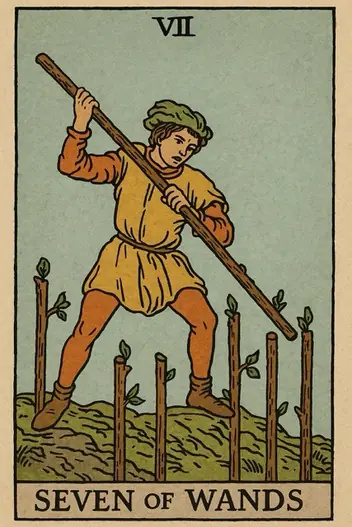
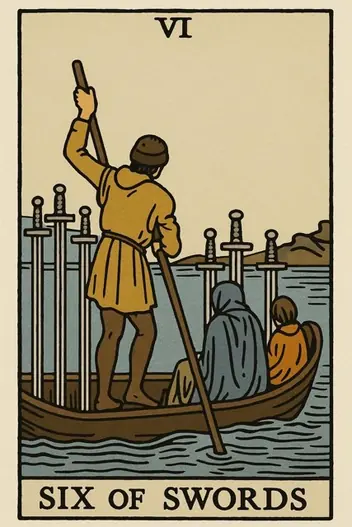
Imagine standing on a hilltop, fending off challengers with a staff, while simultaneously plotting an escape route to calmer waters. This is the psychological landscape of the Seven of Wands combined with the Six of Swords. The Seven of Wands represents defensive struggle—the need to hold your ground against external pressures, criticism, or competition. The Six of Swords embodies calculated transition—moving away from turbulence toward mental clarity and emotional stability. Together, they create a paradox: you are fighting to protect a position you are also preparing to leave.
This pairing reveals a critical inflection point where survival instincts clash with the need for strategic withdrawal. The core dynamic is not about winning a war, but about managing an exit without losing your integrity or resources. Psychologically, this combination demands that you distinguish between battles worth fighting and those that merely drain your energy. It asks: Are you defending a sinking ship, or are you buying time to build a lifeboat?
Seven of Wands and Six of Swords Together: Meaning
The intersection of the Seven of Wands and Six of Swords creates a tension between resistance and release. The Seven of Wands archetype is the warrior on the edge, actively repelling threats—be it a hostile colleague, a controlling partner, or a competitive market. The Six of Swords archetype is the ferryman, silently navigating toward safer shores. When combined, the seeker is likely in a situation where they must fight off immediate attacks while planning their exit strategy. This is not a time for reckless heroism; it is a time for disciplined retreat.
From a Jungian perspective, this combination activates the Shadow of the Martyr—the tendency to stay in a painful situation because it feels noble or familiar. The Seven of Wands can manifest as defensiveness when you actually need detachment. The Six of Swords can become avoidance when confrontation is necessary. The healthy resolution lies in pragmatic discernment: use the Seven’s courage not to win every argument, but to protect your boundaries long enough to execute the Six’s transition. Bold action here means choosing what to fight for and what to walk away from.
The real-world implication is that you are likely in a holding pattern—maintaining a position you no longer fully want, but cannot immediately abandon. This could be a job you are leaving, a relationship you are outgrowing, or a creative project you are pivoting from. The key insight is that defense is not weakness; it is a temporary strategy. The Six of Swords ensures that your retreat is deliberate, not desperate. The most powerful move is to fight for the space you need to think clearly, then move decisively.
Seven of Wands and Six of Swords: Career and Money
Strategic Opportunities:
This pair signals a perfect time to negotiate an exit package, pivot your career, or restructure your role—but only if you defend your leverage first. Use the Seven’s energy to assert your value in salary talks or project proposals before transitioning.
Strategic Opportunities:
If you are an entrepreneur, this combination suggests protecting your market share while developing a new product line or service that moves you away from a saturated or toxic market. Bold move: hire a temporary defender (lawyer, consultant) to handle current conflicts while you focus on the future.
Calculated Risks:
Avoid burning bridges while fighting. The Seven of Wands can make you aggressive or territorial, which will harm your reputation when you need references or future collaborations. The biggest financial risk is over-investing in a losing position just to prove you were right.
Professionally, this combination is a strategic signal for career transition. You may feel under attack at work—from a difficult boss, toxic colleagues, or industry disruption. The Seven of Wands energy is necessary for short-term survival, but the Six of Swords reminds you that the long-term solution is not to win the battle, but to change the battlefield. Bold financial advice: allocate 20% of your energy to defending your current position and 80% to planning your next move. This is not the time for risky investments or impulsive resignations. Create a 90-day transition plan that includes building a financial buffer, updating your network, and protecting your mental health from workplace warfare. The most pragmatic career move is to fight for your exit, not your entry.
Your pair is already on the table. Ask your question and draw the clarifying card
or simply focus on it
Seven of Wands and Six of Swords in Love and Relationships
If you are single:
This combination suggests you may be defending your independence against someone who wants to rush commitment, or you are protecting yourself from repeating past relationship patterns. The transition here is from defensive isolation to intentional openness—only after you’ve moved past old baggage.
If you are in a relationship:
You and your partner may be entrenched in a power struggle while simultaneously sensing the relationship is evolving. The key is to stop fighting each other and start fighting for the relationship’s future—which may require a painful but necessary change in how you communicate.
In relationships, the Seven of Wands and Six of Swords often indicate a couple or individual stuck in a cycle of conflict and avoidance. One partner may be defending their autonomy (Seven of Wands) while the other is emotionally checking out (Six of Swords). This is a red flag for unresolved resentment that is being managed rather than healed. The boldest relationship advice here is to stop defending your position and start navigating toward a shared destination. If you are single, this combination warns against entering a new relationship while still fighting old battles. Healing must precede moving on. The Six of Swords asks you to leave your emotional armor at the shore before boarding the boat to new love.
Get a personalized interpretation
Unlock the combined meaning of your cards in the context of your unique question — for free.
Seven of Wands and Six of Swords Reversed: What Changes?
If the Seven of Wands is reversed:
You have surrendered without a fight. The defense has collapsed due to exhaustion or flawed strategy. You feel overwhelmed and incapable of standing up for your interests. Advice: do not make decisions in a state of fatigue. Restore your resources before choosing a new direction.
If the Six of Swords is reversed:
You are stuck. Internal resistance to change is blocking forward movement. You know you need to leave, but you cling to the past out of fear. Warning: this state leads to depression and stagnation. Acknowledge that "moving on" is frightening, but staying put is even more dangerous.
If BOTH are reversed:
Complete imbalance. You are simultaneously unable to defend what you have and incapable of starting something new. This is an identity crisis. Remedy: start small. Restore one boundary (for example, say "no" to an unnecessary task) and take one small step toward change (send a resume, sign up for a course). Action breaks the vicious cycle.
When Seven of Wands and Six of Swords Signal Trouble
The shadow of this combination is the Paralyzed Warrior—someone who fights endlessly but never leaves, or leaves prematurely without fighting for what matters. The cognitive bias at play is the Sunk Cost Fallacy: you continue defending a position because you’ve already invested so much, even when the Six of Swords clearly indicates it’s time to move on. Alternatively, the Avoidance Bias can manifest as using the Six of Swords to emotionally disengage from a situation that actually requires confrontation. Self-sabotage occurs when you mistake stubbornness for strength, or detachment for wisdom.
Another shadow manifestation is passive-aggressive withdrawal. You may be fighting silently (Seven of Wands internalized) while secretly planning your escape (Six of Swords hidden), creating toxic dynamics where others sense your departure but cannot address it. Poor judgment here includes overestimating your ability to control the transition—the boat may leave without you if you spend too long fighting. The shadow asks: Are you defending your ego, or your future? Honest self-reflection is critical to avoid turning a strategic retreat into a bitter exile.
Overall Meaning of Seven of Wands and Six of Swords
How can the energy of the Seven of Wands be used constructively to balance the Six of Swords? The answer lies in a shift of what is being defended. Instead of defending an old position (a project, relationship, or status), begin defending the process of movement itself. Set boundaries for your new path: "I will not allow fear or the opinions of others to halt my development." This transforms the energy of defense from a reactive mode into a proactive one.
The Six of Swords is not about escape, but about the conscious evacuation of resources. Your task is to protect what you take with you: knowledge, skills, self-esteem, and a financial safety net. The Seven of Wands gives you the strength to say "no" to what pulls you back and "yes" to what leads you forward. A deep strategic counsel: plan your retreat as an advance. Map out your transition: what you are taking, what you are leaving behind, and where your first new base will be. Defense must serve movement, not the other way around.
Thus, this combination teaches us the courage to leave and the wisdom to defend. You cannot wage an endless war for the past. Use your remaining energy to build a bridge to the future, not to fortify the walls around the ruins.
Where to Go From Here
The Seven of Wands and Six of Swords together deliver a pragmatic ultimatum: stop fighting old wars and start navigating new waters. The core message is that defense is a temporary tactic, not a life strategy. Your next step is to audit your battles: Which ones are worth your energy, and which ones are delaying your inevitable transition? The answer lies in your personal context—your specific relationship, career, or financial situation.
While this article provides the archetypal meaning, the true power of Tarot emerges when it speaks directly to your life. The Fortune Cards app allows you to input your exact question—about a partner, a job offer, or a personal dilemma—and receive a deep, personalized interpretation of this exact card combination. Whether you use it on the web or download it, the app bridges the gap between universal symbolism and your unique circumstances. Don’t just read about the cards; let them read you. Get your personalized reading now.
Interpretation by the Fortune Cards editorial team, based on the Rider–Waite tradition and Jungian archetypes. About our methodology · Updated: 2026-08-26
Other Combinations with Seven of Wands
Other Combinations with Six of Swords
Explore Individual Card Meanings
Table of Contents
- Seven of Wands and Six of Swords Together: Meaning
- Seven of Wands and Six of Swords: Career and Money
- Seven of Wands and Six of Swords in Love and Relationships
- Seven of Wands and Six of Swords Reversed: What Changes?
- When Seven of Wands and Six of Swords Signal Trouble
- Overall Meaning of Seven of Wands and Six of Swords
- Where to Go From Here
Ready to find answers to your questions?
Start your first reading now and look at your situation with fresh clarity. The cards are ready to reveal deeper meaning.