Seven of Wands and Five of Swords Meaning in Tarot

- Arcana
- Seven of Wands — Minor Arcana, Wands; Five of Swords — Minor Arcana, Swords
- Elements
- Seven of Wands — Fire; Five of Swords — Air
- Elemental interaction
- Friendly elements — energies support each other
- Numerology
- 7 + 5 = 12 → 3
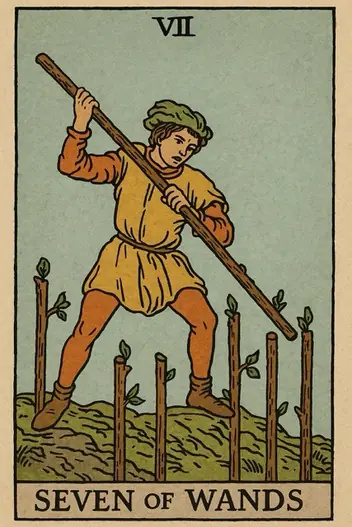
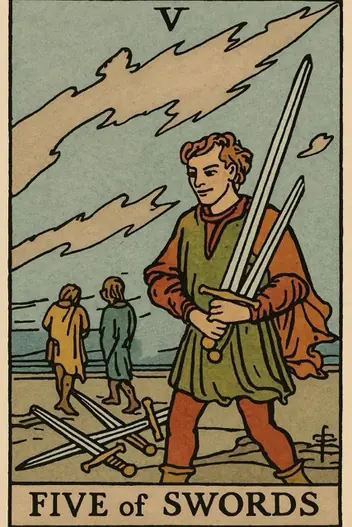
When the Seven of Wands and the Five of Swords appear together in a reading, you are looking at a psychological landscape defined by defensive struggle and the high cost of winning. The Seven of Wands represents the archetype of the underdog—the individual who must stand firm, hold their position, and fight against overwhelming odds. The Five of Swords, however, introduces the shadow of conflict: it speaks of victory achieved through cunning, aggression, or at the expense of others. Together, they create a narrative of a fight that you are determined to win, but one that risks leaving you isolated and depleted.
Psychologically, this combination activates the Warrior archetype in its most conflicted form. You are not fighting for glory; you are fighting for survival of your ego, your values, or your territory. The tension lies in the question: Is this battle worth the casualties? The Five of Swords warns that even if you "win," you may lose the support of your allies, damage your reputation, or exhaust your resources. The Seven of Wands insists that sometimes, you must fight regardless of the cost. The key is to distinguish between a necessary defense of your boundaries and a self-destructive war of attrition.
Seven of Wands and Five of Swords Together: Meaning
The core dynamic of the Seven of Wands and Five of Swords is a paradox of strength versus isolation. You have the energy and willpower to defend your position (Seven of Wands), but you are likely engaging in a conflict that is inherently unfair or morally ambiguous (Five of Swords). This is not a card pairing of collaboration or diplomacy; it is the energy of a lone wolf fighting on multiple fronts. You may feel that you are the only one who sees the truth, and that you must prove your point through sheer force of will.
The psychological state here is one of hyper-vigilance and justified paranoia. You are scanning your environment for threats, ready to counter-attack. However, the Five of Swords warns that your perception of threat may be exaggerated. You might be fighting against people who were never truly enemies, or you may be using "winning" as a way to mask deeper insecurities about your own value. The practical implication is clear: you must assess whether your defensive stance is protecting a genuine boundary or simply feeding a need to be right. If you are constantly fighting, you are not building; you are merely surviving. The challenge is to channel this combative energy into a single, decisive action rather than a prolonged guerilla war.
Your pair is already on the table. Ask your question and draw the clarifying card
or simply focus on it
Seven of Wands and Five of Swords: Career and Money
Strategic Opportunities:
Use the Seven of Wands energy to protect your intellectual property, your position, or a project you believe in. This is a time to stand firm against unfair criticism or workplace politics.
Strategic Opportunities:
Channel the competitive drive of the Five of Swords into strategic negotiations, not personal battles. You can outmaneuver rivals by being smarter, not meaner.
Calculated Risks:
Avoid "winning" at the cost of your professional relationships. A victory that makes you look aggressive or untrustworthy will harm your long-term network and reputation.
In your career, this combination signals a high-stakes professional conflict. You may be under pressure from superiors, competing for a promotion, or defending your work from a hostile colleague. The Five of Swords warns against short-term tactical wins that lead to long-term strategic losses. For example, you might succeed in getting a project approved by undermining a coworker, but you will have created an enemy who will wait for their revenge. The pragmatic approach is to use the Seven of Wands' defensiveness to secure your position, but to avoid the Five of Swords' temptation to gloat or humiliate your opponents. Financially, be cautious of litigation, severance negotiations, or any situation where you might win money but lose your peace of mind. A key financial warning: do not spend more energy fighting for a "principle" than the principle is worth.
Seven of Wands and Five of Swords Love Outcome
If you are single:
This pairing suggests you are attracting or involved in a dynamic where you feel you must prove your worth through debate or competition. Be wary of partners who challenge you just to test your strength; this is a red flag for a toxic power struggle.
If you are in a relationship:
You are likely in a cycle of arguments where one person "wins" but the relationship loses. The goal is no longer connection but victory, which creates a cold, lonely atmosphere.
In relationships, the Seven of Wands and Five of Swords is a warning about emotional exhaustion through conflict. You may be defending your position so fiercely that you forget you are on the same team. The Five of Swords energy can manifest as passive-aggressive remarks, withholding affection to "win" an argument, or keeping score of past grievances. The most important relationship advice here is to recognize when a fight is about power, not about the issue at hand. If you find yourself feeling victorious after a disagreement but also deeply disconnected from your partner, you have fallen into the trap of the Five of Swords. The Seven of Wands reminds you that healthy boundaries are necessary, but they must be enforced with clarity, not cruelty. Ask yourself: Am I fighting for my needs, or am I fighting to be right?
Deepen your understanding
Find out exactly what this reading means for your current life situation with our oracle.
Seven of Wands and Five of Swords Reversed: What Changes?
When cards appear in reversed positions, the dynamics become more complex and less obvious.
Seven of Wands Reversed:
This indicates exhaustion and retreat. You can no longer, or do not wish to, defend your boundaries. This may be a wise withdrawal, or a capitulation due to burnout. Advice: honestly assess whether this position is worth your energy. Sometimes walking away is not a loss, but a survival strategy.
Five of Swords Reversed:
This is internal conflict and guilt. You have won, but feel no satisfaction. Or you have lost, but feel relief. Warning: do not let guilt over past "victories" paralyze your will. Forgive yourself for difficult decisions and move on.
Both cards reversed:
This is total imbalance. You are simultaneously unable to defend yourself and unwilling to win. The situation has reached an impasse. Advice: this is a signal for a complete change of context. You need to step out of this frame of reference. Cease all struggle, even for "peace." Start with a clean slate in another area of life.
The Shadow Side of Seven of Wands and Five of Swords
The shadow side of this pairing is the cognitive bias known as "reactive devaluation" —you automatically dismiss any idea or person that challenges you, seeing them as an enemy rather than a source of information. This leads to self-sabotage through isolation. You may push away allies because you perceive their advice as criticism. The Five of Swords shadow also manifests as a "scorched earth" mentality: a belief that if you cannot win completely, you will destroy everything so no one else can have it. This is the energy of quitting a job in a blaze of glory, burning bridges, or ending a relationship with a final hurtful remark. The pitfall is that you end up alone on a hill you fought to defend, with no one left to share the victory. You must recognize when your ego is driving the conflict, and when the "battle" is actually a projection of internal shame or fear onto an external target.
Seven of Wands and Five of Swords: The Combined Message
How to constructively use the energy of this pair? The key lies in separating "defense" from "attack." The energy of the Seven of Wands is needed to clearly and calmly define your boundaries: "This is my area of responsibility; I am not ready to discuss this." The energy of the Five of Swords should be directed not at people, but at problems and systemic obstacles.
Your strategic task is to transform conflict into competition. Stop fighting with people and start competing with circumstances. For example, if a competitor tries to poach your clients, don't waste energy on counterattacks (Five of Swords). Instead, use the resilience of the Seven of Wands to improve your product so much that clients return on their own.
Deep advice: accept the fact that some battles cannot be won "cleanly." Sometimes the best result is a draw, or even a tactical retreat. Your goal is not to destroy your opponent, but to preserve your integrity and resources for future opportunities. Ask yourself: "What will I gain by winning this argument? Is it worth the relationships I will destroy?" If the answer is no, use the energy of the Seven of Wands to exit the game, rather than the Five of Swords to deliver the final blow.
Where to Go From Here
The Seven of Wands and Five of Swords together deliver a clear message: you have the strength to fight, but you must choose your battles wisely. The core lesson is strategic discernment. Are you defending a genuine value, or are you just addicted to the adrenaline of conflict? The answer lies in your unique situation—your history, your relationships, and your specific goals. General advice can guide you, but only a personalized reading can reveal the hidden motivations and the right course of action for you.
Your next step is to apply this archetypal knowledge to your own life. The Fortune Cards app allows you to do exactly that. By inputting your specific question—whether about a difficult coworker, a partner you're arguing with, or a career decision—you can receive a deep, personalized interpretation of this exact card combination. The app analyzes the nuances of your situation, helping you to see if you are the defender or the aggressor, and what the best strategic move is for your growth. Use it on the web or download it now to transform this general insight into a concrete, actionable plan for your life.
Interpretation by the Fortune Cards editorial team, based on the Rider–Waite tradition and Jungian archetypes. About our methodology · Updated: 2026-08-26
Other Combinations with Seven of Wands
Other Combinations with Five of Swords
Explore Individual Card Meanings
Table of Contents
- Seven of Wands and Five of Swords Together: Meaning
- Seven of Wands and Five of Swords: Career and Money
- Seven of Wands and Five of Swords Love Outcome
- Seven of Wands and Five of Swords Reversed: What Changes?
- The Shadow Side of Seven of Wands and Five of Swords
- Seven of Wands and Five of Swords: The Combined Message
- Where to Go From Here
Ready to find answers to your questions?
Start your first reading now and look at your situation with fresh clarity. The cards are ready to reveal deeper meaning.