Nine of Cups and Five of Swords Together in Tarot

- Arcana
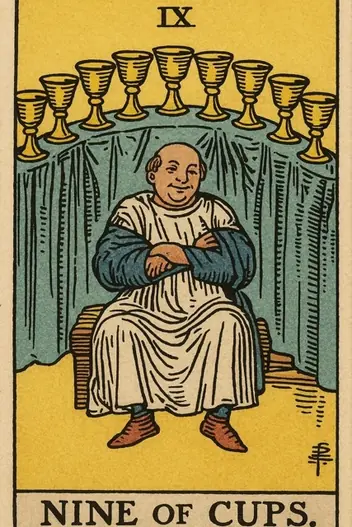
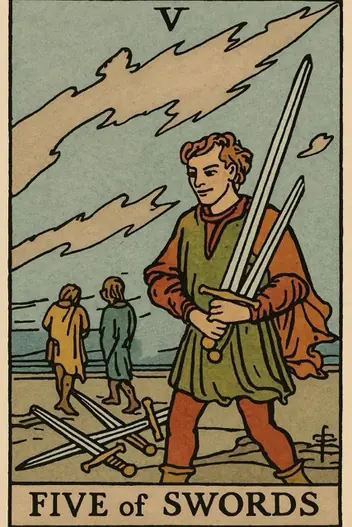
- Nine of Cups — Minor Arcana, Cups; Five of Swords — Minor Arcana, Swords
- Elements
- Nine of Cups — Water; Five of Swords — Air
- Elemental interaction
- Neutral elements — energies coexist without conflict
- Numerology
- 9 + 5 = 14 → 5
This combination presents a fascinating psychological paradox. The Nine of Cups represents the archetype of the "Wish Card"—emotional fulfillment, self-satisfaction, and a sense of having arrived at a desired state. The Five of Swords, by contrast, embodies the "Winner’s Curse"—a victory achieved through conflict, often leaving behind a trail of resentment, isolation, or hollow triumph. When these two collide, the core question becomes: Can you truly enjoy what you’ve won if the cost was your integrity or relationships?
The energy here is not about simple luck or loss. It’s about strategic trade-offs and the psychological cost of winning. You may be on the verge of securing something you deeply desire, but the path to get there involves a direct confrontation, a difficult decision, or a win that feels more like a loss. This is a reading for the pragmatist who must decide if the prize is worth the price.
Nine of Cups and Five of Swords Combination Meaning
The central dynamic is a conflict between personal satisfaction (Cups) and competitive triumph (Swords). The Nine of Cups asks, "Are you happy?" while the Five of Swords asks, "At what expense?" This creates a high-stakes psychological environment where cognitive dissonance is likely. You may find yourself rationalizing a morally ambiguous victory to preserve your sense of self-worth.
This pairing often signals a zero-sum game mindset—a belief that for you to win, someone else must lose. The Nine of Cups’ emotional fulfillment becomes tainted by the Five of Swords’ underlying tension. You might achieve your goal (the job, the partner, the recognition), but the shadow of the conflict lingers, preventing genuine contentment. The key insight here is to distinguish between achievement and fulfillment. One is a measurable outcome; the other is a lasting emotional state.
In practical terms, this combination demands ruthless self-honesty. Ask yourself: Is this victory truly worth the damage to my reputation, relationships, or peace of mind? The cards suggest that short-term gratification can mask long-term psychological debt. The wise path is to assess if you can enjoy your "cup" without looking over your shoulder at the battlefield you left behind.
Your pair is already on the table. Ask your question and draw the clarifying card
or simply focus on it
What Do Nine of Cups and Five of Swords Say About Love?
If you are single:
This pairing warns against pursuing a romantic interest through manipulation or one-upmanship. You may "win" their attention, but the relationship will lack genuine emotional safety.
If you are in a relationship:
You are likely in a power struggle where one partner feels they must "lose" for the other to "win." The immediate victory is hollow and erodes trust.
In love, the Nine of Cups and Five of Swords combination signals a toxic dynamic of control and conditional affection. One partner may be using emotional withdrawal or silent treatment (Five of Swords) to get their way, while the other seeks validation and approval (Nine of Cups). This creates a cycle where affection is treated as a reward for submission. The psychological archetype here is the "Rescuer" and the "Persecutor"—a classic shadow dynamic where both parties feel victimized by the other’s actions.
Key relationship advice: Stop keeping score. The Five of Swords thrives on tallying past grievances. The Nine of Cups wants harmony but may be enabling the conflict by not setting boundaries. The pragmatic solution is to reframe the relationship as a collaboration, not a competition. Agree on non-negotiable values (respect, honesty) and commit to solving problems together, not against each other. If you feel you’ve “won” an argument, you’ve actually lost a chance for deeper intimacy.
Deepen your understanding
Find out exactly what this reading means for your current life situation with our oracle.
What Do Nine of Cups and Five of Swords Indicate for Your Career?
Strategic Opportunities:
This is a powerful time for negotiating a settlement or severance package—you can secure favorable terms, but expect hard bargaining.
Strategic Opportunities:
Use the Nine of Cups’ visualization to clarify your desired outcome, then leverage the Five of Swords’ strategic thinking to execute a precise, calculated move.
Calculated Risks:
Avoid public confrontations or burning bridges. A victory won by humiliating a colleague or competitor will come back to haunt your reputation.
In your career, this combination is a double-edged sword for advancement. You may be presented with a win-lose scenario—a promotion that requires stepping on someone else, or a contract win that alienates a partner. The pragmatic approach is to assess the long-term value of the asset versus the relationship. The Five of Swords often signals a short-term tactical win, while the Nine of Cups represents a sustainable emotional state.
Financial warning: Be wary of "too good to be true" deals that require cutting corners or exploiting others. The money may come, but the ethical cost will compound. Instead, look for win-win scenarios where you can achieve your desires without sacrificing integrity. If you must compete, do so on merit and transparency, not on manipulation. The most profitable strategy here is to walk away from any deal that requires you to betray your values. The Nine of Cups’ true fulfillment comes from earning your success, not stealing it.
Reversed Positions: What Changes?
When cards are reversed, the dynamic weakens or becomes distorted, which can be either worse or better.
Nine of Cups reversed:
This is a state of "shattered dreams". You got what you wanted, but it brought no joy, or your expectations were unrealistic. In combination with the upright Five of Swords, this creates an angry and disillusioned quarreler who fights not for victory, but out of bitterness. Advice: Acknowledge your disappointment. You are not fighting an opponent, but your own illusion.
Five of Swords reversed:
This is the energy of "surrender" or "avoidance". You give up the fight, even when you are in the right. Paired with the upright Nine of Cups, this leads to passive acceptance of an unsatisfactory compromise. You pretend to be happy to avoid conflict. Advice: Your concession is not wisdom, but cowardice. Find the courage to assert your boundaries in a healthy way.
BOTH reversed:
Complete imbalance. This is a state of apathy and powerlessness. You can neither take joy in your achievements (reversed Nine) nor defend yourself (reversed Five). You feel like a victim of circumstances. Advice: Start small. Regain control through routine actions. Tidy up, complete one small task. Restore a sense of basic competence before engaging in major conflicts.
What Are the Risks of Nine of Cups and Five of Swords?
The shadow of this pairing is the triumph of the ego over the soul. You may become trapped in a confirmation bias, only seeing evidence that supports your right to win while ignoring the damage you cause. The cognitive bias at play is the "sunk cost fallacy"—you’ve invested so much in the conflict that you can’t bear to walk away without a "victory," even if the prize is now meaningless.
Self-sabotage manifests as emotional numbness. You get what you wanted (the Nine of Cups), but you feel empty (the Five of Swords’ isolation). This is a classic Pyrrhic victory—a win that costs so much it’s equivalent to a loss. The worst-case scenario is burning a valuable relationship or professional network for a short-term gain that leaves you isolated and regretful. The shadow warns: Do not mistake aggression for assertiveness, or stubbornness for strength.
Nine of Cups and Five of Swords Combined Message
How can the energy of these cards be used constructively? Your task is to separate tactics from strategy. The energy of the Five of Swords is an excellent tactical tool for defense in the moment. The energy of the Nine of Cups is the strategic goal: long-term satisfaction. The key synthesis: use aggression to defend your boundaries, but never to attack.
The strategic advice is to shift your focus from "winning against someone" to "winning for yourself." Your true Nine of Cups is not a state of "I am better than everyone," but a state of "I am at peace with myself and the world." The Five of Swords should become for you not a hammer, but a scalpel—a tool for precise and swift conflict resolution, not for destruction.
To escape this trap, ask yourself: "What is more valuable to me: being right in this argument, or preserving my relationships/reputation/peace of mind?" If you choose peace, your task is to transform the Five of Swords from a weapon into a negotiation tool. Instead of "You are wrong," say "I see it differently, and here are my arguments. Let's find a solution that works for both of us." This is the only way to attain the true satisfaction of the Nine of Cups—not in isolation, but in harmony.
Applying This to Your Situation
The core message of Nine of Cups and Five of Swords is a stark choice: Will you win the battle but lose the war for your own peace of mind? The cards urge you to evaluate whether your current goal is truly aligned with your long-term well-being, or if you’re chasing a hollow victory out of pride or fear. True fulfillment comes from victories that honor your integrity, not from conquests that damage your soul.
While this article provides the general archetype, the true magic happens when Tarot is applied to your unique situation. Your specific question, your timing, and your personal history change the meaning of these cards entirely. Use the Fortune Cards app to get a deep, personalized interpretation of this exact combination for your specific question right now. You can access it on the web or download it to unlock the precise guidance you need for the decision ahead.
Interpretation by the Fortune Cards editorial team, based on the Rider–Waite tradition and Jungian archetypes. About our methodology · Updated: 2026-08-26
Other Combinations with Nine of Cups
Other Combinations with Five of Swords
Explore Individual Card Meanings
Table of Contents
- Nine of Cups and Five of Swords Combination Meaning
- What Do Nine of Cups and Five of Swords Say About Love?
- What Do Nine of Cups and Five of Swords Indicate for Your Career?
- Reversed Positions: What Changes?
- What Are the Risks of Nine of Cups and Five of Swords?
- Nine of Cups and Five of Swords Combined Message
- Applying This to Your Situation
Ready to find answers to your questions?
Start your first reading now and look at your situation with fresh clarity. The cards are ready to reveal deeper meaning.