Love Tarot: Six of Wands and Five of Swords

- Arcana
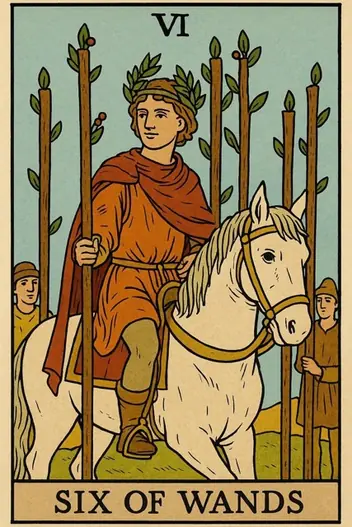
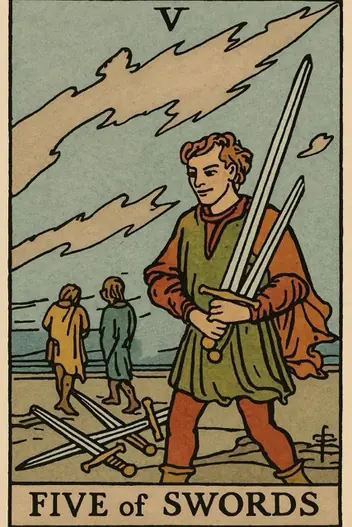
- Six of Wands — Minor Arcana, Wands; Five of Swords — Minor Arcana, Swords
- Elements
- Six of Wands — Fire; Five of Swords — Air
- Elemental interaction
- Friendly elements — energies support each other
- Numerology
- 6 + 5 = 11 → 2
When the Six of Wands—the card of public recognition, validation, and triumphant progress—collides with the Five of Swords—the card of Pyrrhic victories, tense conflict, and hollow conquests—you get a powerful psychological paradox. This pairing often describes a situation where you have "won" in the eyes of others, but the victory feels uneasy, isolating, or morally ambiguous. The applause is real, but so is the underlying tension.
The core dynamic here is the tension between external validation and internal cost. You may be riding high on a wave of success, but the path to that success involved a difficult, perhaps ruthless, confrontation. This combination forces you to ask: Was the win worth what it took to get there? It is not a card of pure triumph, but of strategic success shadowed by relational fallout.
Six of Wands and Five of Swords Combination Meaning
The psychological state created by the Six of Wands and Five of Swords is one of achievement anxiety. You have likely accomplished a significant goal—perhaps you secured a promotion, won a debate, or gained social approval—but the process left a trail of bruised egos or broken alliances. The Jungian archetype at play here is the Trickster or the Conqueror, someone who bends the rules or uses sharp intellect to overcome obstacles, but who now stands alone on the pedestal.
This is a high-stakes mindset where you are acutely aware that your success came at someone else's expense. The Five of Swords warns that the "losers" in your story are not likely to forget or forgive easily. The Six of Wands, however, reminds you that the external world is rewarding your competence. The key insight is this: you are being tested on your ability to handle success with integrity. Can you enjoy the victory without gloating? Can you manage the envy and resentment that often follows a win?
In practical, real-world terms, this combination suggests a need for strategic diplomacy. You have earned your place, but the battlefield is not yet fully pacified. Your next move should not be to celebrate, but to consolidate. Use the recognition you’ve gained to build bridges, not to burn more. The psychological trap is mistaking temporary applause for lasting security.
Six of Wands and Five of Swords in Love Tarot
If you are single:
This pairing warns against a "winning" mentality in dating. You may be tempted to pursue someone for the ego boost (the chase) rather than genuine connection. Beware of turning a potential partner into a conquest; the victory may feel hollow once achieved.
If you are in a relationship:
You are likely in a power struggle where one partner "wins" arguments at the cost of emotional intimacy. The goal is not to be right, but to be connected. A cold, logical victory here can lead to a cold, distant relationship.
In relationships, the Six of Wands and Five of Swords signals a dangerous dynamic of dominance and submission. One partner may feel publicly validated (e.g., "I was right in front of our friends"), while the other feels privately defeated. This creates a toxic cycle of resentment masked by outward appearances. The relationship looks successful from the outside, but inside, there is a lingering sense of unfairness.
The most important relationship advice here is to choose connection over control. If you have recently "won" an argument, ask yourself: Did I win the fight but lose the partner? The psychological health of the relationship depends on moving from a zero-sum game to a collaborative partnership. Acknowledge the other person's perspective publicly to disarm the tension. Your victory is only meaningful if the relationship itself thrives.
Your pair is already on the table. Ask your question and draw the clarifying card
or simply focus on it
What Do Six of Wands and Five of Swords Indicate for Your Career?
Strategic Opportunities:
Leverage your recent win to gain a seat at the table. Use the recognition to request a budget, a promotion, or more autonomy. Your credibility is high right now.
Strategic Opportunities:
Identify and neutralize rivals diplomatically. The Five of Swords suggests you have the upper hand; use it to offer a truce or a partnership, not to crush an opponent.
Calculated Risks:
Avoid public confrontations or gloating. The applause can turn to criticism quickly if you appear arrogant or unethical. Keep your strategy private.
In your professional life, this combination is a double-edged sword. The Six of Wands indicates a clear career win—a successful project, a new client, or a positive performance review. However, the Five of Swords warns that this success may have created enemies or strained team dynamics. You may have cut corners, taken credit for shared work, or outmaneuvered a colleague. Financially, the advice is to avoid risky investments based on overconfidence. The "win" is real, but it is not a guarantee of future success.
The most pragmatic approach is to manage your reputation carefully. Your next career move should focus on alliance-building, not further competition. Offer to mentor someone, share credit publicly, or apologize for any collateral damage. This will transform a hollow victory into a sustainable foundation. Financially, consolidate your gains and avoid speculative bets that could be influenced by your inflated ego.
Reversed Six of Wands and Five of Swords Explained
When cards are reversed, the dynamic becomes distorted, but it does not disappear.
If the Six of Wands is reversed:
This indicates blocked potential. You may win the conflict (Five of Swords), but not receive the recognition you deserve. Your success goes unnoticed, or you sabotage your own advancement out of fear. Advice: stop fighting for recognition where it is not given. Change the arena.
If the Five of Swords is reversed:
This speaks to internal resistance to conflict. You may receive recognition (Six of Wands), but feel like an impostor or experience guilt over how you achieved it. Warning: do not let false modesty deprive you of your well-earned rewards. Separate the outcome from the method.
If BOTH are reversed:
Complete imbalance. You lose in conflicts without receiving recognition. This is a state of apathy and frustration. Corrective strategy: temporarily abandon all competition. Focus on restoring your self-esteem and finding a safe environment where you are valued without a struggle.
Get a personalized interpretation
Unlock the combined meaning of your cards in the context of your unique question — for free.
What Are the Risks of Six of Wands and Five of Swords?
The shadow side of this combination is narcissistic injury and isolation. When the energy is blocked or misdirected, the seeker becomes trapped in a confirmation bias—they only see the praise (Six of Wands) and ignore the damage (Five of Swords). This leads to hubris: believing you are untouchable because of your recent success. The cognitive bias here is the Dunning-Kruger effect—overestimating your competence because of a single victory.
Alternatively, the shadow can manifest as paralyzing guilt. You may feel so guilty about how you achieved your win that you cannot enjoy it, leading to self-sabotage. You might subconsciously ruin your own success because you feel you don't deserve it. The Jungian shadow here is the unacknowledged aggressor—the part of you that enjoys the fight and the conquest, but which you refuse to own. The pitfall is either becoming a ruthless tactician or a guilt-ridden martyr. Neither is a healthy path.
Six of Wands and Five of Swords Combined Message
Constructive use of this combination requires a high level of reflection. Your task is to learn to separate healthy ambition (Six of Wands) from destructive competition (Five of Swords). Ask yourself: "What is the true cost of my victory? Am I willing to pay it?"
The strategic advice lies in redefining the concept of "victory". Instead of striving for triumph over others (Five of Swords), channel the energy of the Six of Wands toward achieving a personal best. Compete with yourself, not with your surroundings. This will allow you to receive recognition for your merits without entering into destructive conflicts.
If conflict is unavoidable, apply the principle of "damage minimization". Win in such a way that your opponent retains the opportunity to retreat with dignity. Do not kick someone when they are down. This is not weakness—it is a strategy for long-term leadership. Your reputation and network of contacts are assets worth more than any fleeting victory.
Where to Go From Here
The core message of the Six of Wands and Five of Swords is that success without integrity is a fragile crown. You have earned recognition, but the cost is real. Your next step is to embrace your victory with humility and repair the relationships you may have damaged. The applause will fade; what remains is the trust you rebuild. Do not let the fear of being "weak" prevent you from making amends. True strength lies in managing the aftermath of your win with grace.
While this article provides a deep analysis of the general archetype, the true power of Tarot lies in its application to your unique life. The Fortune Cards app offers a personalized, AI-driven reading that interprets this exact combination for your specific question—whether about love, career, or personal growth. You can use the app on the web or download it to get a deep, tailored interpretation of the Six of Wands and Five of Swords right now. Stop guessing—get clarity on your specific situation.
Interpretation by the Fortune Cards editorial team, based on the Rider–Waite tradition and Jungian archetypes. About our methodology · Updated: 2026-08-26
Other Combinations with Six of Wands
Other Combinations with Five of Swords
Explore Individual Card Meanings
Table of Contents
- Six of Wands and Five of Swords Combination Meaning
- Six of Wands and Five of Swords in Love Tarot
- What Do Six of Wands and Five of Swords Indicate for Your Career?
- Reversed Six of Wands and Five of Swords Explained
- What Are the Risks of Six of Wands and Five of Swords?
- Six of Wands and Five of Swords Combined Message
- Where to Go From Here
Ready to find answers to your questions?
Start your first reading now and look at your situation with fresh clarity. The cards are ready to reveal deeper meaning.