Five of Swords
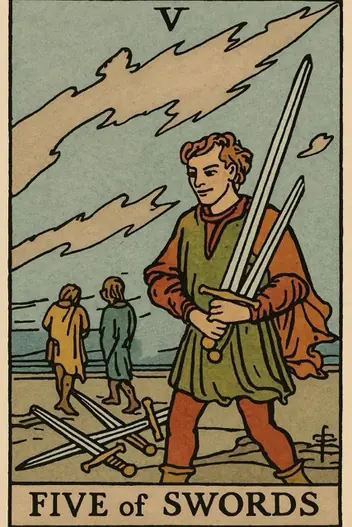
- Arcana
- Minor Arcana, Suit of Swords
- Element
- Air
- Decan
- Venus in Aquarius
- Numerology
- 5
The Five of Swords represents a zero-sum conflict archetype, where winning comes at the cost of isolation and resentment. Psychologically, it embodies the Jungian shadow of the competitive ego—the drive to "prove oneself right" even when the victory is hollow. This card signals a moment where short-term dominance undermines long-term trust, forcing a choice between being effective and being victorious.
The core challenge of this card is recognizing when a battle is not worth fighting. It exposes the cognitive trap of conflating self-worth with winning an argument or a competition. The Five of Swords asks you to audit your motivations: Are you seeking a result, or are you seeking validation through conflict?
Five of Swords: Core Meaning and Interpretation
The upright Five of Swords depicts a psychological state of post-conflict exhaustion and hollow triumph. The individual has secured a tactical win—perhaps they have proven a point, claimed a resource, or silenced a critic—but at the cost of social capital and emotional goodwill. This is the mindset of a person who has "won the battle but lost the war."
The resource this card offers is clarity of purpose under pressure. It forces you to see the real cost of your actions, stripping away rationalizations. The key insight here is that not every conflict requires a winner. Sometimes, the most strategic move is to disengage. The decision-making framework for this card is brutally pragmatic: assess the true value of the prize versus the price of the relationship or reputation lost. Bold the conclusion: If the victory leaves you standing alone in a field of broken alliances, you have not advanced—you have retreated.
Ask your question and flip the cards
or simply focus on it
Is Five of Swords a Yes or a No?
No. The Five of Swords embodies Pyrrhic victory, hollow conquest, and the psychological cost of winning at another’s expense. Its core symbolism—a lone figure clutching three swords while two defeated opponents retreat—signals that any “yes” outcome here comes soaked in resentment, isolation, or moral compromise. In the reversed position, the answer shifts to Leaning No, as it suggests a refusal to engage in further conflict, but still carries the residue of bitterness or a hollow truce. The critical condition: the outcome depends entirely on whether you are willing to sacrifice relationships, self-respect, or long-term peace for a short-term win. If you cannot walk away cleanly, the answer remains a definitive no.
Deepen your understanding
Find out exactly what this reading means for your current life situation with our oracle.
Card of the Day
The Five of Swords cuts through the day with an energy of confrontation, ego battles, and the urge to “win” at all costs. Focus on choosing your battles wisely—ask yourself if the victory you seek is worth the relational damage it will inflict. Take action only if you can assert your boundaries without humiliating or overpowering the other party. Avoid the trap of proving yourself right at the expense of connection, and steer clear of anyone who thrives on argument for argument’s sake. Today’s shadow is the seduction of being “technically correct” while losing the trust or goodwill of those around you.
Five of Swords in Love and Relationships
If you are not in a relationship:
This card warns against approaching potential partners as opponents to be conquered. It indicates a risk of attracting conflict-driven dynamics where you feel compelled to "win" the other person's affection through argument or dominance.
If you are in a relationship:
The Five of Swords signals a power struggle where one partner is prioritizing being "right" over being connected. It reveals a pattern of verbal sparring or passive-aggressive victories that erode emotional safety.
The behavioral pattern here is a defensive ego that mistakes vulnerability for weakness. The practical relationship advice is to distinguish between standing your ground and attacking the other's ground. Emotional intelligence demands you ask: "Do I want resolution, or do I want submission?" Bold the core advice: When the Five of Swords appears, the healthiest move is often to voluntarily lose the argument to preserve the relationship. This is not surrender—it is a strategic choice to protect long-term intimacy over short-term ego gratification.
What Does Five of Swords Say About Their Feelings?
Through the lens of the Five of Swords, this person perceives you as a rival or a source of unresolved tension—someone who challenges their ego or reminds them of a past defeat. They likely associate you with a dynamic where one of you must lose for the other to gain, creating an undercurrent of defensiveness or guardedness. Their hidden intention may be to “win” a psychological point against you, either by proving themselves superior or by withdrawing to protect their pride. Beneath this, they fear being seen as weak or wrong in your eyes, which fuels either cold distance or cutting remarks. There is a clear internal conflict: they respect your strength but resent the anxiety you provoke in them, leaving them torn between engaging and retreating. Their perception of you is not neutral—it is charged with the memory of a battle they have not fully resolved.
Career and Finance
Strategic Opportunities:
The card signals a moment to reassess your competitive strategy. A win is possible, but is it profitable? Use this energy to negotiate from a position of strength, but avoid burning bridges.
Resource Management:
This is an excellent time to cut losses on a toxic project or partnership. The Five of Swords grants the clarity to walk away from a losing proposition, even if it feels like a defeat.
Calculated Risks:
The primary warning is against overplaying your hand. Do not humiliate a rival or competitor publicly, as the backlash will outweigh the immediate gain. Avoid litigation, public disputes, or aggressive takeovers unless the stakes are existential.
Professionally, this card demands a cold-eyed cost-benefit analysis. Ask: "What am I willing to lose to win this?" The financial warning is clear: A Pyrrhic victory drains resources, reputation, and future opportunities. The strategic advice is to focus on win-win outcomes or, failing that, on minimizing damage. In leadership, this card warns against micromanaging or enforcing compliance through intimidation—it breeds resentment and reduces long-term productivity. Bold the warning: Do not trade your reputation for a short-term tactical gain.
Five of Swords Reversed: What Changes
When reversed, the Five of Swords shifts from external conflict to internalized guilt and avoidance. The blocked potential here is the inability to assert oneself when necessary. Instead of fighting a hollow battle, the individual avoids conflict entirely, even when standing up is essential. This manifests as a pattern of passive-aggression, self-sabotage, or playing the victim to avoid responsibility.
The psychological weakness is a fear of rejection or failure that leads to chronic under-prioritization of one's own needs. The warning is against confusing peace with passivity. To correct this imbalance, the individual must reclaim their right to disagree and set boundaries. The logical correction is to practice assertive communication—stating your position clearly without attacking the other party. Bold the corrective: The reversed Five of Swords requires you to risk conflict for the sake of integrity, rather than hiding behind false harmony.
What Are the Pitfalls of Five of Swords?
The shadow of the Five of Swords manifests as a cognitive bias toward adversarial thinking. The individual begins to see all interactions through a lens of competition, even when cooperation is more effective. This leads to self-sabotage through isolation—the person wins every argument but finds themselves alone.
Irrational behaviors include gaslighting, intellectual bullying, and refusing to apologize even when wrong. The core fear is of appearing weak or losing face. The judgment error is overvaluing the immediate prize and undervaluing the relationship. This card's shadow also includes perfectionism in conflict—the belief that if you cannot win completely, you must not engage at all. The practical pitfall is burning bridges that you will later need to cross. The antidote is to separate your ego from the outcome and recognize that a negotiated settlement is often superior to a total victory.
Synthesis: Strategic Conclusion
The Five of Swords is a card of strategic discipline. It does not tell you to avoid conflict; it tells you to choose your battles with the precision of a surgeon. The constructive use of this energy is to assess the real stakes before engaging. Ask: Is this fight about a principle worth defending, or is it about a bruised ego? If the latter, disengage. If the former, fight with minimal collateral damage.
To leverage this card effectively, adopt a long-term perspective. View every conflict as a transaction in your reputation bank account. A win that costs you trust is a net loss. The deep strategic advice is to master the art of strategic withdrawal—knowing when to concede gracefully, preserving your energy for battles that truly matter. This is not weakness; it is the highest form of power.
Ultimately, the Five of Swords teaches that true strength lies in restraint. The most impressive victory is the one that never needed to be fought. Use this card's energy to refine your judgment, sharpen your negotiation skills, and prioritize relationships over arguments. In a world of endless competition, the person who can cooperate without losing their edge is the one who wins in the end.
Applying This to Your Situation
This psychological and strategic breakdown provides a deep understanding of archetypes. However, Tarot is never universal for everyone. To understand exactly how this dynamic applies to your specific situation, a reading tailored exclusively to you is necessary.
Download the Fortune Cards app or visit our platform to get a deep AI interpretation of your unique spread. Don't just read about the cards—use Fortune Cards to find out exactly what step you need to take next.
Try Tarot Spreads with Five of Swords
Interpretation by the Fortune Cards editorial team, based on the Rider–Waite tradition and Jungian archetypes. About our methodology · Updated: 2026-08-26
Top Combinations with Five of Swords
Discover how Five of Swords interacts with other major cards in the deck to form powerful messages.
All 77 Combinations with Five of Swords
Discover how this card interacts with every other card in the Tarot deck and reveal hidden meanings.
Table of Contents
- Five of Swords: Core Meaning and Interpretation
- Is Five of Swords a Yes or a No?
- Card of the Day
- Five of Swords in Love and Relationships
- What Does Five of Swords Say About Their Feelings?
- Career and Finance
- Five of Swords Reversed: What Changes
- What Are the Pitfalls of Five of Swords?
- Synthesis: Strategic Conclusion
- Applying This to Your Situation
Explore Tarot Universe

Ready to find answers to your questions?
Start your first reading now and look at your situation with fresh clarity. The cards are ready to reveal deeper meaning.