Ten of Wands and Five of Swords Tarot Combination

- Arcana
- Ten of Wands — Minor Arcana, Wands; Five of Swords — Minor Arcana, Swords
- Elements
- Ten of Wands — Fire; Five of Swords — Air
- Elemental interaction
- Friendly elements — energies support each other
- Numerology
- 10 + 5 = 15 → 6
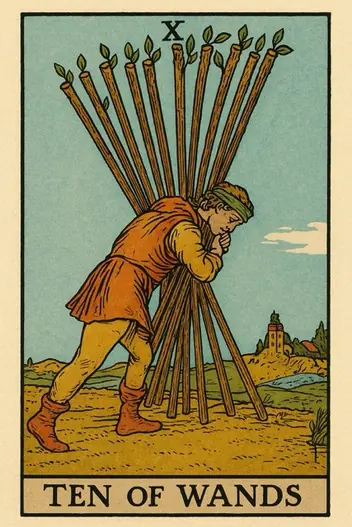
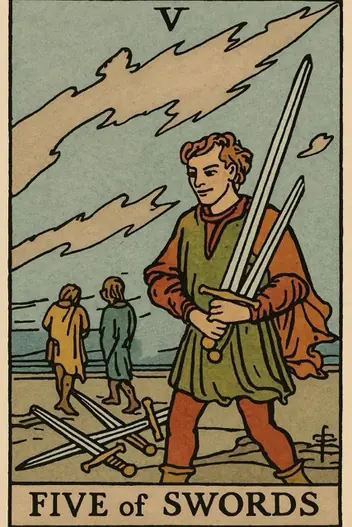
The intersection of the Ten of Wands and the Five of Swords signals a tense moment where overburdened responsibility meets a toxic win-at-all-costs mindset. Psychologically, this pairing represents the internal conflict between the need to carry a heavy load (Ten of Wands) and the impulse to fight, dominate, or cut losses in a way that leaves others—and yourself—damaged (Five of Swords).
In real-world terms, this is the state of a person who has taken on too much, only to find themselves in a battle where the only way out seems to be through aggressive, zero-sum thinking. The core question here is not "Can I win?" but "What am I sacrificing to finish this fight?" The combined energy suggests a strategic crossroads: you can keep pushing through exhaustion, but the victory may feel hollow if it comes at the cost of your integrity or relationships.
Ten of Wands and Five of Swords Card Meaning Explained
When the Ten of Wands (burden, duty, overcommitment) merges with the Five of Swords (conflict, defeat, underhanded tactics), the psychological state is one of defensive exhaustion. You are likely carrying a workload or emotional load that has pushed you past your limits. The Five of Swords energy then activates a survivalist mindset: you start seeing every interaction as a battle you must win to protect your dwindling resources. This is a cognitive distortion known as "scarcity thinking," where you believe that the only way to lighten your load is to defeat someone else.
The practical implication is a high risk of burnout combined with relationship damage. You may be fighting for recognition, for a break, or for someone to acknowledge your sacrifice—but the Five of Swords warns that your methods could alienate allies. The key insight here is that this combination often reflects a self-created trap: you took on the burden (Ten of Wands) without setting boundaries, and now you are fighting battles (Five of Swords) that are largely unnecessary. The strategic action is to pause and ask: Is this fight worth the cost of my peace of mind?
Your pair is already on the table. Ask your question and draw the clarifying card
or simply focus on it
Ten of Wands and Five of Swords Love Outcome
If you are single:
This pairing suggests you are approaching dating with a defensive, transactional mindset. You may be carrying emotional baggage from past relationships and are now ready to "win" at all costs, which can repel genuine connections. Focus on lightening your emotional load before seeking a partner.
If you are in a relationship:
You are likely in a power struggle where one partner feels overwhelmed by responsibilities (Ten of Wands) and the other feels attacked or manipulated (Five of Swords). Communication has become a battlefield, not a bridge.
In a relationship, the Ten of Wands and Five of Swords combination reveals a dynamic of resentment and control. One partner may be doing all the heavy lifting—financially, emotionally, or domestically—while the other feels like they are constantly being "beaten" in arguments. This is a classic dysfunctional cycle: the overburdened partner uses passive-aggressive or confrontational tactics to demand change (Five of Swords), while the other partner withdraws or retaliates. The bold relationship advice here is to stop keeping score. You must renegotiate responsibilities without framing it as a win-lose scenario. Emotional intelligence demands that you recognize that your "victory" in an argument is actually a loss for the partnership. If you can't break this cycle, seek a neutral third party (therapist or mediator) to help you redistribute the load without conflict.
Deepen your understanding
Find out exactly what this reading means for your current life situation with our oracle.
Ten of Wands and Five of Swords: Career and Money
Strategic Opportunities:
Reevaluate your workload. This is the moment to delegate, say "no," or renegotiate deadlines. The Ten of Wands shows you are overcapacity, and the Five of Swords warns that pushing harder will lead to conflict.
Strategic Opportunities:
Identify the real battle. Is this fight about a promotion, a client, or your reputation? The Five of Swords can indicate a win that damages your professional network. Focus on collaboration, not competition.
Calculated Risks:
Avoid office politics and legal disputes. The Five of Swords suggests a high chance of "winning the battle but losing the war." Objectively, do not engage in gossip, backstabbing, or aggressive negotiations—the short-term gain is not worth the long-term reputation damage.
In your career, this combination signals a critical decision point. You are likely in a job or project that is burning you out (Ten of Wands), and you are tempted to use aggressive tactics to get ahead or protect your position (Five of Swords). The bold financial warning is that this is a poor time for risky investments or zero-sum negotiations. The energy here is defensive, not expansive. Instead of fighting for a bigger slice of the pie, consider whether the pie is even worth your energy. Strategic tip: conduct a cost-benefit analysis of your current role. If the burden (Ten of Wands) is not leading to growth or fair compensation, the Five of Swords advises you to cut your losses gracefully—not through conflict, but through a planned exit. Resource management is key: conserve your energy for opportunities that align with your values, not for battles that drain you.
When Ten of Wands and Five of Swords Signal Trouble
The shadow of this combination is self-sabotage through martyrdom and manipulation. The cognitive bias at play is the "sunk cost fallacy"—you keep fighting because you have already invested so much, even when the fight is destructive. The Ten of Wands shadow manifests as victim mentality: you believe that your suffering is noble and that others should recognize your sacrifice. The Five of Wands shadow then turns this into passive-aggressive control: you guilt-trip, manipulate, or compete with others to prove you are the most burdened or the most wronged.
Poor judgment here often looks like picking fights over trivial matters because you are too exhausted to see the bigger picture. You may also fall into black-and-white thinking—seeing colleagues, partners, or friends as either "with you" or "against you." The real pitfall is that you become the very source of the conflict you fear. Instead of solving the overwork problem, you create interpersonal problems that add to your load. Self-awareness is the antidote: recognize that your desire to "win" is actually a cry for relief. The shadow path leads to isolation and burnout; the light path requires vulnerability and asking for help.
Ten of Wands and Five of Swords Reversed: How to Read It
When the Ten of Wands is reversed, it points to blocked potential and recklessness. You aren't just carrying a burden; you refuse to put it down, even though you've already fallen. This is self-sabotage through stubbornness. Advice: admit you are overwhelmed. Asking for help now is not a weakness, but the only way to survive.
If the Five of Swords is reversed, the dynamic shifts toward internal defeat and weakness. You have lost before the battle even began. This can manifest as guilt over past "victories" or as a paralysis of will. You are not the aggressor, but a victim of your own indecision. The solution is not to try to "get even," but to forgive yourself for past mistakes and step out of the race.
When BOTH cards are reversed, a complete imbalance emerges. You are exhausted (Ten of Wands reversed), yet incapable of even healthy competition (Five of Swords reversed). This is a state of apathy and depression. The logical way to correct this: a complete stop. You don't need a plan of action, but total rest and a reassessment of values. Remove all deadlines. Your task is to restore a basic sense of security before thinking about career or relationships.
Ten of Wands and Five of Swords: The Combined Message
How to constructively use the energy of this combination? First, acknowledge that your main task is not to win, but to survive and conserve resources. The Ten of Wands gives you colossal endurance, and the Five of Swords provides sharpness of mind. Combine them not for attack, but for a strategic retreat. Your goal is to exit the game with the fewest losses, not with a trophy.
Second, use the principle of "conscious choice." You are not obligated to carry everything yourself. The Five of Swords suggests that you can "lose" in small matters to win in the main one. Relinquish some control. Allow someone else to take on part of the burden, even if they do it worse. Your task is to shed the load before it crushes you.
A deep strategic advice: conduct an audit of your commitments. Take a sheet of paper and divide it into three columns: "What I am obliged to do," "What I do out of guilt," "What I do out of fear." Cross out the second and third columns. Leave only what your conscience and contract dictate. This is the very "victory" that will not drain you. Clarity on this matter is the only way to navigate this crisis without losing yourself.
Applying This to Your Situation
The Ten of Wands and Five of Swords combination is a powerful signal that you are at a strategic crossroads where your burden and your battles are colliding. The core message is stop fighting and start delegating. You do not need to carry everything alone, and you do not need to win every argument. The true victory here is letting go of what is not yours to carry and choosing peace over pride.
While this article provides a deep archetypal analysis, the real power of Tarot lies in how it applies to your specific situation. Your unique context—your career, your relationship, your emotional history—changes the meaning of these cards. To get a personalized, actionable interpretation of this combination for your exact question, use the Fortune Cards app. You can access it on the web or download it to your device. The app will analyze your unique energy and provide a custom reading that cuts through the general advice and speaks directly to your life. Your next step is just a card draw away.
Interpretation by the Fortune Cards editorial team, based on the Rider–Waite tradition and Jungian archetypes. About our methodology · Updated: 2026-10-15
Other Combinations with Ten of Wands
Other Combinations with Five of Swords
Explore Individual Card Meanings
Table of Contents
- Ten of Wands and Five of Swords Card Meaning Explained
- Ten of Wands and Five of Swords Love Outcome
- Ten of Wands and Five of Swords: Career and Money
- When Ten of Wands and Five of Swords Signal Trouble
- Ten of Wands and Five of Swords Reversed: How to Read It
- Ten of Wands and Five of Swords: The Combined Message
- Applying This to Your Situation
Ready to find answers to your questions?
Start your first reading now and look at your situation with fresh clarity. The cards are ready to reveal deeper meaning.