The Fool and Five of Swords Together in Tarot


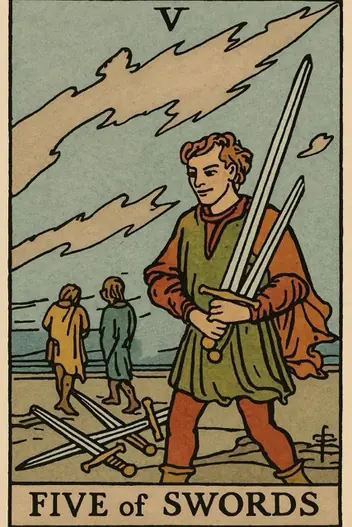
- Arcana
- The Fool — Major Arcana; Five of Swords — Minor Arcana, Swords
- Elements
- The Fool — Air; Five of Swords — Air
- Elemental interaction
- Same element — energies intensify each other
- Numerology
- 0 + 5 = 5
This combination signals a psychological collision between unbounded optimism (The Fool) and calculated conflict (Five of Swords). When these archetypes meet, you are likely entering a situation where your fresh start or bold leap forward comes at a direct cost to others—or where your innocence blinds you to the fact that a win may be hollow. Pragmatically, this pairing demands you examine whether your current path is an authentic liberation or a disguised defeat.
The Five of Swords represents a victory achieved through cunning, dominance, or strategic withdrawal—often leaving bridges burned. The Fool represents the urge to begin anew, unburdened by past mistakes. Together, they create a tension: you may be tempted to start over by "winning" an argument, leaving a situation, or cutting ties, without fully accounting for the fallout. The key insight here is awareness of collateral damage—both to others and to your own long-term reputation.
Core Dynamics & Interpretation
The core psychological dynamic is a conflict between ego-driven victory and authentic self-discovery. The Fool's archetype is about trusting the universe and taking a leap of faith. The Five of Swords is about tactical victory, often at the expense of harmony. When these combine, the seeker may rationalize a destructive or selfish action as a "fresh start." This is a cognitive distortion where the desire for change overrides ethical or relational considerations.
In practice, this energy manifests as a high-risk, low-trust scenario. You might be entering a new phase—new job, new relationship, new location—but doing so in a way that leaves a trail of resentment. The psychological state is one of defensive optimism: you are excited about the future, but also guarded and ready to fight for your position. The real-world implication is that your "new beginning" may be built on shaky ground if you haven't resolved the conflicts you're leaving behind.
The strategic advice is clear: distinguish between a necessary boundary and an unnecessary battle. The Fool's energy is best used when paired with discernment, not recklessness. The Five of Swords warns that winning an argument or a negotiation does not mean you have won the relationship or the long-term game. The most pragmatic interpretation is to ask: Is this victory worth the cost? If the answer is no, then the Fool's leap should be toward reconciliation, not escape.
Your pair is already on the table. Ask your question and draw the clarifying card
or simply focus on it
What Do The Fool and Five of Swords Say About Love?
If you are single:
This pairing suggests you may be attracted to someone who seems exciting and new, but the dynamic could involve power struggles or manipulation. Evaluate whether the initial chemistry is masking a need to "win" rather than connect.
If you are in a relationship:
You or your partner may be using a fresh start as a cover for avoiding conflict. The relationship might feel like a battlefield where one person is trying to "win" an argument at the expense of true intimacy.
The relationship dynamics here are fraught with emotional intelligence deficits. The Fool's naive optimism may lead you to ignore red flags, while the Five of Swords' combative energy can turn minor disagreements into full-blown power struggles. Bold key relationship advice: do not mistake a tactical victory for a relational win. If you find yourself celebrating a "win" in an argument, you have likely lost the connection. The pragmatic approach is to set clear boundaries without needing to dominate. For couples, this combination often indicates a pattern where one partner takes a "leap of faith" (starting a new chapter) by unilaterally deciding the terms, leaving the other feeling defeated. The healthiest path is to co-create the new beginning, not impose it.
Career and Finances
Strategic Opportunities:
Leverage your optimism to pivot into a new role or industry, but only after a thorough risk assessment. The Fool's energy is ideal for exploring uncharted territory.
Strategic Opportunities:
Use the Five of Swords' strategic thinking to outmaneuver competitors, but do so ethically. This is a time for calculated moves, not blind aggression.
Calculated Risks:
Avoid burning bridges or making enemies in the process. A win today could become a reputation liability tomorrow. Bold warning: do not sacrifice long-term trust for short-term gain.
In a professional context, this combination is about decision-making under pressure. You may be tempted to take a bold career move—quitting a job, launching a project, or negotiating a raise—in a way that alienates colleagues or superiors. The Five of Swords advises you to choose your battles carefully. If you "win" a negotiation by being overly aggressive, you may find future collaborations difficult. Financially, this pairing warns against impulsive investments or high-stakes gambles disguised as "opportunities." The Fool's enthusiasm must be tempered by the Five of Swords' realism: get the facts, assess the competition, and then make your move—but do so with integrity.
Uncover hidden insights
Let our advanced Tarot system interpret these archetypes specifically for your personal path.
What Are the Risks of The Fool and Five of Swords?
The shadow manifestation of this combination is self-sabotage through victory. You may win a battle but lose the war. The cognitive biases at play include overconfidence effect (believing your leap is foolproof) and sunk cost fallacy (continuing a conflict because you've already invested). The seeker may act irrationally by ignoring feedback from others, convinced that their "fresh start" justifies any collateral damage. This can lead to social isolation and a pattern of starting over because you've burned every bridge behind you.
Another pitfall is false humility: pretending your actions are innocent (The Fool) while actually engaging in manipulative behavior (Five of Swords). This is a defense mechanism to avoid guilt. The psychological cost is a fragmented sense of identity—you may not recognize yourself after repeatedly "winning" at the expense of your values. The shadow warning is clear: if you feel a need to justify your actions defensively, you are likely in the shadow of this combination.
Reversed Positions: What Changes?
Reversed cards shift the vector: external action turns inward, and conflict becomes hidden or psychosomatic.
If The Fool is Reversed:
This is blocked potential or fear of the new. The person wants to "win" (Five of Swords) but is afraid to take the first step (The Fool). Instead of action, there is self-criticism and paralysis of will. Advice: You need to "allow yourself to make mistakes," otherwise your tactical preparation (Five of Swords) will remain a useless plan.
If the Five of Swords is Reversed:
This is internal resistance or passive aggression. Instead of open conflict, there is gossip, sabotage, and guilt. Here, The Fool manifests as an infantile desire to avoid responsibility for one's actions. Warning: You are wasting energy on self-justification instead of solving the problem.
If BOTH are Reversed:
Complete imbalance. This is a state of "chronic victimhood," unable to start anything new (The Fool) or finish anything old (Five of Swords). The person is trapped in a closed loop of self-blame and helplessness. Way to Correct: Stop looking for an enemy outside. Take one small but concrete action that breaks the pattern—for example, apologize or set a clear deadline for making a decision.
Synthesis: Strategic Conclusion
How to constructively use this explosive mixture? The key lies in directing the Fool's energy toward "destroying old frameworks" rather than "attacking people." The Five of Swords is an excellent tool for analyzing the weak points of a system, while the Fool is ideal for creating radically new solutions. Together, they can become a force for the "strategic destruction" of outdated business processes or toxic relationships — but only if you keep your emotional involvement under control.
Your task is to separate the "player" from the "game." You can be the "Fool" in how you see the world (fresh perspective, freedom from patterns), but you must be the "Five of Swords" in your tactics (cold mind, clear plan). Do not attack the person; attack the problem. Do not "win the argument"; "find the optimal solution." Deep strategic advice: Before acting, ask yourself: "Do I want to be right, or do I want to be effective?" Choosing effectiveness is the only way to preserve the Fool's freedom without being tainted by the mud of the Five of Swords.
Your Next Step: Personal Context Matters
The core message of The Fool and Five of Swords is that a new beginning is not worth the price of your integrity or your relationships. The victory you seek must be aligned with your authentic self, not just your ego. Pragmatically, ask yourself: "Am I starting something new, or am I escaping something unresolved?" The answer will guide your next move.
While this article provides a powerful archetypal analysis, the true magic happens when Tarot is applied to your unique situation. The Fortune Cards app allows you to input your specific question, context, and relationship dynamics to receive a deep, personalized interpretation of this exact combination. Whether you are navigating a career pivot, a relationship crossroads, or an inner conflict, the app offers actionable insights tailored to your life. Use it on the web or download it now to get the clarity you need for your next step.
Interpretation by the Fortune Cards editorial team, based on the Rider–Waite tradition and Jungian archetypes. About our methodology · Updated: 2026-08-26
Other Combinations with The Fool
Other Combinations with Five of Swords
Explore Individual Card Meanings
Ready to find answers to your questions?
Start your first reading now and look at your situation with fresh clarity. The cards are ready to reveal deeper meaning.